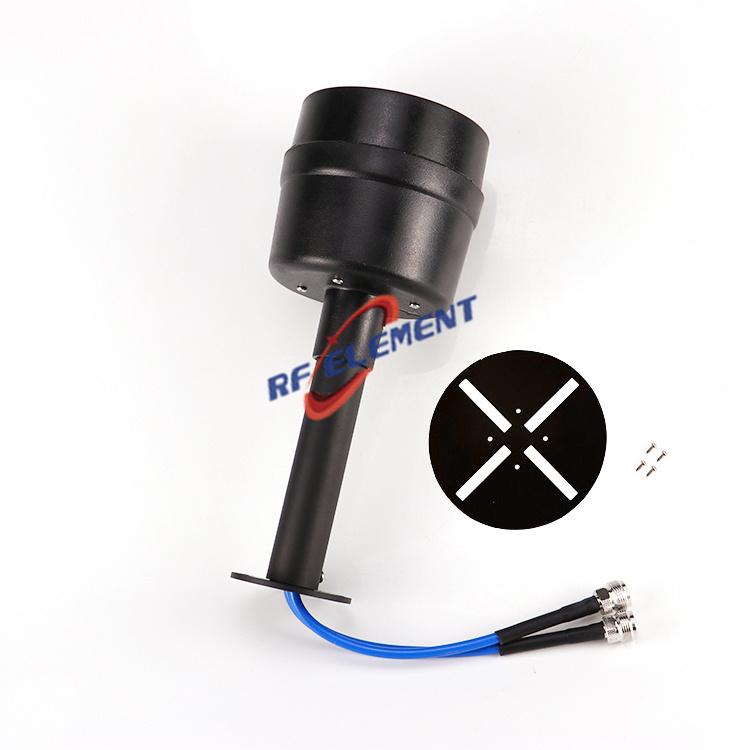
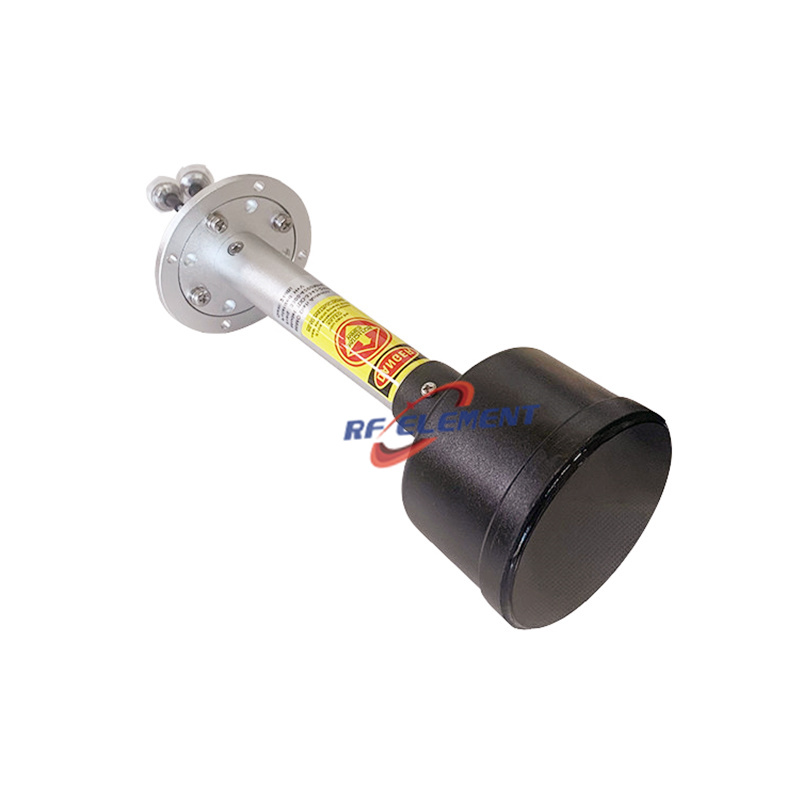
4G 5G MIMO Feedhorn Antenna
- Supported Multi Band Frequencies: 900MHz &1700-2700MHz & 3200-3800MHz
- Gain: >15dBi (with a parabolic dish size of 60cm)
- VSWR: <1.8
- Polarization: Horizontal+Vertical
Specifications
This 4G 5G MIMO feedhorn antenna turns an existing 60cm parabolic dish into a dual-polarized, multi-band link covering 900MHz, 1700-2700MHz and 3200-3800MHz, with more than 15dBi of gain at VSWR under 1.8. It is the practical route for an operator who already owns the reflectors and wants 4G and 5G capacity on the same dish without replacing the mechanical structure.
Upgrade the feed, keep the dish
Most projects that use this feed are rural fixed wireless backhaul sites, where a 60cm dish is already installed and the requirement is to add 4G or 5G capacity without changing the mount or the tower loading.
A parabolic antenna is mostly mechanical: the reflector, the mount, the foundation and the tower loading are already paid for. The feed decides which bands the dish can serve. Replacing a single-band feed with a dual-polarized multi-band feed upgrades the link at a fraction of the cost and disruption of swapping the whole antenna, and it avoids re-engineering the mount and the wind-load calculation.
That is the brief this antenna was designed for: fit the existing feedhorn housing, mate with a 60cm dish, and cover three separate frequency ranges with both polarizations active at once.
Three bands in one feed
The 900MHz band is the awkward one. Its wavelength is roughly three times longer than the 3.5GHz band, so a feed that works well at 5G frequencies is electrically small at 900MHz and tends to lose efficiency. We solved this by changing how the antenna array is mounted rather than by enlarging the feed, which kept the VSWR below 1.8 at 900MHz without making the unit too large for the 60cm dish.
For the 1700-2700MHz range used by 4G LTE and the 3200-3800MHz range used by 5G, the array was developed through repeated simulation until it covered both bands from a single structure that fits existing housings. Horizontal and vertical ports are fed separately, so the radio gets two decorrelated polarizations for MIMO and the link can carry two data streams over the same dish.
Gain across the band comes from matching the feed illumination to the 60cm reflector rather than from increasing the feed aperture. Materials and element dimensions were chosen so that the radiation pattern stays consistent across the three bands, which is what keeps the dish alignment valid when the radio switches band.
Specifications
| Parameter | Value |
|---|---|
| Frequency bands | 900MHz, 1700-2700MHz, 3200-3800MHz |
| Gain | >15dBi with 60cm parabolic dish |
| VSWR | <1.8 |
| Polarization | Horizontal + vertical |
| Ports | Dual port, dual polarized |
| Dish compatibility | 60cm parabolic reflector |
Alignment and installation
Align the dish on the highest frequency in use, because the 3.8GHz beam is the narrowest and the other bands will follow. Check the focal position after fitting the feed: a feed that sits a few millimetres off the focal point still shows an acceptable VSWR but loses gain and raises sidelobes, which is a common cause of a link that tests well on the bench and underperforms in the field.
Keep both polarization feeders the same length and label them at both ends. Use weatherproof boots on the connectors and torque them to specification; at 3.5GHz a loose connector can produce a reflection that looks like a feed problem. Re-check the mount after the first temperature cycle, since a 60cm dish on a steel arm moves more than the numbers suggest.
Customization and ordering
Band combinations, port count, connector type and housing interface can be adapted to an existing dish or feedhorn design. A version covering only 1700-3800MHz is available where the 900MHz band is handled separately, and a 5G n78 variant tuned to 3300-3800MHz can be supplied for operators running that band alone.
Send the dish size, band plan, polarization requirement and connector type to sales@rfelement.com. Samples are typically ready in 3-5 working days and mass production in 15-25 working days.
FAQ — 4G 5G MIMO Feedhorn Antenna
What is the 4G 5G MIMO Feedhorn Antenna used for?
What frequency band does the 4G 5G MIMO Feedhorn Antenna cover?
What are the key specifications of the 4G 5G MIMO Feedhorn Antenna?
Can RF element customize the 4G 5G MIMO Feedhorn Antenna for my application?
What is the MOQ and lead time for the 4G 5G MIMO Feedhorn Antenna?
How do I get a quotation for the 4G 5G MIMO Feedhorn Antenna?