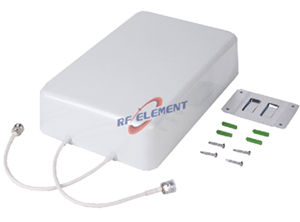
5G n78 3.5GHz MIMO Feedhorn Antenna | 3300-3800 MHz for Parabolic Dish
Specifications
A dual polarized feedhorn for the 3300 to 3800 MHz n78 band, giving 23 dBi on a 60 cm parabolic dish with an 8 by 8 degree beam. Two N-Type female ports carry horizontal and vertical polarization, VSWR is 1.5 or better across the band, and each port is rated at 50 W. The body is aluminium with a black ABS radome, the horn weighs 0.8 kg, and it mounts on a pole and on the feed support of a standard 60 cm dish.
23 dBi from a 60 cm dish
At 3550 MHz the wavelength is 84.5 mm, so a 600 mm dish is 7.1 wavelengths across. The product of the two half power beamwidths divided into 41253 gives 28.1 dBi for a perfect aperture of that electrical size. The datasheet says 23 dBi, and the 5 dB gap is the honest part of the number: it is spillover past the dish rim, blockage by the horn itself, and surface tolerance on a pressed reflector.
Put another way, 23 dBi corresponds to about 0.11 square metres of effective area against 0.28 square metres of physical dish. That ratio is normal for a small dish with a feed at the focus. A supplier quoting 28 dBi on the same 60 cm reflector is quoting the theoretical aperture rather than a measured antenna, and the difference will show up as 5 dB of missing signal on site.
The 8 degree beam is not the illumination angle
This is the most common mistake in feedhorn selection. The 8 by 8 degree figure describes the finished antenna after the horn is fitted to a reflector. The angle that matters when choosing a dish is the illumination angle of the horn on its own, which has to cover the rim of the reflector.
For a 60 cm dish with an f over D ratio of 0.375, the half angle to the rim is about 34 degrees, so the horn needs a 68 degree illumination cone at the minus 10 dB points. A dish with f over D of 0.4 needs 64 degrees and one at 0.35 needs 71 degrees. Fit a narrow horn to a shallow dish and the rim is not lit, so the outer part of the reflector contributes nothing and the gain falls short of the table. Fit a wide horn to a deep dish and energy spills past the rim.
| Frequency Range | 3300-3800MHz | |
| Polarization | Horizontal+Vertical | |
| Gain(dBi) | 23 | |
| Horizontal Beamwidth | 8° | |
| Vertical Beamwidth | 8° | |
| Impedance | 50Ω | |
| VSWR | ≤ 1.5 | |
| Maximum Power | 50W | |
| Connector Type | 2 Port, N-Type Female | |
| Dish Dimension(mm) | 60cm dish | |
| Feeder Horn Weight | 0.8 kg | |
| Operating Temperature | -55° to +60° C (-67° to +140° F) | |
| Radome Material | ABS, Aluminum | |
| Radome Color | Black | |
| Mounting Options | Pole mounting | |
Retrofit without touching the structure
The commercial case for a 0.8 kg horn is that it changes the band of an existing link without changing anything structural. The dish, the mount, the tower loading calculation, the cable entry and the earthing all stay as they are. On a rooftop or a tower where a new integrated antenna would trigger a structural review, replacing the feed is a maintenance task rather than a construction project.
The 0.8 kg mass matters at the focus. It is 0.2 kg heavier than the wideband horn in the same family, which is the cost of the narrower band matching section. Check the feed support clamp rather than the pole: the load path at the focus is short and the clamp is the part that sees the moment.
A 1.5 match across the whole band
VSWR is 1.5 or better from 3300 to 3800 MHz, which is a return loss of 14 dB and a mismatch loss of 0.18 dB. The equivalent wideband horn reaches 1.8 at the top of its range, so this part is the better match for a network that stays inside n78.
Both ports are rated at 50 W. In a 2x2 radio the two ports are usually driven by separate power amplifiers, so read the rating per port rather than as a total. The cross polarization isolation is not stated on the datasheet, and it is worth asking for when the radio relies on polarization multiplexing rather than on spatial separation.
Ordering
Two N-Type female ports are standard, the polarization is horizontal plus vertical, the radome is black, and the horn is supplied with a clamp for a 60 cm dish. Samples in 3-5 days, production in 15-25 days.
If the same dish also has to carry 1710 to 2700 MHz or the 3800 to 4200 MHz band, the wideband 1700-4200 MHz feedhorn covers all three with a 1.5 to 1.8 match. For the rest of the band coverage, see 5G antenna.
Send the dish diameter, its f over D ratio and the radio port count. The diameter sets the gain, the f over D decides whether this horn illuminates the rim correctly, and the port count decides whether the two polarizations are used as two streams or as one. Where several bands have to share one dish, the antenna selector shows which feedhorns cover which sub bands before you commit to a reflector.
FAQ — 5G n78 3.5GHz MIMO Feedhorn Antenna
What is the 5G n78 3.5GHz MIMO Feedhorn Antenna used for?
What frequency band does the 5G n78 3.5GHz MIMO Feedhorn Antenna cover?
What are the key specifications of the 5G n78 3.5GHz MIMO Feedhorn Antenna?
Can RF element customize the 5G n78 3.5GHz MIMO Feedhorn Antenna for my application?
What is the MOQ and lead time for the 5G n78 3.5GHz MIMO Feedhorn Antenna?
How do I get a quotation for the 5G n78 3.5GHz MIMO Feedhorn Antenna?