5G n78 MIMO Panel Antenna | 3.5 GHz Panel Antenna | 3300-3800MHz
Optimize your wireless network with RF element's 5G n78 MIMO Panel Antenna. Designed for 3.5GHz / 5G n78 applications, this 12dBi gain antenna offers high performance and easy installation. Ideal for DAS systems, it ensures enhanced cellular coverage. Request a quote for your project today!
Specifications
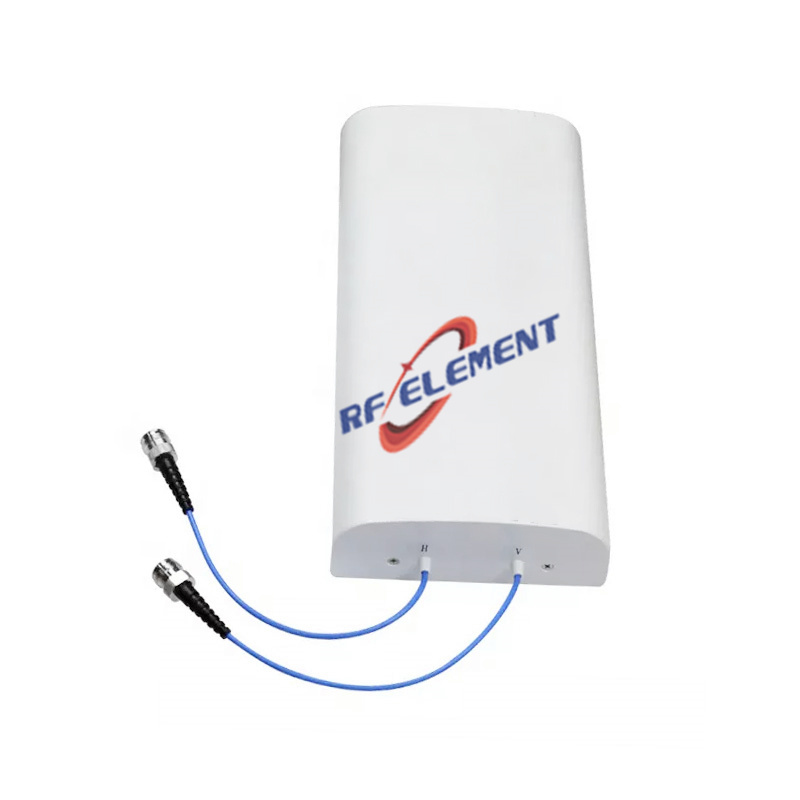
A single-band panel built for the 3.5 GHz C-band and nothing else. Coverage is 3300-3800 MHz with 12 dBi on two N-Type female ports, a 65 degree horizontal beam and a 28 degree vertical beam in a 239 x 190 x 35 mm ABS housing. VSWR stays at or below 1.5 across the whole band, which is the figure that matters when the panel is fed by a small cell that cannot absorb reflected power.
When single band beats wideband
A 698-3800 MHz panel has to make electrical compromises to hold one impedance across a 5.4:1 span, and those compromises show up as pattern ripple and lower gain in every sub-range. A panel cut for 3300-3800 MHz has a 1.15:1 span and can be optimised for one objective. The result here is 12 dBi with a 28 degree vertical pattern, against 6 to 8 dBi for the wideband units in the same footprint.
Twelve decibels is roughly a doubling of coverage distance compared with a 6 dBi panel in free space, and more than that indoors where the narrower beam also reduces multipath arriving from outside the intended zone. If the project is a 3.5 GHz small cell, a private 5G network or a point-to-multipoint distribution layer, the single-band panel usually wins on link budget even though it cannot serve the legacy bands.
Reading the 65 by 28 degree pattern
The horizontal figure of 65 degrees matches a three-sector plan at the top of a building or on a mast: three panels at 120 degree spacing leave small gaps at the sector edges but cover the roof ring with no overlap into the next site. The 28 degree vertical beam is the more useful number in practice, because it sets how far the panel reaches before the ground reflection drops out.
Mounted at 20 m with the beam aimed at the horizon, a 28 degree vertical pattern reaches roughly 40 m further than a 40 degree pattern before the coverage edge falls below the antenna boresight. That is the reason this panel is used for corridor and tunnel coverage as well as for rooftop sectors: the narrow vertical beam follows a long space instead of wasting energy on the near field.
| Frequency Range | 3300-3800MHz | |
| Polarization | Horizontal+Vertical | |
| Gain(dBi) | 12 | |
| Horizontal Beamwidth | 65° | |
| Vertical Beamwidth | 28° | |
| Impedance | 50Ω | |
| VSWR | ≤ 1.5 | |
| Maximum Power | 50W | |
| Connector Type | 2 Port, N-Type Female | |
| Antenna Dimension(mm) | 239*190*35 | |
| Net Weight | 1.0 kg | |
| Operating Temperature | -55° to +60° C (-67° to +140° F) | |
| Radome Material | ABS | |
| Radome Color | White | |
| Mounting Options | Pole mounting | |
What the datasheet does not specify
There is no PIM figure on this page, and that absence is worth reading as information rather than as an omission. A single-operator small cell with one carrier does not generate the intermodulation products that a multi-operator DAS does, so PIM is not the limiting specification for this application. If the panel is going into a shared system with two or more carriers combined at the antenna port, specify a low PIM part instead and ask for the test condition.
Similarly, isolation between the two ports is not listed. The cross-polarised pair is intended as a 2x2 MIMO branch, not as a duplexed transmit and receive pair, so plan the radio side accordingly.
Mounting a 1 kg panel on a pole
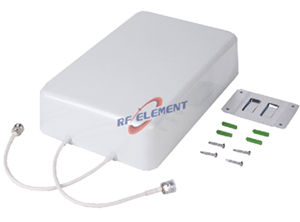
The housing is 1.0 kg and 35 mm deep, with pole mounting as the standard option. On a small cell pole the panel usually shares the structure with the radio unit and the GPS antenna, so keep the radiating face clear of the radio heatsink by at least 200 mm; a metal surface that close to the aperture will distort the horizontal pattern more than the datasheet tolerance suggests.
For wall mounting on a building face, the same 200 mm clearance applies and the panel should be aimed along the wall rather than square to it where the objective is street coverage, because the wall itself becomes a reflector behind the unit.
Ordering and adjacent options
Two N-Type female ports are standard, with 4.3-10 available on request. Radome colour is white. Samples in 3-5 days, production in 15-25 days.
If the same 3.5 GHz coverage has to be delivered from a ceiling or from a pole with an omnidirectional pattern, the 3.5 GHz fiberglass omni antenna covers 3400-3800 MHz at 11 dBi with a single port. Where the requirement is wider band coverage at lower gain, the 5G antenna range lists the wideband panels by sub-range.
Tell us the band plan, the mounting height and the horizontal sector width you need to fill. On a 3.5 GHz small cell that is usually enough to confirm whether 12 dBi and 65 degrees is the right combination or whether a narrower sector is required.
FAQ — 5G n78 MIMO Panel Antenna
What is the 5G n78 MIMO Panel Antenna used for?
What frequency band does the 5G n78 MIMO Panel Antenna cover?
What are the key specifications of the 5G n78 MIMO Panel Antenna?
Can RF element customize the 5G n78 MIMO Panel Antenna for my application?
What is the MOQ and lead time for the 5G n78 MIMO Panel Antenna?
How do I get a quotation for the 5G n78 MIMO Panel Antenna?