5G Panel Antenna | Low PIM Rated (-150dBc@2x20W), 698-3800 MHz
Specifications
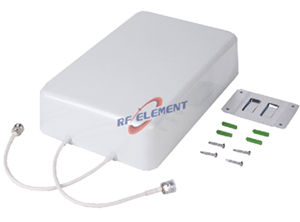
A single-port panel that covers 698-3800 MHz in a 165 x 155 x 45 mm housing weighing 0.4 kg. Gain is 6 dBi at 698-960 MHz and 7 dBi in the two upper sub-ranges, with a 90 degree horizontal beam in the low band narrowing to 50 degrees at 3300-3800 MHz. Front-to-back ratio improves from 10 dB to 15 dB as the frequency rises, and third order PIM is rated at -153 dBc under two 43 dBm carriers.
One port is often the correct answer
Dual-polarised panels are sold as the default because 2x2 MIMO is the default in modern remote units, but a large part of the installed base is not 2x2. A single-port remote, a repeater with one antenna connection, a legacy DAS head end or a cost-sensitive coverage fill all need one port, and fitting a two-port panel to that equipment wastes half the antenna and half the cable schedule.
This panel is the SISO member of the family. It shares the low PIM construction and the 4.3-10 female interface with the two-port version, so a site that starts as single port can later move to dual polarisation without changing the mounting position or the cable route.
Why front-to-back ratio matters outdoors
Front-to-back ratio is the difference between the gain on boresight and the gain directly behind the panel. It is listed as 10 dB at 698-960 MHz and 15 dB in the two upper sub-ranges. On a wall mount that figure decides how much energy is thrown back into the building behind the antenna, and on a pole it decides how much of the pattern wraps around to interfere with a co-sited sector facing the other way.
Fifteen decibels in the mid and high bands is a working figure for a coverage panel. Ten decibels in the low band is normal for an aperture this small and is the reason the unit should not be used as a back-to-back pair on the same pole without a physical separation of at least half a metre.
| Frequency Range | 698-3800MHz | ||
| Frequency Sub-Range(Mhz) | 698-960 | 1710-2700 | 3300-3800 |
| Polarization | Vertical | ||
| Gain(dBi) | 6 | 7 | 7 |
| Horizontal Beam width | 90±15° | 60±20° | 50±20° |
| Vertical Beam width | 85° | 55° | 40° |
| Impedance | 50Ω | ||
| VSWR | ≤ 1.8 | ≤ 1.6 | ≤1.8 |
| PIM, 3rd Order | -153 dBc@2x43dBm | ||
| Front-to-Back Ratio | ≥ 10dB | ≥ 15dB | ≥ 15dB |
| Maximum Power | 50 W | ||
| Connector Type | 1 Port, 4.3-10 Female | ||
| Dimension | 165*155*45 mm | ||
| Net Weight | 0.4 kg | ||
| Packing Size | 64*28*35 cm(20 pcs) | ||
| Radome Material | Plastic ABS | ||
| Operating Temperature | -55° to +60° C (-67° to +140° F) | ||
| Mounting Options | wall mounting or pole mounting(Optional) | ||
The 0.4 kg advantage
Weight is the specification that gets ignored until installation. At 0.4 kg and 45 mm deep, this panel can be fixed to a plasterboard wall with the supplied fasteners, to a ceiling grid rail, or to a lightweight pole that would not carry a 1.1 kg wideband panel. Packing is 20 pieces per carton, which matters for a multi-floor rollout where the installer carries stock between floors.
The small aperture does cost gain in the low band. A 165 mm wide panel cannot produce 8 dBi at 700 MHz, and the 6 dBi figure is the honest outcome. Where the low band is the primary coverage requirement rather than a secondary one, a larger panel is the better choice.
Deployment notes
Mount the panel with the radiating face clear of metal for at least 200 mm. On an interior wall, avoid positioning it directly above a metal door frame or a riser cupboard, both of which produce a notch in the low band pattern that is easy to miss during a walk test.
Where the panel is used indoors with a remote unit mounted in the same cupboard, keep the two units on separate walls if possible. A 165 mm panel placed 100 mm from a metal enclosure behaves like a different antenna, and the VSWR at the band edges will rise above the datasheet value.
Customisation and ordering
Radome colour, packing quantity and connector variant are confirmed at order. Samples in 3-5 days, production in 15-25 days.
If the project does need dual polarisation, the two-port version of this panel keeps the same 698-3800 MHz coverage with 8 dBi in the mid band at 1.1 kg. The 5G antenna range sets out the full family by port count.
Send the remote unit model, the mounting surface and the sub-ranges in use. Those details decide whether this panel or the two-port version is the correct part, and whether the mounting hardware in the box is sufficient for the wall you have.
FAQ — 5G Panel Antenna
What is the 5G Panel Antenna used for?
What frequency band does the 5G Panel Antenna cover?
What are the key specifications of the 5G Panel Antenna?
Can RF element customize the 5G Panel Antenna for my application?
What is the MOQ and lead time for the 5G Panel Antenna?
How do I get a quotation for the 5G Panel Antenna?