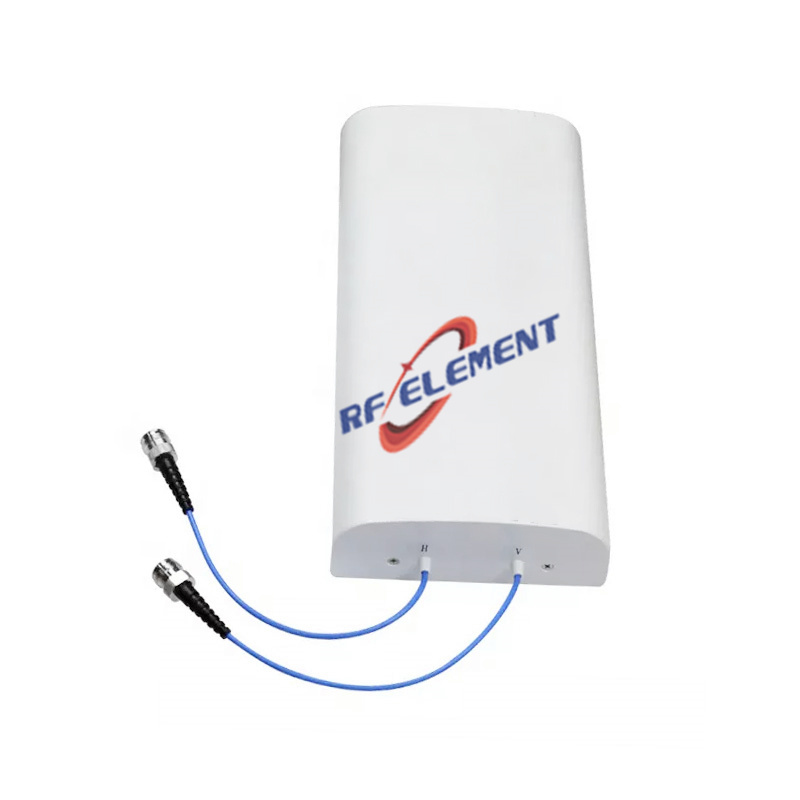
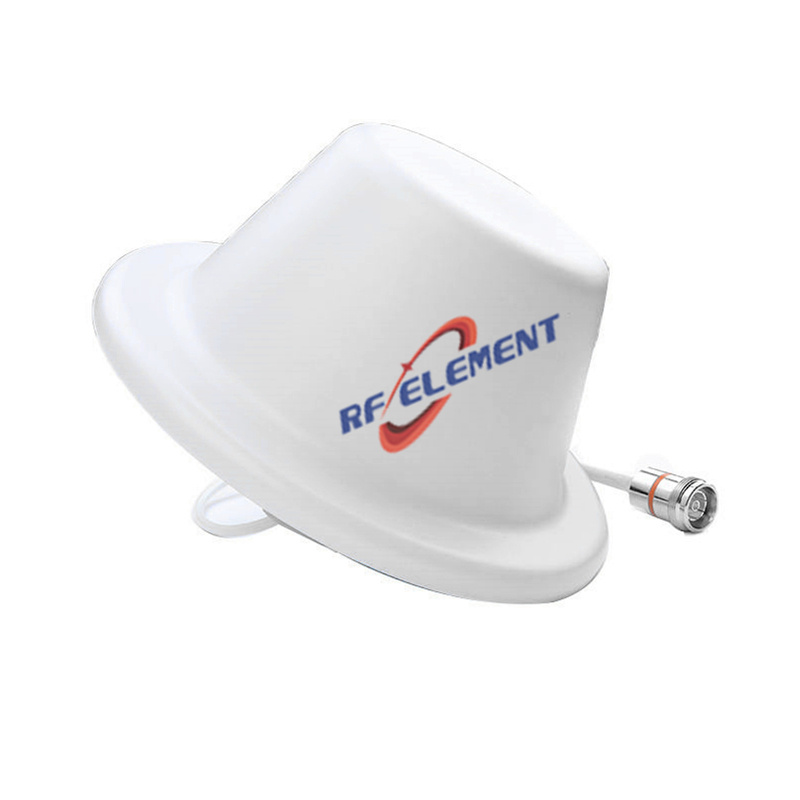
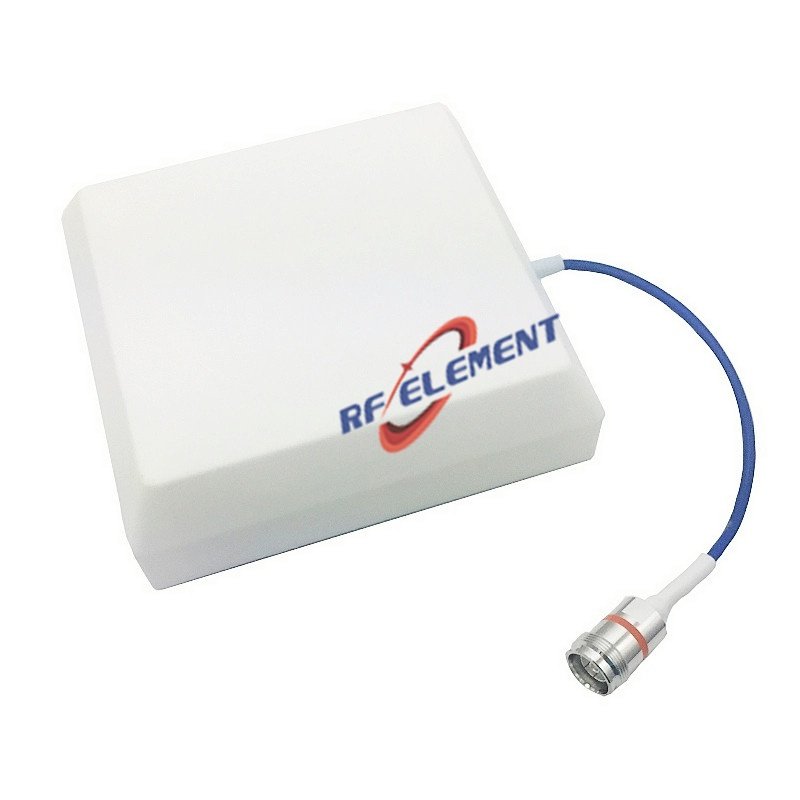
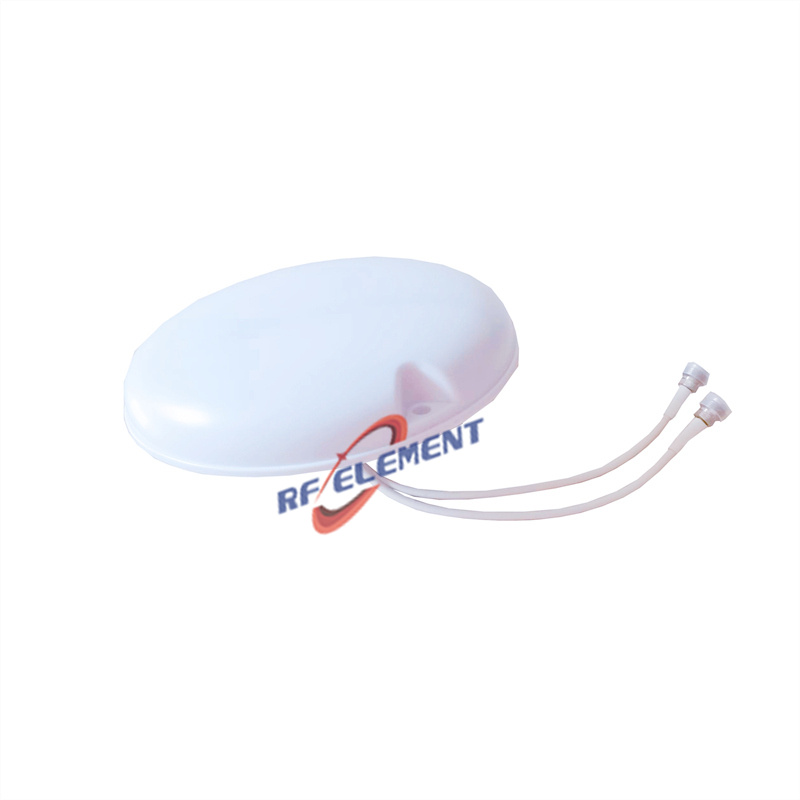
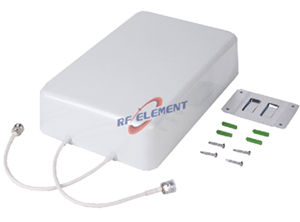
Dual Polarized 5G MIMO Ceiling Antenna | Low PIM Rated Indoor Antenna 698-3800MHz
Enhance indoor 5G coverage with RF element's dual polarized 5G MIMO ceiling antenna. Featuring Linear×2 polarization, this low PIM (-150dBc) antenna delivers robust MIMO performance across 698-3800MHz. Its sleek, low-profile design integrates seamlessly into any ceiling, making it the ideal choice for DAS, offices, hotels, and public venues. Contact us for a quote today!
Specifications
A 215 mm ceiling antenna with two orthogonal linear polarizations in a 42 mm body. The extra depth over a flat 15 mm disc is the physical cost of fitting both polarization planes into one housing, and the benefit is a more stable MIMO link in rooms where the direct path and the reflected path arrive at similar strength.
What dual polarization changes indoors
In a corridor or an open office, a single-polarization ceiling antenna delivers one dominant path. The second stream has to come from reflections, which are weaker and less predictable, so the MIMO gain in practice is often well below the theoretical 2x. Two orthogonal polarizations give the receiver a genuinely independent second signal at the same delay and roughly the same level, which is why dual-polarized indoor antennas typically show a measurable throughput gain in dense multipath even when the pattern is identical.
The polarization is specified as linear x2. That describes the radiating structure, not the port count: this model has a single 4.3-10 Female connector. Where the remote unit needs two physically separate ports, use a two-port plate and treat the polarization arrangement as a layout question rather than a data sheet one.
Body size and pattern
Gain runs 2.5 dBi at 698-806 MHz, 4.5 dBi across 806 MHz to 2.7 GHz, and 4.0 dBi at 3300-3800 MHz. Vertical beamwidth is 90 degrees at the bottom of the band, narrowing to 40 degrees at the top, which is the same progression as the flat discs and gives predictable overlap at a 3 m ceiling with 4-5 m spacing.
| Frequency Range | 698-3800MHz | |||
| Frequency Sub-Range(Mhz) | 698-806 | 806-960 | 1710-2700 | 3300-3800 |
| Polarization | Linear×2 | |||
| Gain(dBi) | 2.5 | 4.5 | 4.5 | 4.0 |
| Horizontal Beam width | 360° | |||
| Vertical Beam width | 90±10° | 85±10° | 65±10° | 40±20° |
| Impedance | 50Ω | |||
| VSWR | ≤ 1.8 | ≤ 1.5 | ≤ 1.5 | ≤ 1.8 |
| Maximum Power | 50 W | |||
| PIM, 3rd Order | -150dBc@2*43dBm | |||
| Connector | 4.3-10 Female | |||
| Dimension | φ215*42 mm | |||
| Net Weight | 0.5kg | |||
| Packing Size | 62*47*48cm(20 PCS) | |||
| Operating Temperature | -55° to +60° C (-67° to +140° F) | |||
| Radome Material | Plastic ABS | |||
| Radome Color | White | |||
| Mounting Options | fasteners and screws included for ceiling mounting | |||
The 42 mm body clears a standard suspended grid from below and does not need a recessed can. At 0.5 kg it is light enough for a grid clip, but the fixing points should be used as designed rather than a single central anchor, because the two polarization planes are aligned to the housing and a tilted mount skews the pattern.
PIM and shared systems
-150 dBc under two 43 dBm carriers is the operator-standard figure for an indoor passive layer, and it is met here without the size penalty of a 280 mm disc. Maximum power 50 W. Where several operators share the same ceiling layer, the antenna contribution stays at the same floor as the larger units, so the choice between them can be made on pattern and depth alone.
Installation
Mount with the polarization axis vertical relative to the room, not relative to the tile grid; a 45 degree rotation costs several dB of isolation between the two planes and is the most common installation error on dual-polarized indoor units. Mark the housing orientation before fixing.
Keep 250 mm clear of metal above the unit and route the cable away from luminaire drivers and dimmer circuits. At the low end of the band those sources raise the noise floor enough to mask the benefit of the second polarization.
Alternatives
Where depth is tight, the 15 mm low PIM disc gives a comparable pattern in a much thinner body with a single polarization. Where the design needs four independent ports rather than two polarization planes in one housing, the 4x4 slim plate is the correct part. Both belong to the same DAS in-building antenna family.
Customisation and ordering
Radome colour, cable length and packing quantity are selectable. The 215 mm diameter, 42 mm depth and linear x2 polarization are fixed tooling. Samples in 3-5 days, production in 15-25 days.
Tell us the remote unit model and its port configuration. If it expects two ports, we will quote a two-port ceiling unit instead; if it expects one port and the site is multipath-rich, this is the version to sample.
FAQ — Dual Polarized 5G MIMO Ceiling Antenna
What is the Dual Polarized 5G MIMO Ceiling Antenna used for?
What frequency band does the Dual Polarized 5G MIMO Ceiling Antenna cover?
What are the key specifications of the Dual Polarized 5G MIMO Ceiling Antenna?
Can RF element customize the Dual Polarized 5G MIMO Ceiling Antenna for my application?
What is the MOQ and lead time for the Dual Polarized 5G MIMO Ceiling Antenna?
How do I get a quotation for the Dual Polarized 5G MIMO Ceiling Antenna?