915MHz RFID Panel Antenna | 900-930MHz High Gain 13dBi
Specifications
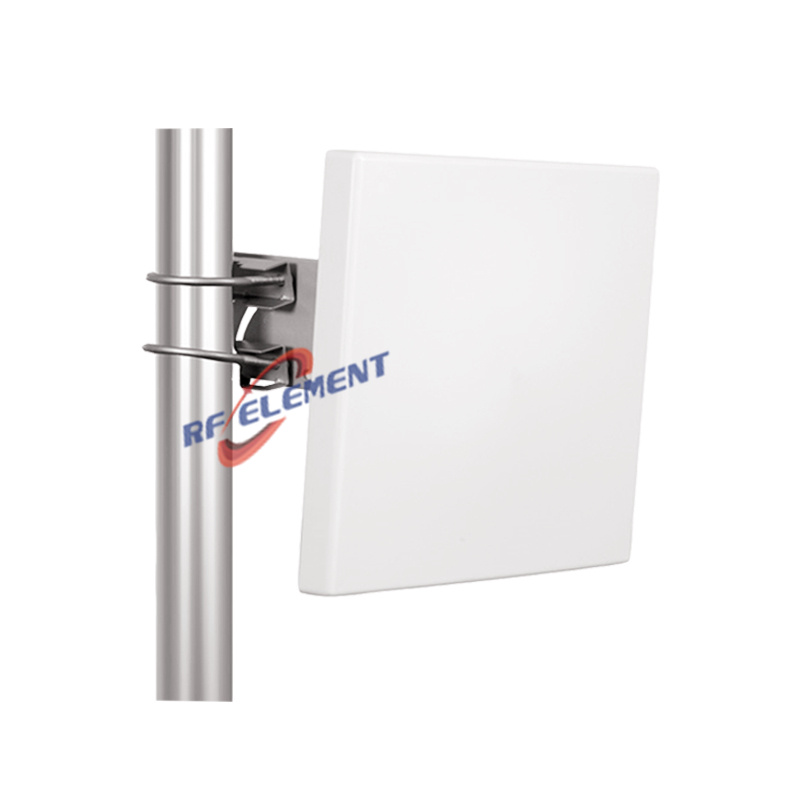
A 13 dBi panel for 900-930 MHz RFID readers, on a 450 x 450 x 40 mm plate weighing 3.0 kg. The horizontal beam is 38 degrees and the vertical beam 41 degrees, VSWR is at or below 1.5 across the band, and the single port is an N-Type female connector rated at 50 W. It is intended for portal and conveyor readers where the read zone has to be narrow enough to exclude neighbouring pallets.
Thirty-eight degrees defines the read zone
At 38 degrees horizontal, the beam covers about 69 m of width at 100 m and 345 m at 500 m. For an RFID installation the useful part of that pattern is much closer: the antenna is normally mounted 3 to 8 m from the tags, so the read zone is a cone whose width at the tag plane is roughly two thirds of the distance from the antenna.
That geometry is what makes a 13 dBi panel suitable for a portal or a conveyor gate: the zone is narrow enough that tags outside the gate are not read, and long enough that a pallet passing through the gate is illuminated for several hundred milliseconds. A wider antenna would read neighbouring pallets and create false positives.
Linear polarisation and tag orientation
The polarisation of this antenna is vertical and linear. An RFID tag whose dipole is vertical presents a good match and reads at the full rated distance; a tag lying flat with a horizontal dipole is cross-polarised and the read range falls sharply. That is not a defect in the antenna, but it is the single most common cause of an RFID portal that works for cartons on one pallet and fails for cartons on the next.
If the tag orientation cannot be controlled, a circularly polarised reader antenna is the correct part. If the installation can enforce orientation, a linear antenna gives more forward gain and a cleaner zone than a circular one of the same size.
| Frequency Range | 900-930MHz | |
| Polarization | Vertical | |
| Gain(dBi) | 13 | |
| Horizontal Beamwidth | 38° | |
| Vertical Beamwidth | 41° | |
| Impedance | 50Ω | |
| VSWR | ≤ 1.5 | |
| Maximum Power | 50W | |
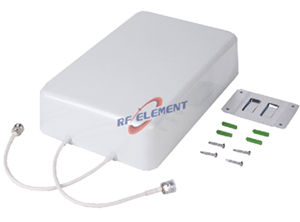
| Connector Type | 1 Port, N-Type Female | |
| Antenna Dimension(mm) | 450*450*40 | |
| Net Weight | 3.0 kg | |
| Operating Temperature | -55° to +60° C (-67° to +140° F) | |
| Radome Material | ABS | |
| Radome Color | White | |
| Mounting Options | Pole mounting | |
Reader power and cable loss
An RFID reader typically delivers between 0.5 and 1 W at the port, and the cable between the reader and the antenna can easily lose 2 to 3 dB on a 10 m run of thin coax. At 900 MHz that loss is a large fraction of the available power, so use a low loss cable and keep the run short, or mount the reader close to the antenna in a weatherproof enclosure.
The 50 W rating of this antenna is far above what an RFID reader produces, so the limiting factor is the reader and the cable, not the antenna. Do not interpret the power rating as a statement about read range.
Mounting at a portal
At 3.0 kg and 450 mm square, the panel needs a rigid mount. On a portal frame, fix the bracket to the structural member rather than to the cladding, and aim the panel so that its boresight crosses the gate at the height where the tags travel. A 41 degree vertical beam gives some tolerance in height, but the horizontal aim is what determines whether tags on the far side of the frame are read.
Keep the antenna at least 500 mm from metal framework in front of it. At 900 MHz a metal post inside the near field produces a shadow that appears as a dead spot in the read zone, and moving the antenna 100 mm often fixes it.
Ordering
N-Type female is standard, with radome colour and packing quantity confirmed at order. Samples in 3-5 days, production in 15-25 days.
Where the portal is wide and the tags are close, the 9 dBi 915 MHz RFID panel antenna uses a 65 degree beam on a 260 mm plate. For a gateway omni rather than a directional reader antenna, the 8 dBi IoT omni antenna covers 900-930 MHz in a 1540 mm radome.
Send the portal width, the tag orientation and the reader model. Tag orientation decides whether a linear antenna is appropriate, and that answer comes before any discussion of gain.
FAQ — 915MHz RFID Panel Antenna
What is the 915MHz RFID Panel Antenna used for?
What frequency band does the 915MHz RFID Panel Antenna cover?
What are the key specifications of the 915MHz RFID Panel Antenna?
Can RF element customize the 915MHz RFID Panel Antenna for my application?
What is the MOQ and lead time for the 915MHz RFID Panel Antenna?
How do I get a quotation for the 915MHz RFID Panel Antenna?