915MHz RFID Panel Antenna | 9dBi Gain
Specifications
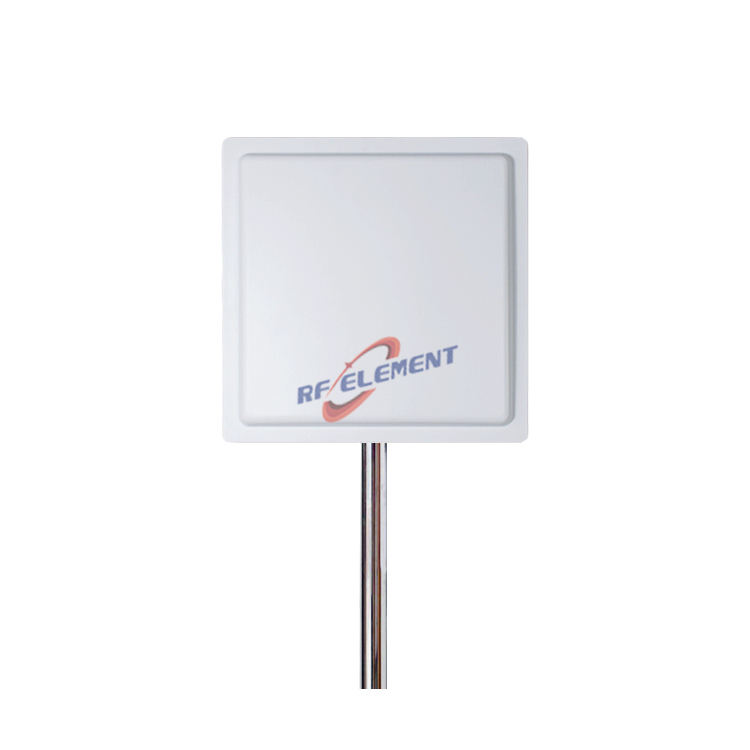
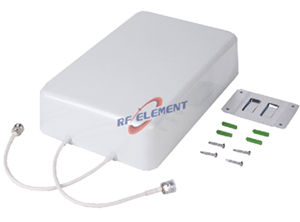
A 9 dBi panel for 900-930 MHz RFID readers, on a 260 x 260 x 45 mm plate weighing 1.3 kg. The horizontal beam is 65 degrees and the vertical beam 60 degrees, VSWR is at or below 1.5, and the single port is an N-Type female connector. It is intended for dock doors and wide openings where the tags pass close to the antenna.
A wide zone for a dock door
At 65 degrees horizontal, this antenna covers about 127 m of width at 100 m and the whole width of a loading dock at the 3 to 6 m distance where tags actually pass. That is the reason it exists: a dock door is wider than a conveyor gate, and a 38 degree panel mounted at the door frame would leave the outer edges of the opening unread.
The 60 degree vertical beam does the same job in the other axis. A pallet stacked 2 m high passes through the beam without the top or bottom tags falling outside the pattern, which is a common failure with narrow antennas mounted at door-frame height.
Smaller plate, wider pattern
The 260 mm plate is roughly half the area of the 13 dBi version, which is why the gain is 4 dB lower and the beam is 27 degrees wider. At 1.3 kg it can be mounted on a door frame or a light gantry without a structural bracket, and a single person can install it from a step ladder.
For a retrofit into an existing dock, that matters more than the gain difference. A 3 kg panel often requires a new mounting point, while a 1.3 kg panel can use the frame that is already there.
| Frequency Range | 900-930MHz | |
| Polarization | Vertical | |
| Gain(dBi) | 9 | |
| Horizontal Beamwidth | 65° | |
| Vertical Beamwidth | 60° | |
| Impedance | 50Ω | |
| VSWR | ≤ 1.5 | |
| Maximum Power | 50W | |
| Connector Type | 1 Port, N-Type Female | |
| Antenna Dimension(mm) | 260*260*45 | |
| Net Weight | 1.3 kg | |
| Operating Temperature | -55° to +60° C (-67° to +140° F) | |
| Radome Material | ABS | |
| Radome Color | White | |
| Mounting Options | Pole Mounting | |
Tag orientation still decides the read
The antenna is linearly polarised, vertically. Tags mounted vertically on cartons read well; tags lying flat on a pallet are cross-polarised and read poorly regardless of gain. In a dock environment where pallets arrive from different suppliers, orientation is rarely consistent, and the practical fix is either a second antenna mounted at 90 degrees or a circularly polarised reader antenna.
Increasing gain does not solve a polarisation mismatch. A 13 dBi linear antenna reads a cross-polarised tag no better than a 9 dBi one, so the specification decision should start with orientation rather than with decibels.
Adjacent gates and false reads
At 65 degrees the beam is wide enough to illuminate the next gate on a multi-door dock. Where two readers operate side by side, either space the antennas so that the beams do not overlap at the tag plane, or use a narrower antenna at each door and accept that the outer edges of the opening need a second unit.
Reader power and antenna gain together determine whether a neighbouring gate is read. Reducing reader power is often a cheaper fix than changing the antenna, and it is worth testing before ordering a narrower panel.
Ordering
N-Type female is standard, with radome colour and packing quantity confirmed at order. Samples in 3-5 days, production in 15-25 days.
Where the gate is narrow and the tags are further away, the 13 dBi 915 MHz RFID panel antenna uses a 38 degree beam on a 450 mm plate. For a general 900 MHz directional antenna rather than an RFID reader antenna, the 11 dBi IoT panel antenna covers the same band with a 55 degree beam.
Send the opening width, the tag orientation and the number of adjacent gates. Those three answers decide whether a wide or narrow antenna is appropriate, and they matter more than the gain figure.
FAQ — 915MHz RFID Panel Antenna
What is the 915MHz RFID Panel Antenna used for?
What frequency band does the 915MHz RFID Panel Antenna cover?
What are the key specifications of the 915MHz RFID Panel Antenna?
Can RF element customize the 915MHz RFID Panel Antenna for my application?
What is the MOQ and lead time for the 915MHz RFID Panel Antenna?
How do I get a quotation for the 915MHz RFID Panel Antenna?