5GHz WiFi Omni Antenna | WiFi Booster Omni Antenna | 9dBi
Specifications
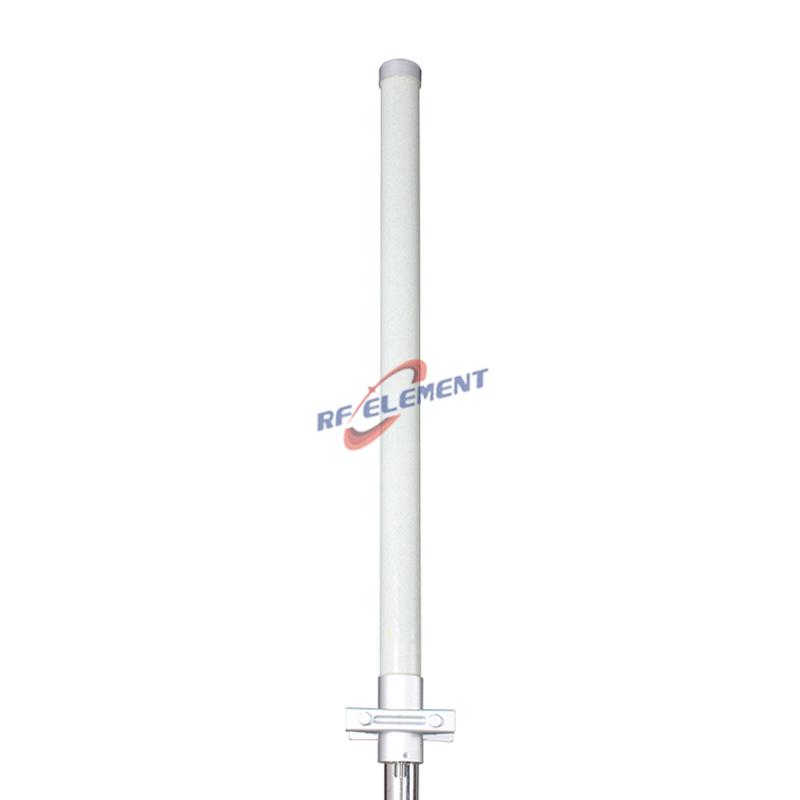
A single-port 5 GHz omni in a 560 mm fibreglass radome, 22 mm in diameter and 0.5 kg in weight. Gain is 9 dBi over 5150-5850 MHz, the vertical beam is 12 degrees and the horizontal pattern is 360 degrees. VSWR is at or below 1.8 and the port is available as N-Type female or N-Type male, which makes the antenna usable on a mast with a direct pigtail or through a short feeder.
Where a single port still makes sense at 5 GHz
Most 5 GHz access points are 2x2 or better, so a SISO antenna looks like a step backwards. It is not, in three cases: a legacy 802.11a access point, a point-to-multipoint bridge with a single radio chain, and a cost-sensitive hotspot where the second branch would add a feeder and a connector without a measurable throughput gain at the cell edge.
At 5 GHz the second spatial stream is realised mainly when the signal to noise ratio is high and the environment has enough scattering. In a rural distribution network with clear line of sight and a single dominant path, a 9 dBi SISO omni often delivers close to the same throughput as a 2x2 unit, because the second stream is not usable at range.
The 12 degree beam and the inner radius
A 9 dBi omni at 5 GHz has a 12 degree vertical beam. That is wider than the 7 degree beam of the 12 dBi unit, which pushes the inner edge of coverage closer to the mast and makes the antenna more forgiving of mounting height. At 12 m height the beam reaches ground level at roughly 57 m, and at 20 m height at roughly 95 m.
Those figures are the reason this antenna is often specified for street-level hotspots on lamp posts and building corners rather than for high masts. A lamp post at 6 m gives coverage from about 28 m outward, which is the right geometry for a public hotspot serving a square or a car park.
Fibreglass at 22 mm
The radome is filament wound fibreglass, which allows a 22 mm diameter at 560 mm length without the wall thickness that an ABS design would need for the same stiffness. Lower wall loss at 5 GHz and a stable pattern across the -55 to +60 C range are the practical benefits. The antenna is light enough to mount on a timber arm or a slim signpost without a structural bracket.
Because the radome is slim, the mounting clamp has to grip the base rather than the middle of the tube. A clamp tightened around the middle of a 22 mm fibreglass tube will crush the wall before it holds the antenna against wind load.
| Frequency Range | 5150-5850MHz | |
| Polarization | Vertical | |
| Gain(dBi) | 9 | |
| Horizontal Beamwidth | 360° | |
| Vertical Beamwidth | 12° | |
| Impedance | 50Ω | |
| VSWR | ≤ 1.8 | |
| Maximum Power | 50W | |
| Connector Type | 1 Port, N-Type Female / N-Type Male | |
| Antenna Dimension(mm) | Φ 22*560/ Φ 20*560 | |
| Net Weight | 0.5 kg | |
| Operating Temperature | -55° to +60° C (-67° to +140° F) | |
| Radome Material | Fiberglass | |
| Radome Color | White or Grey | |
| Mounting Options | Pole mounting | |
Standard compatibility
An antenna is a passive component, so the 802.11 standard named in a datasheet describes the radios it is typically paired with, not a limit on the antenna. This unit covers 5150-5850 MHz, which covers 802.11a, 802.11n and 802.11ac channels in the U-NII-1, U-NII-2 and U-NII-3 bands, and it will work with 802.11ax equipment on the same channels.
What the antenna does affect is the radiation pattern and the match. A radio expecting a 50 ohm load will see VSWR of 1.8 or better across the band, which is a return loss of about 11 dB, and that is adequate for any of the standards above without a matching network.
Ordering
Connector gender, radome colour and packing quantity are confirmed at order. Samples in 3-5 days, production in 15-25 days.
Where the access point is 2x2 and the site justifies two branches, the dual-polarised 12 dBi 5 GHz omni carries both polarisations in a 650 mm radome at 2.0 kg. The full WiFi antenna range lists the omni and sector designs by band.
Tell us the radio model, the mounting height and whether the link is point-to-point or multipoint. A single radio chain changes the answer more than any other detail in the brief.
FAQ — 5GHz WiFi Omni Antenna
What is the 5GHz WiFi Omni Antenna used for?
What frequency band does the 5GHz WiFi Omni Antenna cover?
What are the key specifications of the 5GHz WiFi Omni Antenna?
Can RF element customize the 5GHz WiFi Omni Antenna for my application?
What is the MOQ and lead time for the 5GHz WiFi Omni Antenna?
How do I get a quotation for the 5GHz WiFi Omni Antenna?