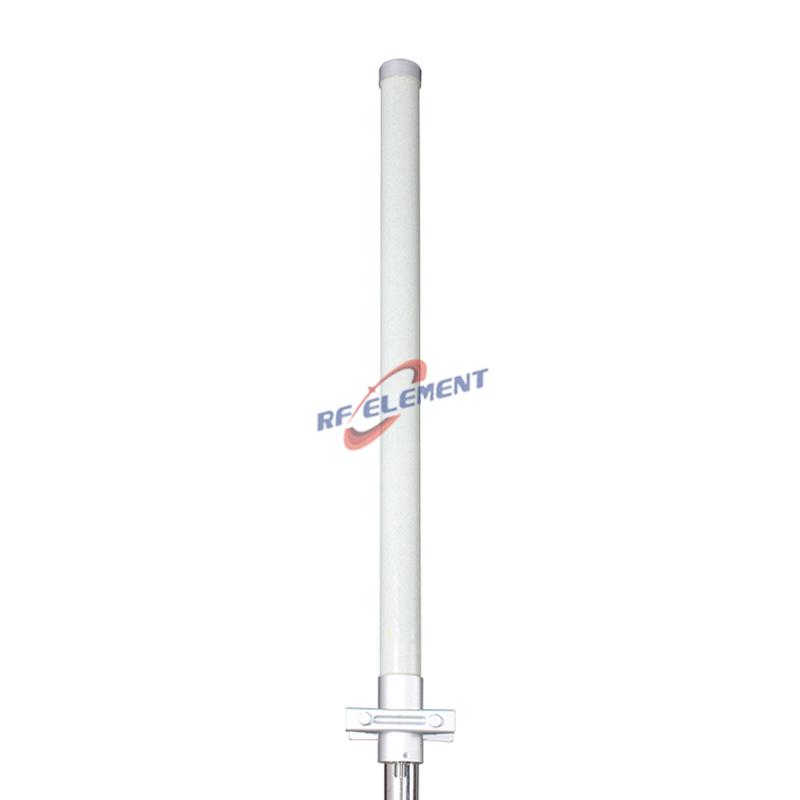
5GHz WiFi MIMO Omni Antenna | Dual Polarity 12dBi Gain
Specifications
A two-port 5 GHz omni for point-to-multipoint distribution, with vertical and horizontal polarisation sharing a single 650 mm by 75 mm radome. Gain is 12 dBi across 5150-5850 MHz, the vertical beam is 7 degrees and the horizontal pattern is a full 360 degrees. VSWR is at or below 1.8, maximum power is 50 W, and the two outputs are N-Type female on a white ABS housing weighing 2.0 kg.
Seven degrees is a coverage ring, not a coverage circle
At 5 GHz a 12 dBi omni has a very flat vertical pattern. The 7 degree beam means the useful coverage starts some distance from the mast and ends where the link budget runs out, leaving a vertical cone of silence directly below the antenna. That cone is not a defect: it is the mechanism by which the gain is produced, and every high gain omni has it.
The practical consequence is that mounting height and radius have to be chosen together. At 20 m height the beam reaches ground level at about 160 m and extends to roughly 500 m with a typical 5 GHz subscriber unit. If the requirement is coverage from 30 m outward, the antenna should be lower or the beam should be wider; a 9 dBi omni with a 12 degree beam is the usual answer.
Why 5 GHz behaves differently from 2.4 GHz
Free space loss at 5.8 GHz is about 7.6 dB higher than at 2.4 GHz for the same distance, and building penetration is significantly worse. The higher gain of this antenna partly compensates, but the compensation only works on the direct path: at 5 GHz the first Fresnel zone is smaller, so a clear line of sight matters more than antenna gain in a suburban deployment.
In practice this means the 5 GHz omni should be mounted above the clutter line rather than at eave height, and the subscriber antennas should be aimed with more care than their 2.4 GHz counterparts. A 12 dBi omni at 20 m with a clear path will outperform a 15 dBi unit at 8 m behind a tree line every time.
| Frequency Range | 5150-5850MHz | |
| Polarization | Horizontal+Vertical | |
| Gain(dBi) | 12 | |
| Horizontal Beamwidth | 360° | |
| Vertical Beamwidth | 7° | |
| Impedance | 50Ω | |
| VSWR | ≤ 1.8 | |
| Maximum Power | 50W | |
| Connector Type | 2 Port, N-Type Female | |
| Antenna Dimension(mm) | Φ 75*650 | |
| Net Weight | 2.0 kg | |
| Operating Temperature | -55° to +60° C (-67° to +140° F) | |
| Radome Material | ABS | |
| Radome Color | White | |
| Mounting Options | Pole mounting | |
2x2 MIMO from a single radome
Two polarisations in one enclosure give a 2x2 access point two branches from one mounting position. At 5 GHz the cross-polar discrimination is better than at 2.4 GHz because the elements are further apart in wavelengths, so the two branches stay decorrelated over a wider angle. That is the reason a single 75 mm radome can carry a useful 2x2 MIMO signal at 5 GHz while the same approach at 2.4 GHz is more compromised.
Both ports must be connected. Leaving one port open does not turn this into a 12 dBi SISO antenna; it changes the impedance match and the pattern, and the VSWR figure in the table no longer applies.
Pole and wind load
At 2.0 kg and 650 mm long, this antenna is light enough for a 40 mm pole but still presents a wind moment that should be checked on an exposed rooftop. Clamp at two points and keep the radome at least 125 mm from the mast surface at 5 GHz. A metal mast closer than that produces a deep null in the horizontal pattern that is easy to mistake for a radio fault.
On a wall bracket, the same 200 mm clearance rule applies. Where the antenna must be mounted against a metal surface, accept that the pattern becomes directional and plan the coverage accordingly rather than expecting a full circle.
Ordering
Two N-Type female ports are standard, with radome colour and packing quantity confirmed at order. Samples in 3-5 days, production in 15-25 days.
For a single-polarisation 5 GHz link, the 9 dBi 5 GHz omni antenna weighs 0.5 kg and uses one feeder. Where the site has to serve both bands from one mast, the dual band 4x4 MIMO omni antenna covers 2.4 and 5 GHz in a single radome.
Send the mounting height, the required inner and outer radius and the access point port count. The inner radius is the number most often left out of a brief, and it is the one that decides whether a 7 degree beam will work.
FAQ — 5GHz WiFi MIMO Omni Antenna
What is the 5GHz WiFi MIMO Omni Antenna used for?
What frequency band does the 5GHz WiFi MIMO Omni Antenna cover?
What are the key specifications of the 5GHz WiFi MIMO Omni Antenna?
Can RF element customize the 5GHz WiFi MIMO Omni Antenna for my application?
What is the MOQ and lead time for the 5GHz WiFi MIMO Omni Antenna?
How do I get a quotation for the 5GHz WiFi MIMO Omni Antenna?