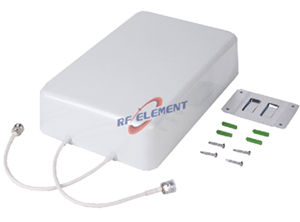
5GHz MIMO Sector Antenna | Dual Polarity WiFi Sector Antenna | 19dBi
Specifications
A 90 degree sector antenna for 5 GHz base stations with 19 dBi on two N-Type female ports, in a 770 x 115 x 60 mm white PVC radome weighing 3.0 kg. The vertical beam is 7 degrees plus or minus one, the horizontal pattern covers a full 90 degrees, VSWR is at or below 1.8, and the power rating is 100 W.
A high gain sector is a compromise between two numbers
Nineteen decibels with a 90 degree horizontal beam is only possible because the vertical pattern is compressed to 7 degrees. The horizontal coverage is what a sector plan needs, and the vertical compression is what produces the gain. Every 3 dB of additional gain in a sector antenna comes from narrowing the vertical beam, not from widening the horizontal one.
That has a direct consequence for site design: a 7 degree vertical beam is less tolerant of mounting height differences between sites than the 15 degree sector in the 2.4 GHz range. If the network is planned on a repeated template with the same pole height at every site, this antenna will perform consistently. If heights vary by more than a few metres, the coverage edges will vary with them.
What 7 degrees covers at 5 GHz
At 20 m height, a 7 degree beam reaches the ground at about 163 m and extends to the radio horizon on a clear path. At 30 m the inner edge moves out to about 245 m. For a dense urban grid with sites every 400 to 600 m, that is a workable footprint; for a site expected to cover the street immediately below the mast, it is not.
The sector edges are where the vertical beam matters most. At the 45 degree azimuth point, the effective gain is 3 dB lower than at boresight, which extends the inner edge of coverage outward at the sector boundary. Overlapping adjacent sectors by 10 to 15 degrees compensates for that effect and is the normal practice with this beamwidth.
| Frequency Range | 5150-5850MHz | |
| Polarization | Horizontal+Vertical | |
| Gain(dBi) | 19 | |
| Horizontal Beamwidth | 90° | |
| Vertical Beamwidth | 7±1° | |
| Impedance | 50Ω | |
| VSWR | ≤ 1.8 | |
| Maximum Power | 100W | |
| Connector Type | 2 Port, N-Type Female | |
| Antenna Dimension(mm) | 770*115*60 | |
| Net Weight | 3.0 kg | |
| Operating Temperature | -55° to +60° C (-67° to +140° F) | |
| Radome Material | PVC | |
| Radome Color | White | |
| Mounting Options | Pole mounting | |
Ninety degrees and sector count
A 90 degree sector supports four sectors with no overlap or three sectors with 30 degrees of overlap. At 5 GHz most regulatory domains allow many non-overlapping channels, so a four-sector plan does deliver the capacity benefit that is harder to achieve at 2.4 GHz. That is the usual reason for choosing this antenna over the 2.4 GHz sector.
Where the site serves both bands, the 5 GHz sectors can be rotated 45 degrees relative to the 2.4 GHz sectors to reduce coupling between the two systems on the same mast. The mechanical mounting permits that offset without special hardware.
100 W and a 770 mm radome
The 100 W rating suits a 5 GHz base station running at high duty cycle. The 770 mm length is the aperture needed to reach 19 dBi at this beamwidth, and it also makes the antenna the longest item in the 5 GHz sector family, which matters for transport and for pole loading.
At 3.0 kg and 770 mm, clamp the antenna at both ends of the mounting plate. A single centre clamp allows the radome to oscillate in gusty wind, and the movement is visible in the RSSI as a slow fading pattern that is easy to misdiagnose as interference.
Ordering
Two N-Type female ports are standard, with radome colour and packing quantity confirmed at order. Samples in 3-5 days, production in 15-25 days.
Where the site is a dense small cell grid and a shorter antenna is easier to mount, the 15 dBi 5 GHz MIMO sector antenna uses a 510 mm radome with an 8 degree beam. For a point-to-point link rather than a sector, the 20 dBi 5 GHz panel antenna provides a 13 degree beam on a flat plate.
Send the sector plan, the site height template and the radio output power. The height template is the detail that decides whether a 7 degree vertical beam is an advantage or a coverage problem.
FAQ — 5GHz MIMO Sector Antenna
What is the 5GHz MIMO Sector Antenna used for?
What frequency band does the 5GHz MIMO Sector Antenna cover?
What are the key specifications of the 5GHz MIMO Sector Antenna?
Can RF element customize the 5GHz MIMO Sector Antenna for my application?
What is the MOQ and lead time for the 5GHz MIMO Sector Antenna?
How do I get a quotation for the 5GHz MIMO Sector Antenna?