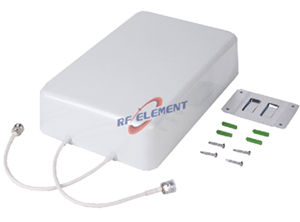
Dual Band WiFi Panel Antenna | 2.4GHz/5GHz 19dBi
Specifications
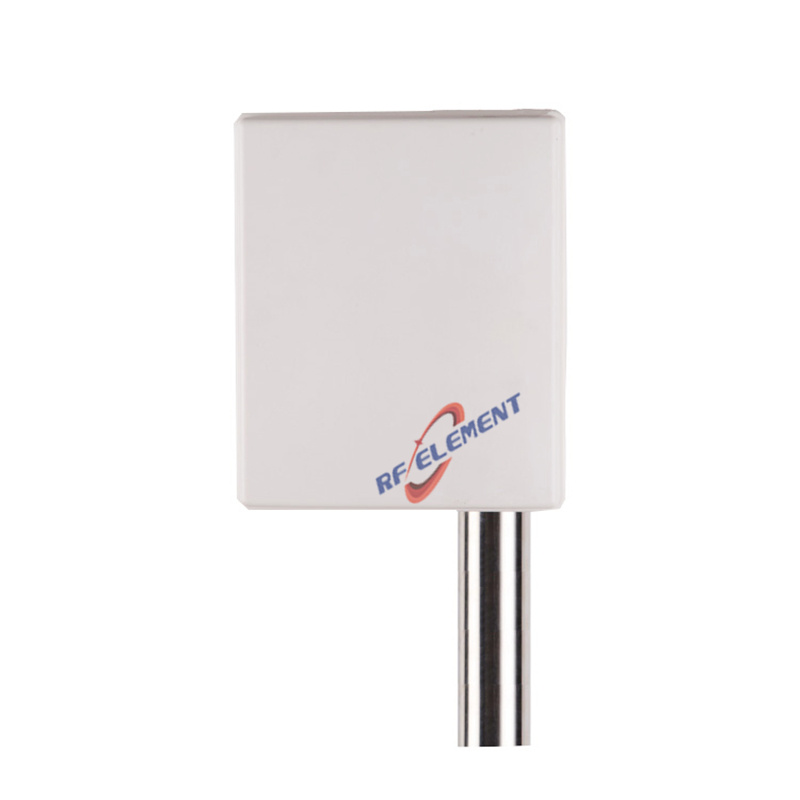
A high gain dual-band panel on a 350 x 350 x 45 mm plate weighing 2.0 kg, with four N-Type female ports. Gain is 16 dBi at 2400-2500 MHz and 18 dBi at 5150-5850 MHz, with horizontal beamwidths of 30 and 25 degrees and vertical beamwidths of 18 and 16 degrees. VSWR is at or below 1.8 and the rating is 50 W per port.
Two bands at high gain in one aperture
Running both bands at 16 and 18 dBi in a single housing is the reason this plate is 350 mm square rather than 239 mm. The extra aperture buys roughly 4 dB over the compact dual-band panel in each band, which is the difference between a small cell coverage antenna and a unit that can serve a distributed network across several hundred metres.
The ports split two per band, one vertical and one horizontal, so each band supports a 2x2 MIMO branch. That is the practical maximum for a four-port housing, and it should be confirmed against the radio port map before ordering.
Narrow beams and aiming
At 25 degrees horizontal and 16 degrees vertical, the 5 GHz beam is close to a point-to-point panel in behaviour. At 500 m the horizontal coverage is about 221 m wide, and at 1 km about 443 m. For a multipoint base station serving clients in a 30 degree arc, that is a reasonable match; for a sector plan with 90 degree spacing, it leaves gaps.
Where this panel is used for a dual-band point-to-point link, the narrow beam is an advantage: it rejects interference from adjacent sectors and allows the same channel to be reused on a nearby path. The cost is that both ends must be aligned with care, and a one degree error at 1 km moves the coverage edge by about 17 m.
Why run both bands on one link
A dual-band bridge can use 5 GHz for the primary link and 2.4 GHz as a backup path, or split traffic so that latency-sensitive services use the less congested band. A single antenna serving both means the backup path has the same alignment and the same mounting, which removes a common failure mode in redundant links.
The 2.4 GHz beam is 30 degrees by 18 degrees, slightly wider than the 5 GHz pattern, so the lower band path is more tolerant of alignment error. In practice the 2.4 GHz link is aligned first and the 5 GHz path then falls close to boresight.
| Frequency Range | 2400 – 2500 MHz | 5150 – 5850 MHz |
| Polarization | Horizontal +Vertical | |
| Gain(dBi) | 16±1dBi | 18±1dBi |
| Horizontal Beamwidth | 30° 25° | |
| Vertical Beamwidth | 18° 16° | |
| Impedance | 50Ω | |
| VSWR | ≤ 1.8 | |
| Maximum Power | 50W | |
| Connector Type | 4 Port, N-Type Female | |
| Antenna Dimension(mm) | 350*350*45 | |
| Net Weight | 2.0kg | |
| Operating Temperature | -55° to +60° C (-67° to +140° F) | |
| Radome Material | ABS | |
| Mounting Options | Hanged on pole | |
Mechanical load at 350 mm
At 2.0 kg and 45 mm deep, the plate is manageable on a pole of 40 mm or more, but the 350 mm square face is a significant wind area. Clamp at two points and keep 200 mm clearance from the pole surface. On a rooftop mast, check the total load with the radio and the mounting bracket included, not just the antenna weight.
The four connectors are grouped on the rear face. Leave enough service loop to remove the plate without disconnecting the feeders, because a 350 mm plate is awkward to hold while a cable is being reconnected at height.
Ordering
Four N-Type female ports are standard, with radome colour and packing quantity confirmed at order. Samples in 3-5 days, production in 15-25 days.
Where the site needs wide azimuth coverage rather than a narrow panel, the dual band WiFi sector antenna covers 90 degrees on both bands with four ports. Where mounting space is tight and 12 to 14 dBi is sufficient, the 14 dBi dual band panel antenna uses a 239 mm plate at 1.2 kg.
Send the link distance, the radio port map and the mounting height. On a dual-band link the port map and the distance together decide whether this panel or the compact version is the right part.
FAQ — Dual Band WiFi Panel Antenna
What is the Dual Band WiFi Panel Antenna used for?
What frequency band does the Dual Band WiFi Panel Antenna cover?
What are the key specifications of the Dual Band WiFi Panel Antenna?
Can RF element customize the Dual Band WiFi Panel Antenna for my application?
What is the MOQ and lead time for the Dual Band WiFi Panel Antenna?
How do I get a quotation for the Dual Band WiFi Panel Antenna?