Dual Band WiFi Panel Antenna | 2.4GHz/5GHz 14dBi
Specifications
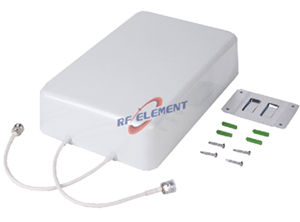
A dual-band panel with four N-Type female ports in a 239 x 190 x 35 mm housing weighing 1.2 kg. Gain is 12 dBi at 2400-2500 MHz and 14 dBi at 5150-5850 MHz, with horizontal beamwidths of 50 and 45 degrees and vertical beamwidths of 60 and 40 degrees. VSWR is at or below 1.8 and the maximum power is 50 W.
Four ports, two bands, two branches each
Two vertical and two horizontal elements share one housing, which gives two ports per band. That is a 2x2 MIMO arrangement on each band, not a 4x4 on either. A 4x4 radio per band would need eight ports, and this housing does not provide them.
The advantage over two separate single-band panels is pole space and cable route. One 239 x 190 mm plate replaces two antennas, two brackets and two sets of fixings, and the four feeders leave from one point rather than two. On a small cell pole where space is already allocated to the radio, the GPS unit and the power cable, that consolidation is worth more than a few tenths of a decibel.
The wide vertical beam at 2.4 GHz
A 60 degree vertical beam at 2.4 GHz is unusually wide for a 12 dBi panel, and it is the reason this antenna suits short range coverage rather than long links. At 6 m mounting height, the beam reaches the ground about 5 m from the pole and covers a broad area with no near-field gap, which is the right shape for a small cell serving a street corner or a courtyard.
At 5 GHz the vertical beam narrows to 40 degrees and the gain rises to 14 dBi, so the same panel reaches further in the higher band. That asymmetry is useful in a small cell that carries most traffic on 5 GHz while using 2.4 GHz for legacy devices and fallback.
Dual-band economics
The 2.4 GHz gain of 12 dBi is lower than the 14 to 18 dBi available from single-band panels, because the aperture is shared between two bands and two polarisations. The 5 GHz figure of 14 dBi is similarly below the 20 dBi single-band unit. If either band needs maximum range, a dedicated antenna is the better choice.
Where both bands serve the same local area, the shared aperture is efficient: the coverage footprints overlap closely, and the radio can steer clients between bands without a coverage mismatch. That is the typical small cell requirement, and it is what this panel is designed for.
| Frequency Range | 2400 – 2500 MHz | 5150 – 5850 MHz |
| Polarization | Horizontal +Vertical | |
| Gain(dBi) | 12dBi | 14dBi |
| Horizontal Beamwidth | 50° 45° | |
| Vertical Beamwidth | 60° 40° | |
| Impedance | 50Ω | |
| VSWR | ≤ 1.8 | |
| Maximum Power | 50W | |
| Connector Type | 4 Port, N-Type Female | |
| Antenna Dimension(mm) | 239*190*35 | |
| Net Weight | 1.2kg | |
| Operating Temperature | -55° to +60° C (-67° to +140° F) | |
| Radome Material | ABS | |
| Mounting Options | Hanged on pole | |
Four feeders, one route
Four N-Type connectors in a 239 mm wide housing leave limited space for cable management. Use right-angle or swept connectors where the cables have to turn immediately, and secure the bundle to the pole within 300 mm of the antenna so that the connector bodies do not carry the cable weight.
Label the four ports at both ends before installation. A crossed pair between a 2.4 GHz and a 5 GHz port will not damage the radio, but it will produce a puzzling coverage pattern that takes time to diagnose on site.
Ordering
Four N-Type female ports are standard, with radome colour and packing quantity confirmed at order. Samples in 3-5 days, production in 15-25 days.
Where the site needs more gain on both bands, the 19 dBi dual band panel antenna uses a 350 mm plate with 30 and 25 degree horizontal beams. Where the requirement is a wide azimuth sector rather than a panel, the dual band WiFi sector antenna covers 90 degrees on both bands.
Send the radio port map, the mounting height and the coverage radius on each band. The port map confirms whether four ports are enough, and the radius decides whether this panel or the 19 dBi version is correct.
FAQ — Dual Band WiFi Panel Antenna
What is the Dual Band WiFi Panel Antenna used for?
What frequency band does the Dual Band WiFi Panel Antenna cover?
What are the key specifications of the Dual Band WiFi Panel Antenna?
Can RF element customize the Dual Band WiFi Panel Antenna for my application?
What is the MOQ and lead time for the Dual Band WiFi Panel Antenna?
How do I get a quotation for the Dual Band WiFi Panel Antenna?