2.4GHz WiFi Panel Antenna | 14dBi Gain
Specifications
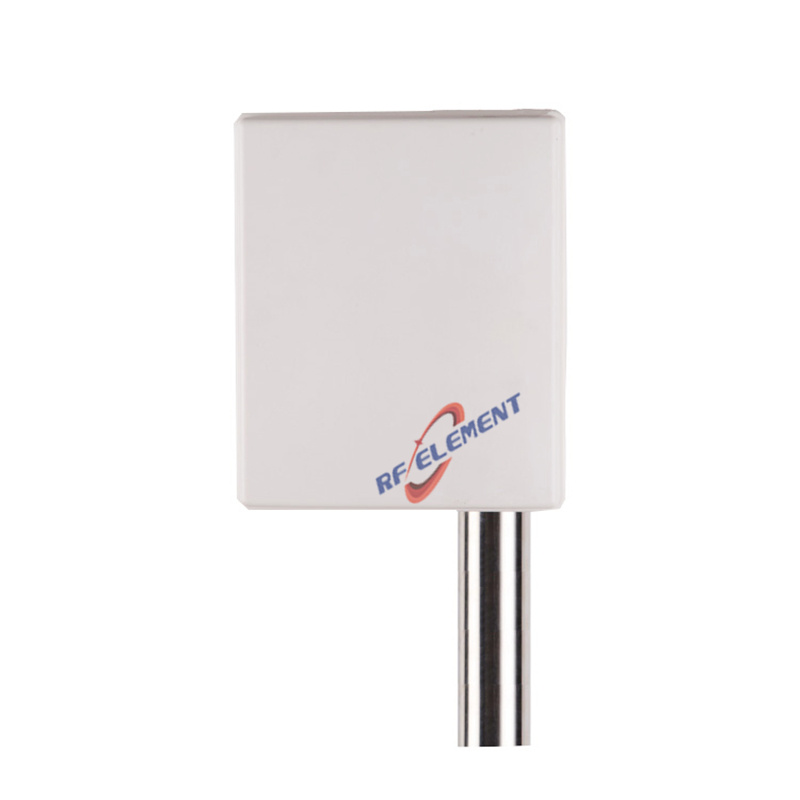
A compact 2.4 GHz panel with 14 dBi of gain on a 239 x 190 x 35 mm plate that weighs 0.9 kg. The horizontal beam is 35 degrees wide and the vertical beam 30 degrees, VSWR is at or below 1.5 across 2400-2500 MHz, and the single port is an N-Type female connector. Maximum power is 50 W and the radome is white ABS.
Aiming tolerance is the real specification
A 35 degree horizontal beam covers about 63 m of width at 100 m and 315 m at 500 m. Compared with a 22 degree panel, that is 60 percent more angular tolerance, which matters on a link where the mounting bracket is not adjustable in fine increments or where the pole leans slightly.
For a 300 m point-to-point link, a 35 degree beam means the two ends can be aligned with a compass and a visual check rather than a spectrum analyser. The 4 dB lower gain compared with an 18 dBi unit is usually recovered by better alignment and by the reduced risk of a mis-aimed installation.
One antenna for indoor and outdoor use
The 239 x 190 mm plate is small enough to mount on an interior wall as a directional indoor antenna, and the white ABS radome is rated for the same -55 to +60 C range as the outdoor units. That dual use is useful for system integrators who want one part number for a warehouse coverage design that extends into a yard.
Indoors, a 35 degree beam at 14 dBi covers the length of a warehouse aisle or a long hall from a single wall position. The 30 degree vertical beam is wide enough that mounting height is not critical, which is the main reason this antenna is easier to deploy indoors than the 18 dBi unit.
| Frequency Range | 2400-2500MHz | |
| Polarization | Vertical | |
| Gain(dBi) | 14 | |
| Horizontal Beamwidth | 35° | |
| Vertical Beamwidth | 30° | |
| Impedance | 50Ω | |
| VSWR | ≤ 1.5 | |
| Maximum Power | 50W | |
| Connector Type | 1Port, N-Type Female | |
| Antenna Dimension(mm) | 239*190*35 | |
| Net Weight | 0.9 kg | |
| Operating Temperature | -55° to +60° C (-67° to +140° F) | |
| Radome Material | ABS | |
| Radome Color | White | |
| Mounting Options | Pole mounting | |
Where 0.9 kg changes the installation
At less than a kilogram, this panel can be fixed to a timber fascia, a parapet or a lightweight pole without a structural survey. The 35 mm depth also means the antenna sits close to the wall, so the lever arm on the fixings is small and the wind load is lower than the 305 mm square plate.
Where the mounting surface is a metal wall, use a standoff of at least 100 mm. The plate is a half-wavelength-scale aperture at 2.4 GHz, and a metal surface directly behind it changes the match and the front-to-back ratio in ways that are not captured in the datasheet.
Choosing between 14 and 18 dBi
The decision is usually about distance and clutter rather than gain. Up to about 500 m with a clear path, 14 dBi at both ends is sufficient for a 54 Mbps class link with margin. Beyond 1 km, the extra 4 dB of the 18 dBi unit is worth having, provided the path has Fresnel clearance and the antennas can be aimed accurately.
In an urban multipoint network where clients are spread across a 60 degree sector, the wider beam of this antenna serves more of them without a second panel, which is often worth more than the gain difference.
Ordering
N-Type female is standard, with radome colour and packing quantity confirmed at order. Samples in 3-5 days, production in 15-25 days.
For a longer link or a narrower sector, the 18 dBi 2.4 GHz panel antenna uses a 22 degree beam on a 305 mm plate. Where the requirement is a 90 degree sector with two polarisations, the 2.4 GHz MIMO sector antenna covers the wider azimuth with 100 W handling.
Send the link distance, the mounting surface and the number of client directions to be covered. Those three answers separate a point-to-point panel from a sector antenna.
FAQ — 2.4GHz WiFi Panel Antenna
What is the 2.4GHz WiFi Panel Antenna used for?
What frequency band does the 2.4GHz WiFi Panel Antenna cover?
What are the key specifications of the 2.4GHz WiFi Panel Antenna?
Can RF element customize the 2.4GHz WiFi Panel Antenna for my application?
What is the MOQ and lead time for the 2.4GHz WiFi Panel Antenna?
How do I get a quotation for the 2.4GHz WiFi Panel Antenna?