2.4GHz WiFi MIMO Sector Antenna | 90-Degree Dual Polarity MIMO Sector Antenna
Specifications
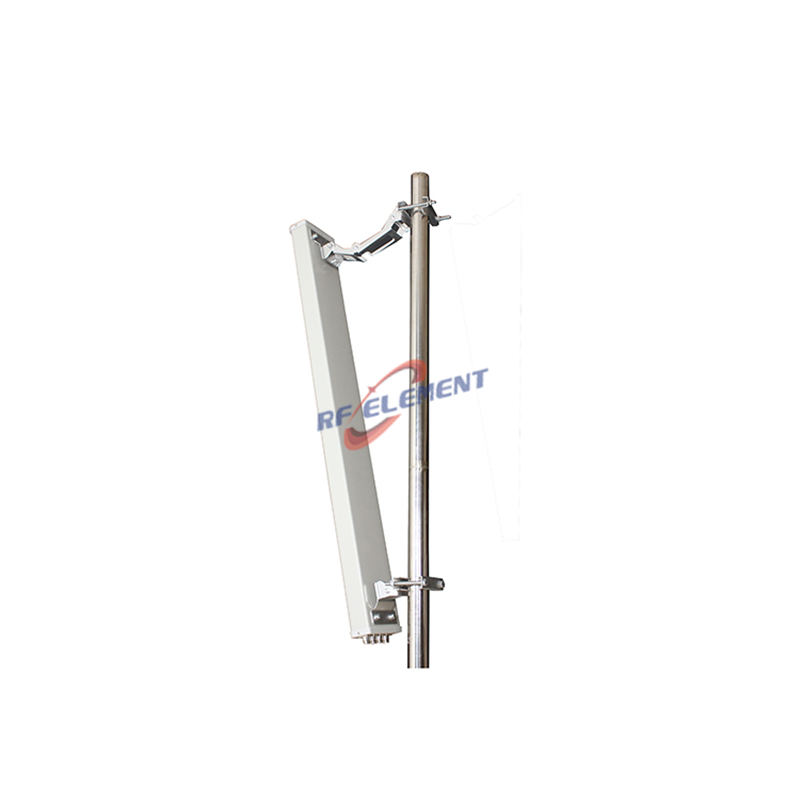
A 90 degree sector antenna for 2.4 GHz base stations, with 14 dBi on two N-Type female ports and a 510 x 128 x 58 mm grey PVC radome weighing 3.0 kg. The horizontal beam covers 90 degrees and the vertical beam 15 degrees, VSWR is at or below 1.8, and the power rating is 100 W, which is higher than the 50 W common to the flat panel units in the range.
Three sectors or four
A 90 degree sector antenna supports a four-sector plan with no overlap, or a three-sector plan with 30 degrees of overlap at each boundary. The three-sector layout is usually the better choice for coverage: the overlap provides soft handover between sectors and eliminates the nulls that appear exactly at the boundary in a four-sector plan.
The four-sector layout is used when capacity rather than coverage is the objective, because each sector carries a quarter of the traffic. At 2.4 GHz, where the channel plan has only three non-overlapping channels in most regulatory domains, a four-sector plan forces channel reuse within the same site and the capacity benefit is smaller than the sector count suggests.
The 15 degree vertical beam and mounting height
Fifteen degrees is wide for a sector antenna and suits a mounting height between 10 and 25 m. At 15 m the beam reaches the ground at about 57 m and extends to the radio horizon on a clear path. At 40 m the inner edge moves out to about 150 m, leaving a coverage hole around the base of the mast that is often mistaken for a radio problem.
For a rooftop site where the objective includes the street below, this is the wrong vertical beam. A sector with a 30 degree vertical pattern, even at lower gain, covers the near street better. Where the site serves a distribution ring at distance, 15 degrees is a good compromise between gain and tolerance.
| Frequency Range | 2400-2500MHz | |
| Polarization | Horizontal+Vertical | |
| Gain(dBi) | 14 | |
| Horizontal Beamwidth | 90° | |
| Vertical Beamwidth | 15° | |
| Impedance | 50Ω | |
| VSWR | ≤ 1.8 | |
| Maximum Power | 100W | |
| Connector Type | 2 Port, N-Type Female | |
| Antenna Dimension(mm) | 510*128*58 | |
| Net Weight | 3.0 kg | |
| Operating Temperature | -55° to +60° C (-67° to +140° F) | |
| Radome Material | PVC | |
| Radome Color | Grey | |
| Mounting Options | Pole mounting | |
100 W and a PVC radome
The 100 W rating is the specification that distinguishes this antenna from the indoor panels. It suits a base station radio with a 20 to 40 W output running at a high duty cycle, where the antenna has to dissipate heat from the connector and the feed network rather than from the radiating elements alone.
The radome is extruded PVC rather than ABS. PVC has better ultraviolet stability over a long service life and a slightly higher dielectric loss, which is why the gain is 14 dBi rather than the 15 to 16 dBi that a shorter ABS design might reach. For a fixed installation expected to last a decade, the PVC body is the more durable choice.
Two polarisations for 2x2 MIMO
The two ports are vertically and horizontally polarised. In a 2x2 MIMO base station, both ports must be connected to separate radio chains; the antenna provides two decorrelated branches across the 90 degree sector, and the MIMO benefit is realised where the client environment provides scattering.
Isolation between the ports is not stated in the table. For a 2x2 branch at moderate power this is rarely the limiting factor, but where the two ports are used for separate radios rather than for MIMO, ask for the isolation figure at the operating channel before committing.
Mechanical notes
At 3.0 kg and 510 mm long, the antenna needs a pole of at least 40 mm diameter with clamps at both ends of the mounting plate. The 58 mm depth keeps the centre of pressure close to the pole, which reduces the twisting moment compared with a flat panel of the same area.
Keep the radome at least 150 mm from the pole surface. The 90 degree pattern is less sensitive to a nearby mast than a narrow panel, but the sector edges will still be affected, and the effect is not symmetric.
Ordering
Two N-Type female ports are standard, with radome colour and packing quantity confirmed at order. Samples in 3-5 days, production in 15-25 days.
For a single direction link instead of a sector, the 18 dBi 2.4 GHz panel antenna delivers more gain on a 22 degree beam. Where the site is dual band, the dual band panel antenna covers 2.4 and 5 GHz with four ports.
Send the sector plan, the mounting height and the radio output power. The sector count decides the antenna gain class, and the mounting height decides whether a 15 degree vertical beam will reach the street.
FAQ — 2.4GHz WiFi MIMO Sector Antenna
What is the 2.4GHz WiFi MIMO Sector Antenna used for?
What frequency band does the 2.4GHz WiFi MIMO Sector Antenna cover?
What are the key specifications of the 2.4GHz WiFi MIMO Sector Antenna?
Can RF element customize the 2.4GHz WiFi MIMO Sector Antenna for my application?
What is the MOQ and lead time for the 2.4GHz WiFi MIMO Sector Antenna?
How do I get a quotation for the 2.4GHz WiFi MIMO Sector Antenna?