5GHz WiFi MIMO Sector Antenna | 90-Degree Dual Polarity MIMO Sector Antenna
Specifications
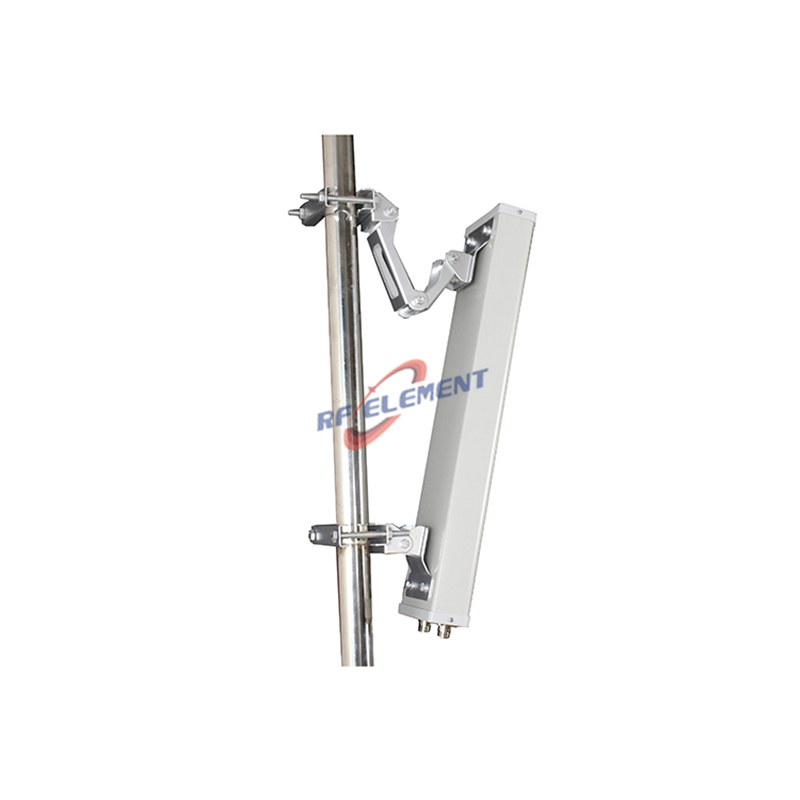
A 90 degree sector antenna for 5 GHz with 15 dBi on two N-Type female ports, in a 510 x 128 x 58 mm grey PVC radome weighing 3.0 kg. The vertical beam is 8 degrees, VSWR is at or below 1.8 across 5150-5850 MHz, the power rating is 100 W and the horizontal pattern covers the full 90 degree sector. It is the shorter of the two 90 degree 5 GHz sectors in the range, intended for dense site grids where a 770 mm long radome is difficult to mount.
Fifteen against nineteen decibels
The 19 dBi sector in the same family uses a 770 mm radome and a 7 degree vertical beam. This antenna uses 510 mm and 8 degrees, and the 4 dB difference in gain translates to roughly 40 percent less coverage radius in free space, or about 25 percent less in a cluttered urban environment.
The choice between them is usually about site density rather than performance. In a grid with sites every 300 to 500 m, 15 dBi is sufficient and the shorter radome is easier to transport, mount and keep within the pole loading limit. Where sites are 800 m apart or more, the extra 4 dB is worth the longer antenna.
The 8 degree vertical beam
At 20 m height, an 8 degree beam reaches the ground at about 143 m. That inner edge is the number to check against the site plan: if the objective includes coverage of the street within 100 m of the mast, neither this antenna nor the 19 dBi version will deliver it, and a wider vertical beam or a lower mounting point is required.
At 15 m the inner edge moves in to about 107 m, which is why this antenna is often mounted lower than a 19 dBi sector on the same site. The shorter radome also makes a lower mounting position easier to achieve on a wall or a parapet.
| Frequency Range | 5150-5850MHz | |
| Polarization | Horizontal+Vertical | |
| Gain(dBi) | 15 | |
| Horizontal Beamwidth | 90° | |
| Vertical Beamwidth | 8° | |
| Impedance | 50Ω | |
| VSWR | ≤ 1.8 | |
| Maximum Power | 100W | |
| Connector Type | 2 Port, N-Type Female | |
| Antenna Dimension(mm) | 510*128*58 | |
| Net Weight | 3.0 kg | |
| Operating Temperature | -55° to +60° C (-67° to +140° F) | |
| Radome Material | PVC | |
| Radome Color | Grey | |
| Mounting Options | Pole mounting | |
Half the length, same power rating
At 510 mm and 3.0 kg, this is the shortest 100 W sector in the 5 GHz family. The mass is concentrated in the mounting plate and the connector block rather than distributed along the radome, so the pole clamp has to carry a compact load rather than a long lever. That makes the antenna suitable for wall brackets and parapet mounts where a 770 mm radome would be awkward.
The PVC radome is UV stable and does not chalk in the way that painted ABS can. On a coastal site, the aluminium mounting plate should be checked for dissimilar metal corrosion at the fixings and isolated with a nylon washer if the pole is galvanised steel.
Sector planning at 90 degrees
Three sectors with 30 degrees of overlap, or four sectors with no overlap, are both workable. At 5 GHz the channel plan usually allows a four-sector reuse pattern, which is the main reason to choose 5 GHz for capacity rather than coverage.
When two bands share a mast, offset the 5 GHz sectors by 45 degrees from the 2.4 GHz sectors to reduce coupling. The isolation between the two systems is then set by the antenna patterns rather than by the physical spacing, which is easier to achieve on a crowded pole.
Ordering
Two N-Type female ports are standard, with radome colour and packing quantity confirmed at order. Samples in 3-5 days, production in 15-25 days.
Where the site spacing is wider and the extra gain is needed, the 19 dBi 5 GHz MIMO sector antenna uses a 770 mm radome with a 7 degree beam. Where the requirement is dual band coverage from one sector housing, the dual band WiFi sector antenna covers 2.4 and 5 GHz with four ports.
Send the site grid, the mounting height and the required cell radius. The grid spacing is what separates the 15 dBi and 19 dBi sectors, and it is usually the only number that matters.
FAQ — 5GHz WiFi MIMO Sector Antenna
What is the 5GHz WiFi MIMO Sector Antenna used for?
What frequency band does the 5GHz WiFi MIMO Sector Antenna cover?
What are the key specifications of the 5GHz WiFi MIMO Sector Antenna?
Can RF element customize the 5GHz WiFi MIMO Sector Antenna for my application?
What is the MOQ and lead time for the 5GHz WiFi MIMO Sector Antenna?
How do I get a quotation for the 5GHz WiFi MIMO Sector Antenna?