2.4GHz WiFi MIMO Omni Antenna | Dual Polarity 13dBi Gain
Specifications
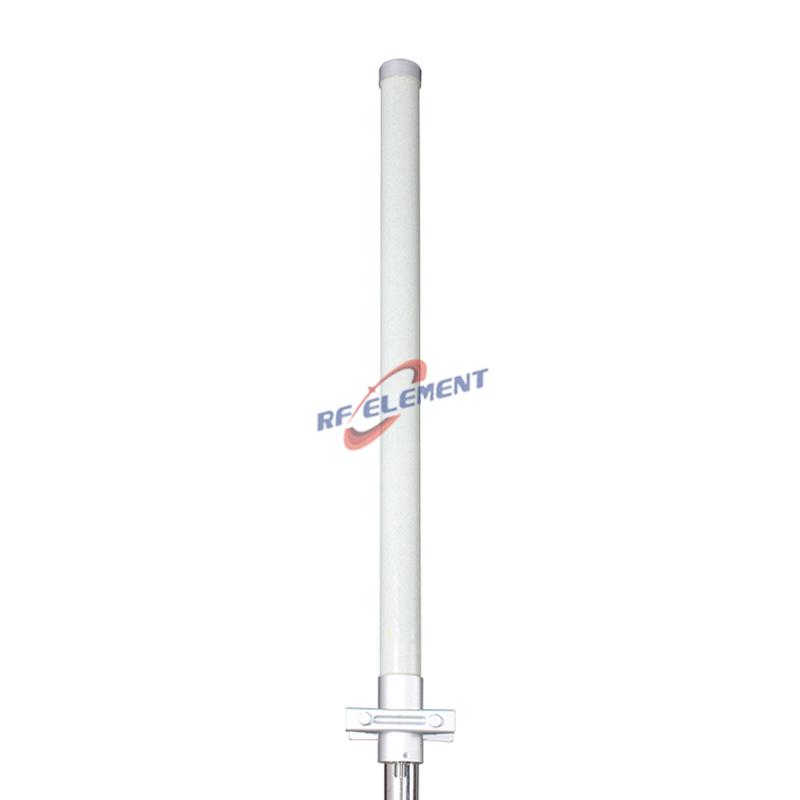
A 2.4 GHz omni antenna that carries two polarisations in one radome, so a single pole position serves a 2x2 MIMO base station without a second antenna and a second feeder. Gain is 13 dBi from a 1150 mm by 75 mm white ABS housing, with a 360 degree horizontal pattern and a vertical beamwidth of 8 degrees. Two N-Type female ports sit at the base, and VSWR stays at or below 1.5 across 2400-2500 MHz.
What an 8 degree vertical beam does to coverage
Thirteen decibels of omni gain is produced by compressing the vertical pattern, not by increasing the power in every direction. An 8 degree beam drawn from a 1150 mm aperture concentrates the energy into a flat disc that leaves the antenna almost horizontally, then falls away quickly above and below. The practical result is a coverage ring whose outer radius is set by the link budget and whose inner edge is a function of mounting height.
Mounted at 15 m on a mast, the beam reaches the ground at roughly 100 m from the base and continues to about 400 m before the pattern drops below the horizon. Directly under the antenna there is a cone with no usable signal, which is why this antenna is specified for point-to-multipoint distribution to subscriber units rather than for covering the mast site itself. If the requirement includes the area at the base of the pole, a lower gain omni with a 15 degree beam is the correct part.
Two polarisations in one enclosure
The two ports are fed by vertically and horizontally polarised radiating elements stacked in the same radome. For a 2x2 MIMO access point, that gives two decorrelated branches from one mounting point, which is the whole reason this product exists: a conventional 2x2 omni installation needs two separate antennas spaced apart, two pole brackets and two runs of coax.
Cross-polarisation discrimination in an omni is never as clean as in a panel, because the elements share the same aperture. Expect the two branches to be correlated at the horizon and less correlated at higher angles, which in practice means the MIMO gain is realised close to the cell edge rather than at boresight.
| Frequency Range | 2400-2500MHz | |
| Polarization | Horizontal+Vertical | |
| Gain(dBi) | 13 | |
| Horizontal Beamwidth | 360° | |
| Vertical Beamwidth | 8° | |
| Impedance | 50Ω | |
| VSWR | ≤ 1.5 | |
| Maximum Power | 50W | |
| Connector Type | 2 Port, N-Type Female | |
| Antenna Dimension(mm) | Φ 75*1150 | |
| Net Weight | 3.2 kg | |
| Operating Temperature | -55° to +60° C (-67° to +140° F) | |
| Radome Material | ABS | |
| Radome Color | White | |
| Mounting Options | Pole mounting | |
Mechanical load on a 1150 mm pole
At 3.2 kg and 1.15 m long, the antenna presents a wind moment that a short bracket will not carry. Use a pole of at least 50 mm diameter and clamp the antenna at two points along the radome, not one. On a rooftop mast, check the design wind speed for the site rather than assuming the bracket supplied is adequate: the load at 40 m/s on this surface area is roughly four times the still-air weight.
Keep the antenna clear of the metal mast head by at least one wavelength at 2.4 GHz, about 125 mm. Closer spacing distorts the horizontal pattern into a cardioid and the 360 degree figure no longer applies.
Where this antenna is the wrong choice
If the subscriber units are spread over a wide vertical angle, a 13 dBi omni will miss the near ones to reach the far ones. If the site is a dense urban hotspot with users at street level and on balconies, an 8 dBi omni with a 15 degree beam distributes more evenly and usually delivers a better aggregate throughput despite the lower headline gain.
The other case is interference. A narrow vertical beam also receives less from adjacent cells at different heights, which is an advantage, but the 360 degree horizontal pattern means every interfering source at the same elevation is received at full gain. In a congested 2.4 GHz environment, a sectorised panel installation is the answer rather than a higher gain omni.
Ordering
Two N-Type female ports are standard, with radome colour and packing quantity confirmed at order. Samples in 3-5 days, production in 15-25 days.
Where a single polarisation is enough, the 8 dBi 2.4 GHz omni antenna weighs 0.5 kg and uses one feeder. The WiFi antenna range groups the omni and panel designs by band and port count.
Send the mounting height, the required coverage radius and the access point port count. Those three answers decide between this antenna and the lower gain units in the same family.
FAQ — 2.4GHz WiFi MIMO Omni Antenna
What is the 2.4GHz WiFi MIMO Omni Antenna used for?
What frequency band does the 2.4GHz WiFi MIMO Omni Antenna cover?
What are the key specifications of the 2.4GHz WiFi MIMO Omni Antenna?
Can RF element customize the 2.4GHz WiFi MIMO Omni Antenna for my application?
What is the MOQ and lead time for the 2.4GHz WiFi MIMO Omni Antenna?
How do I get a quotation for the 2.4GHz WiFi MIMO Omni Antenna?