Dual Band WiFi Omni Antenna | 2.4GHz/5.8GHz 8dBi
Specifications
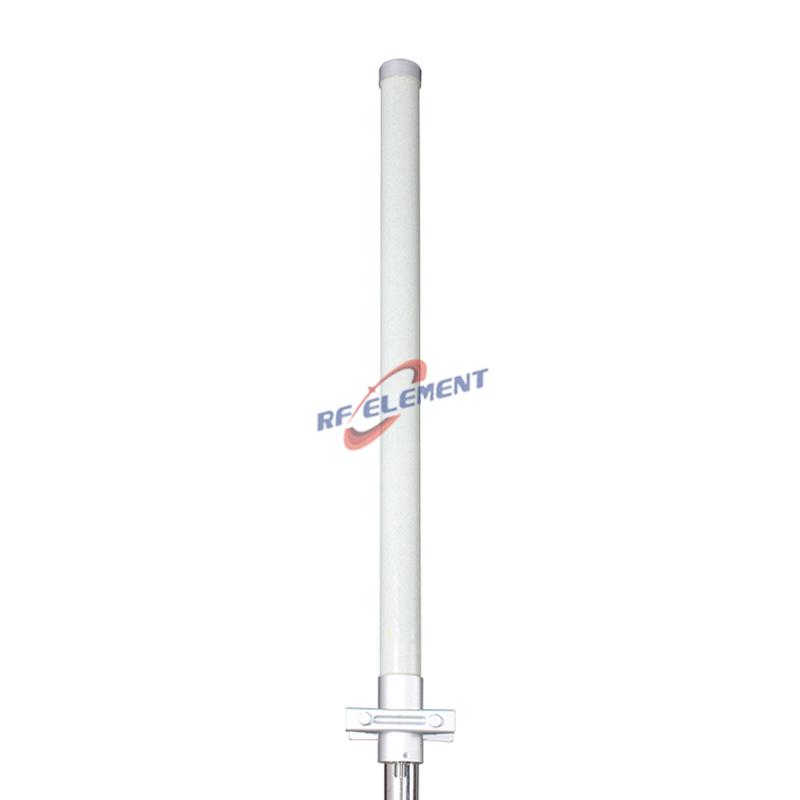
A dual-band omni with six SMA female pigtails, three for 2.4 GHz and three for 5 GHz, packaged in a 280 mm tall radome that is 132 mm across. Gain is 7.5 dBi at 2400-2500 MHz and 8 dBi at 5150-5850 MHz, with a 360 degree horizontal pattern and vertical beamwidths of 28 and 25 degrees. The unit weighs 1.0 kg and is designed to hang on a pole.
Three streams, six cables
A 3x3 access point needs three branches per band, which is why this antenna terminates in six SMA connectors rather than four. The physical installation is the part that catches people out: six pigtails leaving one radome need a cable tray or a loom, and the bend radius of a 3 mm coax is not as small as it looks. Plan the route before the pole is erected, not after.
The three branches per band are vertically polarised and spaced within the radome. Spacing inside a 132 mm diameter is small in wavelengths at 2.4 GHz, so the branches are partially correlated; the practical benefit of the third stream at 2.4 GHz is smaller than the stream count suggests, and most of the throughput gain from 3x3 is realised at 5 GHz where the spacing is a larger fraction of a wavelength.
A short radome means a wide vertical beam
At 280 mm the radome is much shorter than the 560 and 1250 mm units in the range, and that directly produces the widest vertical beam in the family: 28 degrees at 2.4 GHz and 25 degrees at 5 GHz. Compared with a 12 dBi unit at 7 degrees, this antenna covers the space close to the mounting point far better and reaches less far.
For a ceiling-level or eave-level installation serving a concourse, a yard or a small car park, that is the right shape. Mounted at 4 m with a 28 degree beam, coverage begins about 7 m from the mast and extends past 120 m, with no cone of silence under the antenna. Where the requirement is a long narrow ring at distance, a higher gain unit is the correct part.
| Frequency Range | 2400 – 2500 MHz | 5150 – 5850 MHz |
| Polarization | Vertical | |
| Gain(dBi) | 7.5dBi | 8dBi |
| Horizontal Beamwidth | 360° | |
| Vertical Beamwidth | 28° 25° | |
| Impedance | 50Ω | |
| VSWR | ≤ 2.0 | |
| Maximum Power | 50W | |
| Connector Type | 6 Port, SMA-Female 2.4GHz: 3*SMA-Female; 5.8GHz: 3*SMA-Female | |
| Antenna Dimension(mm) | Φ132*280 | |
| Net Weight | 1.0kg | |
| Operating Temperature | -55° to +60° C (-67° to +140° F) | |
| Radome Material | ABS | |
| Mounting Options | Hanged on pole | |
The VSWR of 2.0 across both bands
VSWR is listed as 2.0 for both bands, which corresponds to a return loss of about 9.5 dB. That is a wider tolerance than the 1.5 of the single-band units, and it reflects the difficulty of holding a match across two separated bands in one compact structure.
For a 50 W maximum rating and a typical access point output of 100 to 250 mW, a 2.0 VSWR is not a problem. It becomes relevant when the antenna is fed by a booster or a radio with limited protection, where reflected power is dissipated as heat in the output stage. If the radio datasheet specifies a maximum VSWR of 1.5, this antenna is outside that window at the band edges.
Hanging on a pole
The mounting option is described as hanging on a pole, which means the bracket clamps the radome body and the weight hangs below the clamp point. At 1.0 kg the load is modest, but the six cables add a downward pull that should be relieved with a drip loop and a cable tie above the connector row.
Keep the radome 200 mm clear of the pole surface at 2.4 GHz and 125 mm at 5 GHz. A 132 mm diameter radome is wide enough that a close pole produces a deep null on one side rather than a gentle ripple.
Ordering
Six SMA female connectors are standard, with radome colour and packing quantity confirmed at order. Samples in 3-5 days, production in 15-25 days.
For a 4x4 access point, the dual band 4x4 MIMO omni antenna provides four N-Type ports at 3.2 kg. Where a single feed is enough, the dual band 12 dBi omni antenna uses one N-Type port for both bands.
Send the access point model, the number of radio chains and the mounting height. The chain count decides the connector count, and that is the specification that cannot be changed on site.
FAQ — Dual Band WiFi Omni Antenna
What is the Dual Band WiFi Omni Antenna used for?
What frequency band does the Dual Band WiFi Omni Antenna cover?
What are the key specifications of the Dual Band WiFi Omni Antenna?
Can RF element customize the Dual Band WiFi Omni Antenna for my application?
What is the MOQ and lead time for the Dual Band WiFi Omni Antenna?
How do I get a quotation for the Dual Band WiFi Omni Antenna?