GSM Yagi Antenna | 824-960 MHz | 12dBi Gain
Specifications
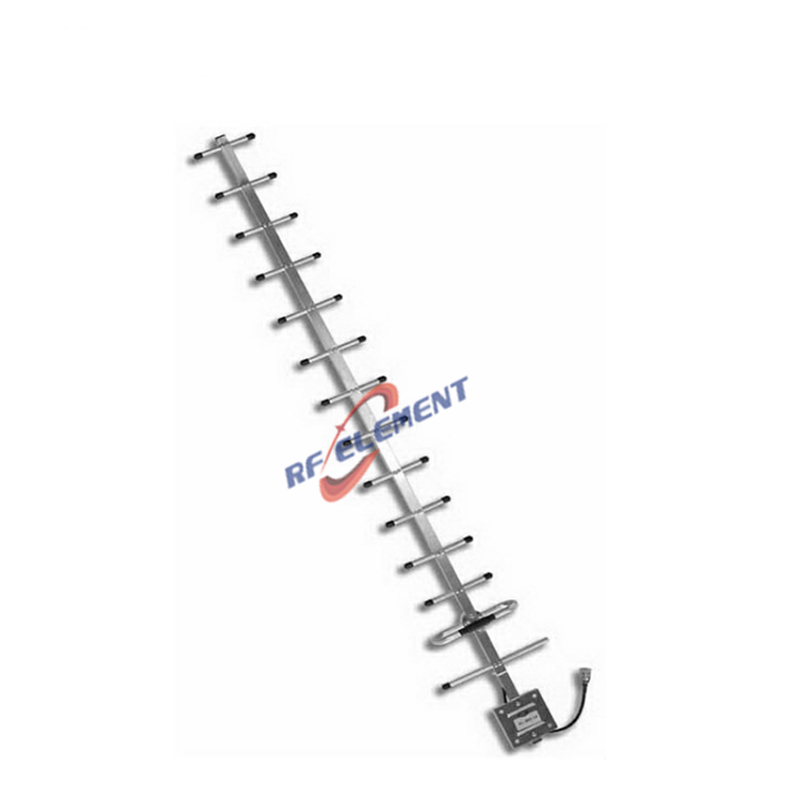
A 900 MHz Yagi with 12 dBi of gain on an 800 mm aluminium boom, 185 mm wide and 65 mm deep, weighing 0.6 kg. The horizontal beam is 55 degrees and the vertical beam 50 degrees, VSWR is at or below 1.5 across 824-960 MHz, and the single port is an N-Type male connector. It is the lightest Yagi in the 900 MHz family, intended for telemetry sites where the mounting structure is light and access is difficult.
The middle of the Yagi range
At 12 dBi this antenna sits between the 14 dBi long-boom unit and the 10 dBi UHF designs. The 2 dB difference against the 14 dBi version is the difference between a 55 degree beam and a 40 degree one, and that angular difference matters more than the decibels when the link is short and the mounting is not rigid.
For a link of 2 to 5 km, 12 dBi at both ends provides margin without demanding the aiming precision of a longer Yagi. For a link beyond 10 km, the extra 2 dB is worth having and the 14 dBi version is the better choice. Between those distances, either antenna works and the decision usually comes down to the mounting.
| Frequency Range | 824-960MHz | |
| Polarization | Vertical | |
| Gain(dBi) | 12 | |
| Horizontal Beamwidth | 55° | |
| Vertical Beamwidth | 50° | |
| Impedance | 50Ω | |
| VSWR | ≤ 1.5 | |
| Maximum Power | 50W | |
| Connector Type | 1 Port, N-Type Male | |
| Antenna Dimension(mm) | 800*185*65mm | |
| Net Weight | 0.6 kg | |
| Operating Temperature | -55° to +60° C (-67° to +140° F) | |
| Material | Aluminum | |
| Radome Color | White | |
| Mounting Options | Pole mounting | |
A 55 degree beam and real-world aiming
At 55 degrees horizontal, the beam covers about 104 m of width at 100 m and 521 m at 500 m. That tolerance means the antenna can be aimed with a compass bearing and a visual sighting rather than a spectrum analyser, which is significant on a remote SCADA site where the installer may not carry RF test equipment.
The 50 degree vertical beam also means the antenna does not need precise downtilt. On a link between two sites at different heights, a 50 degree vertical pattern keeps both ends inside the beam without mechanical adjustment.
0.6 kg on a light mast
At 0.6 kg, this is the lightest Yagi in the 900 MHz family. It can be mounted on a thin-wall pole, a timber post or a building parapet with a simple bracket, and one person can carry and install it without a second pair of hands. That is the practical reason it is often chosen for telemetry sites where access is difficult.
The 65 mm depth is mostly the balun housing at the rear of the boom. Keep the balun out of standing water by mounting the antenna with the connector pointing down, and seal the N-Type joint with self-amalgamating tape.
SCADA, LPWAN and cellular
The 824-960 MHz coverage includes the 850 MHz cellular band, the 900 MHz ISM band and the LPWAN channels inside it. For a SCADA or telemetry link, the antenna is usually aimed at a single master station, and the 55 degree beam is wide enough to tolerate a small alignment error without admitting much interference from the sides.
For a LoRa gateway that serves sensors in several directions, a Yagi is the wrong shape in any gain class. A sector antenna covering 90 degrees, or an omni, is the correct part, and the Yagi should be reserved for point-to-point links.
Ordering
N-Type male is standard, with packing quantity confirmed at order. Samples in 3-5 days, production in 15-25 days.
Where the link is longer and the boom can be supported, the 14 dBi 900 MHz GSM Yagi antenna adds 2 dB on a 1350 mm boom. Where the radio is 2x2 and the far end uses cross-polarised antennas, the 11 dBi 900 MHz MIMO Yagi antenna provides both polarisations in one assembly.
Send the link distance, the mounting surface and the radio connector. On a telemetry site the mounting surface usually decides the antenna more than the link budget does.
FAQ — GSM Yagi Antenna
What is the GSM Yagi Antenna used for?
What frequency band does the GSM Yagi Antenna cover?
What are the key specifications of the GSM Yagi Antenna?
Can RF element customize the GSM Yagi Antenna for my application?
What is the MOQ and lead time for the GSM Yagi Antenna?
How do I get a quotation for the GSM Yagi Antenna?