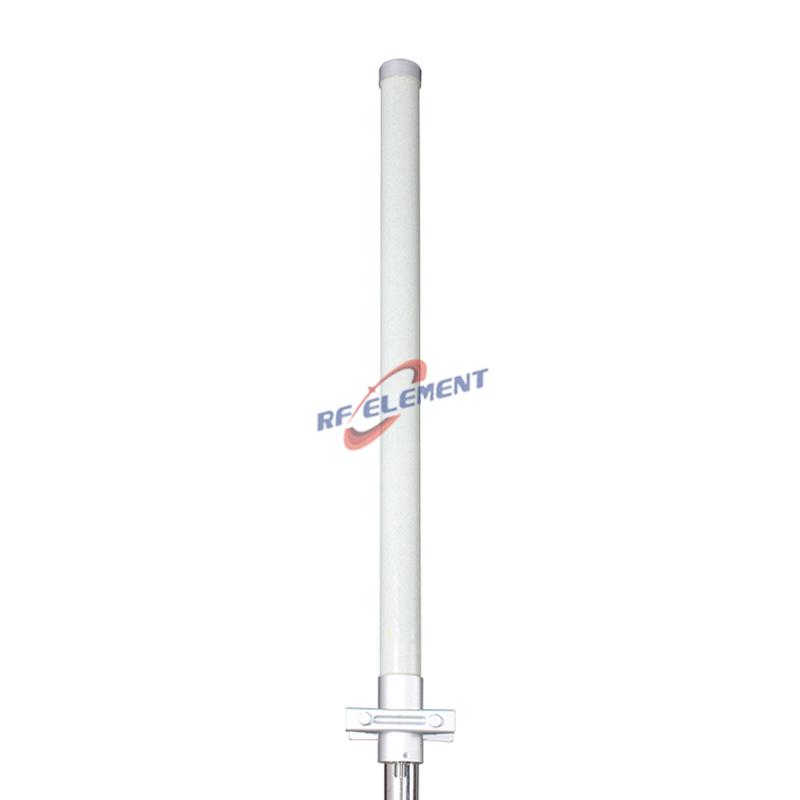
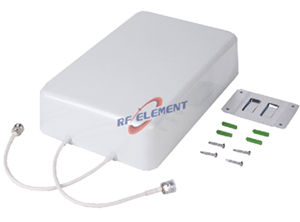
WiFi Booster Omni Antenna | 2.4GHz Omni Antenna | 5dBi
Specifications
A 300 mm fibreglass omni for 2.4 GHz with 5 dBi of gain and a 28 degree vertical beam, weighing 0.2 kg. The horizontal pattern is a full 360 degrees, VSWR is at or below 1.5 across 2400-2500 MHz, and the single output is an N-Type male connector on a grey radome 20 mm in diameter. It is intended for hotspots, boosters and small outdoor areas where the mounting point is a fascia board, a camera pole or the radio enclosure itself.
The case for a short, wide omni
Most antenna selection starts by maximising gain, which is the wrong instinct when the users are close to the mounting point. A 5 dBi omni with a 28 degree beam covers a small yard, a rooftop terrace, a marina pontoon or a single floor of a warehouse evenly, because the pattern does not need to be aimed and there is no cone of silence under the antenna.
Compared with an 8 dBi unit at 15 degrees, this antenna reaches roughly 40 percent less far but covers the near field completely. Where the cell radius requirement is under 80 m, the lower gain unit usually delivers a better average signal across the area and fewer complaints from users standing under the mast.
Geometry of a 28 degree beam
At 4 m mounting height, a 28 degree vertical beam intersects the ground about 7.5 m from the base and stays above the noise floor to roughly 90 m with a typical 20 dBm access point and a 5 dBi client. That footprint suits a hotspot in a public square or a hotel courtyard where the antenna is on a wall bracket or a short post.
At 8 m height the same beam starts covering the ground at about 15 m and extends to 130 m. The geometry scales predictably, which makes this antenna easy to specify: choose the mounting height for the inner radius and accept the outer radius that follows.
0.2 kg and a 20 mm radome
At 300 mm and 0.2 kg, the antenna can be fixed to a fascia board, a camera pole or a signpost with a single clamp. That is its main advantage over the longer units in the range: it does not need a structural bracket, a second clamp or a guy wire, and it can be installed by one person on a ladder without a mast survey.
The fibreglass radome is stiff enough that the antenna does not oscillate in wind, but the 20 mm diameter means the clamp should be a saddle type rather than a U-bolt, which will crush the tube at normal tightening torque.
| Frequency Range | 2400-2500MHz | |
| Polarization | Vertical | |
| Gain(dBi) | 5±1 | |
| Horizontal Beamwidth | 360° | |
| Vertical Beamwidth | 28° | |
| Impedance | 50Ω | |
| VSWR | ≤ 1.5 | |
| Maximum Power | 50W | |
| Connector Type | 1 Port, N-Type Male | |
| Antenna Dimension(mm) | Φ 20*300 | |
| Net Weight | 0.2 kg | |
| Operating Temperature | -55° to +60° C (-67° to +140° F) | |
| Radome Material | Fiberglass | |
| Radome Color | Grey | |
| Mounting Options | Pole mounting | |
The N-Type male output
An N-Type male connector screws directly onto a bulkhead or a short pigtail, which removes one joint from the weather path. On a booster or a small outdoor access point with an N-Type female port, the antenna can be mounted directly on the radio, eliminating the feeder entirely and with it roughly 1 to 2 dB of cable loss at 2.4 GHz.
Direct mounting is also the neatest solution for a hotspot on a pole: no cable, no drip loop, no connector to seal. The radio enclosure becomes the mounting point, and the antenna becomes part of it.
Ordering
The N-Type male connector is standard, with radome colour and packing quantity confirmed at order. Samples in 3-5 days, production in 15-25 days.
Where the site needs more reach, the 8 dBi 2.4 GHz omni antenna extends the radius at the cost of a narrower vertical beam. The full WiFi antenna range sets out the omni and sector options by band.
Tell us the mounting height, the area to be covered and the radio connector gender. For a 300 mm antenna the mounting point usually decides the model more than the radio does.
FAQ — WiFi Booster Omni Antenna
What is the WiFi Booster Omni Antenna used for?
What frequency band does the WiFi Booster Omni Antenna cover?
What are the key specifications of the WiFi Booster Omni Antenna?
Can RF element customize the WiFi Booster Omni Antenna for my application?
What is the MOQ and lead time for the WiFi Booster Omni Antenna?
How do I get a quotation for the WiFi Booster Omni Antenna?