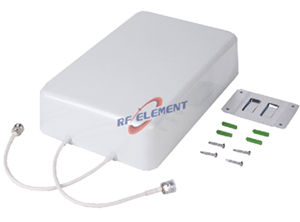
433MHz Panel Antenna | 428-438 MHz 8dBi
Specifications
An 8 dBi directional panel for 428-438 MHz on a 395 x 375 x 45 mm plate weighing 3.0 kg. The horizontal beam is 78 degrees and the vertical beam 65 degrees, VSWR is at or below 1.5 across the 10 MHz band, and the single port is an N-Type female connector rated at 50 W. It is intended for compounds and yards where the equipment is spread across an area rather than concentrated in one direction.
Three kilograms for eight decibels
At 433 MHz a 395 mm square plate is only about half a wavelength across, so the gain is limited by aperture rather than by the design. The 3.0 kg weight comes from the plate, the reflector and the mounting bracket needed to hold a structure that size in wind, not from any inefficiency in the antenna.
For comparison, an 18 dBi panel at 2.4 GHz uses a 305 mm plate and weighs 2.0 kg. The 433 MHz antenna produces 10 dB less gain from a larger plate: that is the physics of a longer wavelength, and it is why UHF directional antennas are physically large for modest gain.
Seventy-eight degrees is not a Yagi
A 78 degree horizontal beam covers about 160 m of width at 100 m and 800 m at 500 m. That is a broad directional pattern, closer to a sector than to a point-to-point link. The antenna is intended for a compound, a yard, a quarry or a section of pipeline where the equipment is spread across an area rather than concentrated in one direction.
Where the requirement is a link to a single distant point, a Yagi at 433 MHz would give more gain in the same wind area, but its boom would be over 2 m long and its beam would be 40 degrees or less. This panel is the practical compromise when the site has both near and far equipment in the same direction.
| Frequency Range | 428-438MHz | |
| Polarization | Vertical | |
| Gain(dBi) | 8 | |
| Horizontal Beamwidth | 78° | |
| Vertical Beamwidth | 65° | |
| Impedance | 50Ω | |
| VSWR | ≤ 1.5 | |
| Maximum Power | 50W | |
| Connector Type | 1 Port, N-Type Female | |
| Antenna Dimension(mm) | 395*375*45 | |
| Net Weight | 3.0 kg | |
| Operating Temperature | -55° to +60° C (-67° to +140° F) | |
| Radome Material | ABS | |
| Radome Color | White | |
| Mounting Options | Pole Mounting | |
Vertical beam and mounting height
The 65 degree vertical beam is almost as wide as the horizontal, which makes the antenna forgiving of mounting height. At 8 m the pattern reaches the ground about 7 m in front of the plate and continues to the radio horizon on a clear path. That is the right shape for a wall-mounted panel overlooking a yard.
Mounted on a pole, the same antenna should be aimed with a slight downtilt so that the near edge of coverage lands where the equipment is, rather than passing over it. A 5 degree tilt moves the near edge from about 7 m to about 12 m at the same height.
Wind load and fixings
At 3.0 kg and 395 mm square, the panel presents a significant sail area. Clamp the mounting plate to a pole of at least 50 mm diameter and use both fixing points, not one. On a wall, use anchors rated for four times the antenna weight plus the cable load, because the moment arm at 45 mm depth plus the bracket offset is larger than the weight alone suggests.
Keep the plate at least 500 mm from any metal surface in front of it. At 433 MHz that is about three quarters of a wavelength, and a metal roof or a mast closer than that will distort the 78 degree pattern noticeably.
Ordering
N-Type female is standard, with radome colour and packing quantity confirmed at order. Samples in 3-5 days, production in 15-25 days.
Where the coverage has to be a full circle, the 5 dBi 433 MHz omni antenna uses a 1200 mm radome at 2.5 kg. Where the site is at 450-470 MHz rather than 433 MHz, the UHF MIMO panel antenna provides 9 dBi with two polarisations.
Send the area to be covered, the mounting height and the number of radio directions. A 78 degree beam covers a wide area from one position, and that is usually the deciding factor at this frequency.
FAQ — 433MHz Panel Antenna
What is the 433MHz Panel Antenna used for?
What frequency band does the 433MHz Panel Antenna cover?
What are the key specifications of the 433MHz Panel Antenna?
Can RF element customize the 433MHz Panel Antenna for my application?
What is the MOQ and lead time for the 433MHz Panel Antenna?
How do I get a quotation for the 433MHz Panel Antenna?