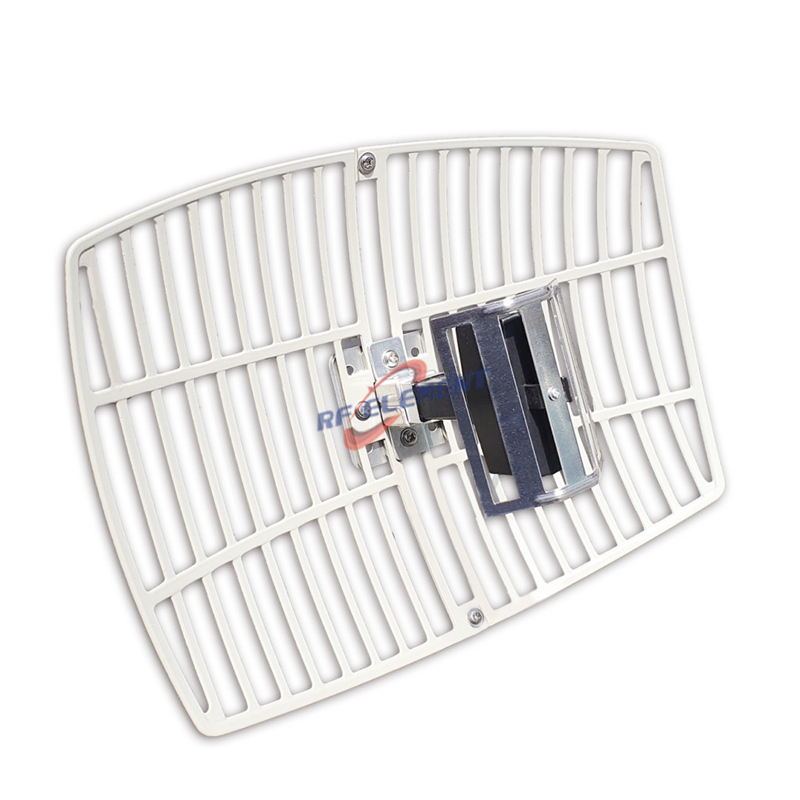
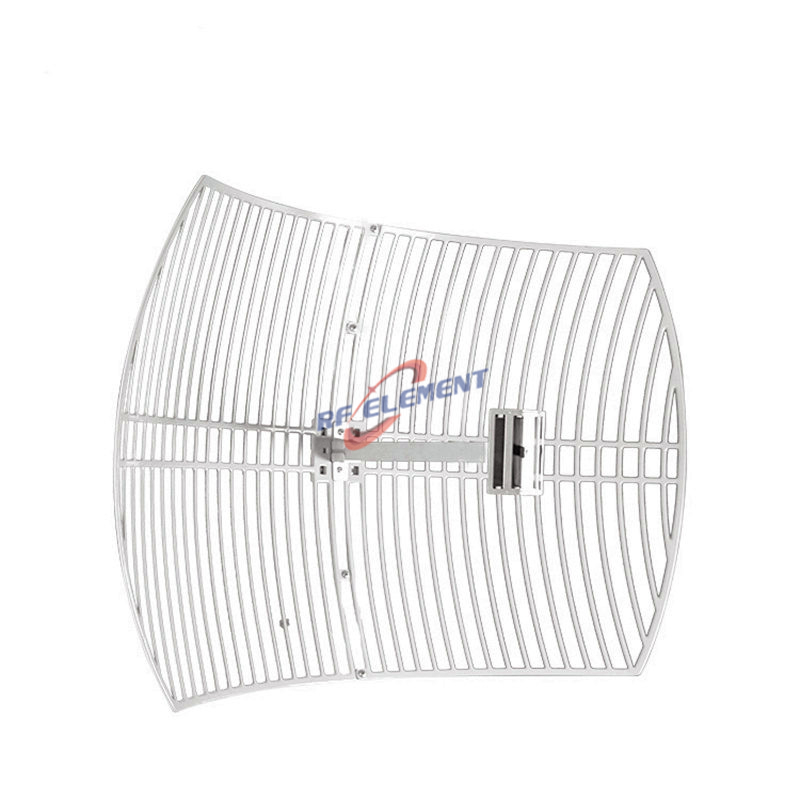
5GHz MIMO Parabolic Dish Antenna | 30dBi Dual Polarized 60cm Parabolic Dish Antenna
Specifications
A 600 mm parabolic dish for 4900 to 6000 MHz with two N-Type female ports, one per polarization, delivering 28 to 30 dBi depending on the sub band. The beam is 5 degrees in both planes, front to back ratio is at least 32 dB, cross polarization isolation is at least 30 dB, and each port is rated at 100 W. The reflector is aluminium with a grey or white finish, the assembly weighs 7 kg, and it mounts on a pole with the bracket supplied.
A 600 mm reflector at 5 GHz
A 600 mm circle is 0.283 square metres of aperture. At 5800 MHz the free space wavelength is 51.7 mm, so the dish is 11.6 wavelengths across. That electrical size is what a 30 dBi figure requires, and it is also why the same reflector would give only 21 dBi at 2450 MHz.
There is a useful cross check on any dish datasheet. The product of the two half power beamwidths, divided into 41253, gives the gain in dBi for a perfect aperture. Here 5 by 5 degrees gives 1650, or 32.2 dBi. A quoted 30 dBi against that number means the figure is the realised gain after spillover, blockage and surface tolerance, not a calculated optimum. When a sheet quotes 33 dBi with a 5 degree beam, the two numbers disagree and one of them is being rounded for the brochure.
Two polarizations inside 5 degrees
Two ports on a narrow beam dish are usually sold as 2x2 MIMO, and it is worth being precise about what that means. Spatial multiplexing needs angular spread at the receiver, and a 5 degree beam at 5 km covers about 440 m, so the two streams do not arrive from widely separated directions. The second stream comes from the orthogonal polarization rather than from a second path.
That is why the cross polarization isolation figure matters more than the port count. At 30 dB, the two channels are separated well enough to run independent data streams and to keep the branch correlation low. Below about 20 dB the second stream carries mostly the same information as the first and the radio falls back to a single stream, which is a common reason a 2x2 link performs like a 1x1 link after installation.
| Frequency Range | 4900-6000MHz | |||||
| Frequency Sub-Range(Mhz) | 4900-5150 | 5150-5850 | 5850-6000 | |||
| Polarization | Horizontal+Vertical | |||||
| Gain(dBi) | 28±0.5 | 29±0.5 | 30±0.5 | |||
| Horizontal Beam width | 5±0.5° | |||||
| Vertical Beam width | 5±0.5° | |||||
| Impedance | 50Ω | |||||
| VSWR | ≤ 1.8 | ≤ 1.5 | ≤2.0 | |||
| Front-to-Back Ratio | ≥32dB | |||||
| Cross-Pol Isolation | ≥30dB | |||||
| Maximum Power | 100W | |||||
| Connector Type | 2 Port, N-Type Female | |||||
| Antenna Size | Φ600mm | |||||
| Weight | 7kg | |||||
| Operating Temperature | -55° to +60° C (-67° to +140° F) | |||||
| Material | Aluminum | |||||
| Color | Gray or White | |||||
| Mounting Options | Hange on pole | |||||
The three sub bands and their match
The table splits 4900 to 6000 MHz into three ranges and gives a different VSWR to each. The middle range, 5150 to 5850 MHz, is the best matched at 1.5, which is a return loss of 14 dB and a mismatch loss of 0.18 dB. The lower range at 4.9 to 5.15 GHz is 1.8, and the top range at 5.85 to 6.0 GHz is 2.0, a return loss of 9.5 dB.
The pattern tells a planner where the feed was optimised. If the link runs in the 5.15 to 5.85 GHz WiFi bands, the dish is at its best. If it runs at 4.9 GHz for public safety or at the very top of the band, the match is still usable but the site should be swept rather than assumed. A VSWR of 2.0 is not a fault, but it is the point where a marginal feeder run starts to show.
Front to back ratio and co-siting
32 dB of front to back ratio means that a signal arriving from behind the dish is attenuated by 32 dB relative to the same signal from the front. On a shared mast with another 5 GHz link pointing the opposite way, that figure is the difference between co-siting working and one link desensing the other.
The number also sets the minimum angular separation on a rooftop. Two dishes on the same roof need to be more than 90 degrees apart in azimuth if their back lobes are to fall below the noise floor of the other link. Below that, move one of them to a different edge of the roof or change its polarization.
Ordering
Two N-Type female ports are standard, the radome colour is grey or white, and the mount suits a 50 to 90 mm pole. Samples in 3-5 days, production in 15-25 days.
For a path longer than 20 km, the 90 cm dish version adds 4 dB in a 4 by 3 degree beam. For the selection logic behind the two reflectors, the 5 GHz MIMO dish antenna guide sets out the trade between gain and wind load. The full range of single band options sits in the 5 GHz WiFi antenna range.
Send the path length, the band and the mast arrangement. The length decides between the two reflectors, the band decides which sub band match applies, and the mast arrangement decides whether the front to back ratio is being used as a filter or just as a specification.
FAQ — 5GHz MIMO Parabolic Dish Antenna
What is the 5GHz MIMO Parabolic Dish Antenna used for?
What frequency band does the 5GHz MIMO Parabolic Dish Antenna cover?
What are the key specifications of the 5GHz MIMO Parabolic Dish Antenna?
Can RF element customize the 5GHz MIMO Parabolic Dish Antenna for my application?
What is the MOQ and lead time for the 5GHz MIMO Parabolic Dish Antenna?
How do I get a quotation for the 5GHz MIMO Parabolic Dish Antenna?