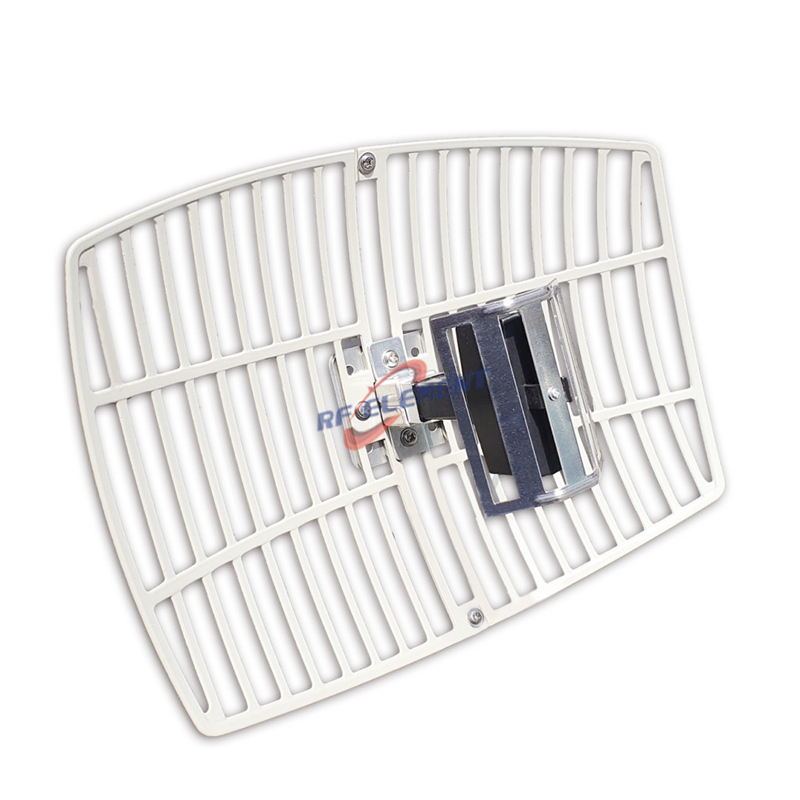
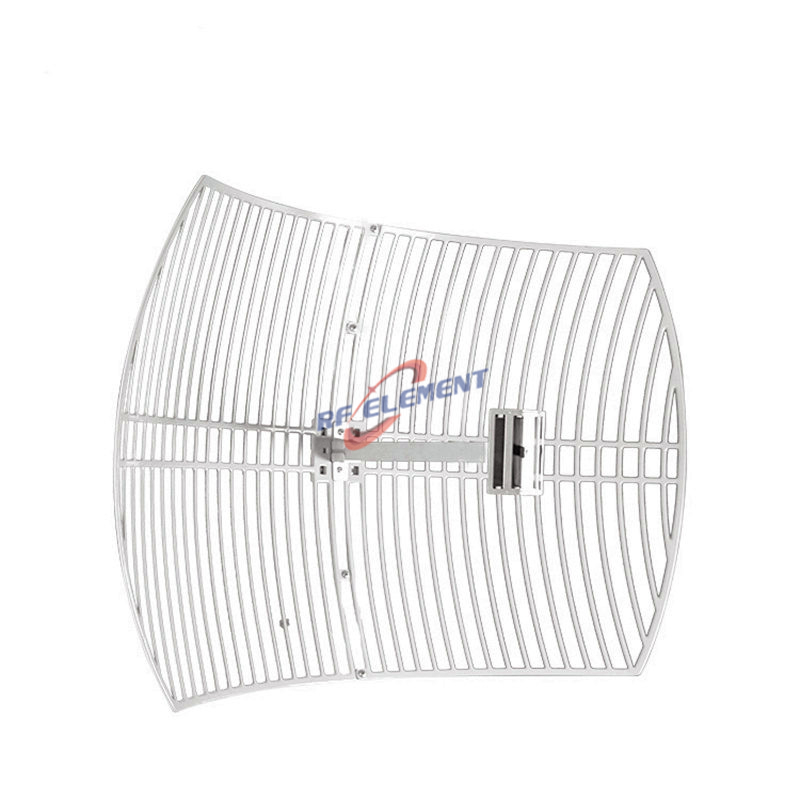
Dual Band Grid Antenna For 2.4GHz and 5GHz
- Supported Dual Band Frequencies: 2400-2500MHz & 5150-5850MHz
- Gain: >15dBi (with a grid size of 30x40cm)
- VSWR: <1.8
- Polarization: Vertical
Specifications
This dual band grid antenna covers 2400-2500MHz and 5150-5850MHz through a single feed point, delivering more than 15dBi from a 30 x 40cm grid for WiFi bridging where one radio has to work on both bands. It uses a dual-band circuit board inside a standard radome envelope, so an integrator can add 5GHz capability without redesigning the housing or re-tooling the mount.
One feed point, two bands
Most grid antennas are single-band, which forces a bridge installation to choose between 2.4GHz for range and 5GHz for throughput, or to fit two antennas and two feeders. Combining both bands behind one feed point removes that choice. The radio sees a single antenna port, the tower sees a single mount, and the installer aligns one dish instead of two.
The electrical difficulty is that a grid designed for 2.4GHz has a mesh spacing set by the longer wavelength, while 5.8GHz wants a finer mesh and a different focal relationship. The dual-band board and the aluminum reflector were developed together so that both bands see an efficient aperture rather than one band working and the other merely resonating.
Grid reflector design
A grid reflector is chosen over a solid dish for a reason: it delivers most of the gain of a solid reflector at a fraction of the wind load and weight, and it costs less to ship and to mount. At 2.4GHz and 5.8GHz the mesh is electrically small enough that the surface behaves as a continuous reflector in the forward direction while letting wind and rain pass through.
To reach the 15dBi target we designed a new aluminum reflector profile rather than reusing the single-band geometry, then iterated the structure until VSWR stayed below 1.8 across both bands. The board was kept within the dimensions of the existing radome so that the tooling and the mounting interface carried over unchanged, which is where most of the programme cost saving came from.
Specifications
| Parameter | Value |
|---|---|
| Frequency range | 2400-2500MHz and 5150-5850MHz |
| Gain | >15dBi with 30 x 40cm grid |
| VSWR | <1.8 |
| Polarization | Vertical |
| Feed | Single feed point, dual band |
| Reflector | Aluminum grid |
Bridge deployment notes
Align for the 5.8GHz link if both bands are used, because the narrower 5GHz beam is the harder of the two to peak and the 2.4GHz pattern will follow. Keep the first Fresnel zone clear: a 15dBi grid at 5.8GHz still needs a clean path, and a rooftop edge or a tree line inside the zone will cost more throughput than the antenna gain adds. Use vertical polarization on both ends unless the site has a specific reason to cross-polarize, and keep feeder runs short at 5.8GHz where cable loss is roughly double the 2.4GHz figure for the same cable.
Where the link passes through a region with heavy rain, budget additional fade margin on the 5.8GHz channel and consider using 2.4GHz as the primary path with 5GHz for capacity. The dual-band feed makes that switch a radio setting rather than a hardware change.
Customization and ordering
Grid size, gain, band pairing and connector type can be adapted, and the radome interface can be matched to an existing enclosure if the project already has tooling. A single-band 5GHz version of the same mechanical design is available where the 2.4GHz band is not required.
Send the link distance, band plan, required gain and connector type to sales@rfelement.com. Samples are typically ready in 3-5 working days and mass production in 15-25 working days.
FAQ — Dual Band Grid Antenna For 2.4GHz and 5GHz
What is the Dual Band Grid Antenna For 2.4GHz and 5GHz used for?
What frequency band does the Dual Band Grid Antenna For 2.4GHz and 5GHz cover?
What are the key specifications of the Dual Band Grid Antenna For 2.4GHz and 5GHz?
Can RF element customize the Dual Band Grid Antenna For 2.4GHz and 5GHz for my application?
What is the MOQ and lead time for the Dual Band Grid Antenna For 2.4GHz and 5GHz?
How do I get a quotation for the Dual Band Grid Antenna For 2.4GHz and 5GHz?