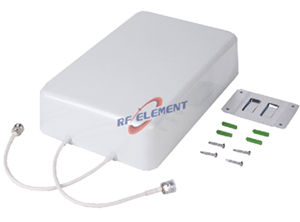
Indoor 5G MIMO Panel Antenna | 698-4200MHz Wall-Mount Booster
Specifications
A two-port indoor panel designed to be fixed to a wall rather than to a ceiling. Coverage spans 698-4200 MHz in five sub-ranges with 6 dBi at the bottom edge, 8 dBi at 1710-2700 MHz and 5 dBi at 3800-4200 MHz. The radiating face measures 310 x 230 mm and projects 73 mm, and the unit weighs 1.0 kg before the cable load is added.
When a wall beats a ceiling
A ceiling antenna radiates downward in a cone, which is the right pattern over a floor plate of even height and open layout. A wall-mounted panel radiates sideways, which is the right pattern in three situations that ceiling units handle badly: rooms with a ceiling above about 5 m, stairwells and lift lobbies where the coverage axis is vertical rather than horizontal, and long corridors where the ceiling position would be far from the occupied zone.
In each case the panel is mounted at 2.2 to 2.6 m facing along the space. The pattern reaches the far end with less energy wasted on the near field, and the unit stays within arm reach for maintenance without a platform.
The narrow vertical beam at 806-960 MHz
The vertical beamwidth is 30 degrees at 806-960 MHz, the narrowest figure in the table. That is a deliberate outcome of the aperture at that frequency, and it has a practical consequence: the panel covers a long, thin corridor well and a wide room badly at 900 MHz. Where the 900 MHz band is the primary service, mount the panel at one end of the space and aim it down the length.
At 1710-2700 MHz the vertical beam opens to 35 degrees and at the top band to 40 degrees, so the same unit serves a wider area in the higher bands. This is the pattern behaviour that makes a single wall panel viable for a multi-band small cell or a DAS remote.
| Frequency Range | 698-4200MHz | ||||
| Frequency Sub-Range(Mhz) | 698-806 | 806-960 | 1710-2700 | 3300-3800 | 3800-4200 |
| Polarization | ±45° | ||||
| Gain(dBi) | 6.0±0.5 | 8±0.5 | 7±0.5 | 6±0.5 | 5±0.5 |
| Horizontal Beam width | 80±10° | 70±10° | 70±10° | 60±10° | 60±10° |
| Vertical Beam width | 50±10° | 30±10° | 35±10° | 40±10° | 40±10° |
| Impedance | 50Ω | ||||
| VSWR | ≤ 1.8 | ≤ 1.6 | ≤1.6 | ≤1.8 | ≤2.0 |
| 3rd Order for 2×20 W Carriers | -153 dBc | ||||
| Front-to-Back Ratio | ≥ 10dB | ≥ 10dB | ≥ 15dB | ≥ 15dB | ≥ 15dB |
| Isolation | ≥ 20dB | ≥ 20dB | ≥ 25dB | ≥ 25dB | ≥ 25dB |
| Maximum Power | 50 W | ||||
| Connector Type | 2 Port, 4.3-10 Female or N-Type Female | ||||
| Length | 310 mm | ||||
| Width | 230 mm | ||||
| Depth | 73 mm | ||||
| Net Weight | 1.0 kg | ||||
| Operating Temperature | -55° to +60° C (-67° to +140° F) | ||||
| Radome Material | Plastic ABS | ||||
| Radome Color | White | ||||
| Mounting Options | fasteners and screws included for wall mounting | ||||
Isolation and stream count
Isolation is 20 dB in the two lower sub-ranges and 25 dB at 3300-4200 MHz. Twenty decibels is workable for a 2x2 branch in a low multipath environment such as a corridor, where the two polarisations stay reasonably independent. It is not enough to run the two ports as separate operators without additional filtering.
If the remote unit is 4x4, this panel is not the right part regardless of isolation: two ports can only carry two streams, and the radio will fall back to 2x2. The four-port plate in the range is the correct choice for a 4x4 remote, at the cost of 2.5 kg and a 450 mm plate.
Mounting detail that changes performance
Seventy-three millimetres of projection is enough to clear most wall furniture but not enough to clear a structural column or a riser cupboard door. Keep the radiating face at least 200 mm from any metal surface, and avoid mounting the panel so that it fires across a metal door frame within the first metre; the frame acts as a knife edge and produces a shadow that no amount of radio power will fill.
On plasterboard, use the supplied fasteners into a stud or a proprietary anchor rated for four times the unit weight. The mass is small, but the moment arm at 73 mm of projection is larger than a flat ceiling unit, and a single anchor in hollow board will creep over time.
Ordering
Two 4.3-10 female or N-Type female ports are standard, with radome colour and packing quantity confirmed at order. Samples in 3-5 days, production in 15-25 days.
Where the ceiling is the correct mounting surface, the 2-port 5G DAS ceiling antenna covers 698-3800 MHz in a 215 mm disc. For the pole-mounted outdoor equivalent of this panel, the outdoor 2x2 MIMO panel uses the same plate with pole clamps.
Send the ceiling height, the coverage axis and the remote unit port count. Those three answers decide between a wall panel, a ceiling unit and a four-port plate.
FAQ — Indoor 5G MIMO Panel Antenna
What is the Indoor 5G MIMO Panel Antenna used for?
What frequency band does the Indoor 5G MIMO Panel Antenna cover?
What are the key specifications of the Indoor 5G MIMO Panel Antenna?
Can RF element customize the Indoor 5G MIMO Panel Antenna for my application?
What is the MOQ and lead time for the Indoor 5G MIMO Panel Antenna?
How do I get a quotation for the Indoor 5G MIMO Panel Antenna?