LoRa Omni Antenna | 868MHz and 915MHz Bands
Specifications
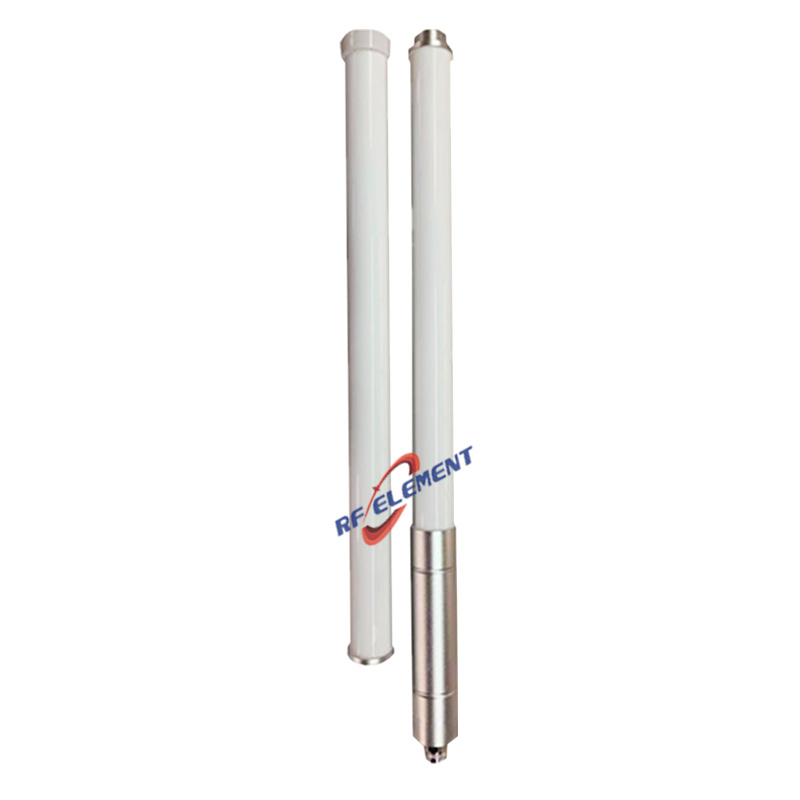
A 5 dBi LoRa omni covering both the 860-870 MHz and 902-928 MHz bands in a 600 mm fibreglass radome 22 mm in diameter, weighing 1.0 kg. The horizontal pattern is a full 360 degrees and the vertical beam is 35 degrees, VSWR is at or below 1.5, and the single port is available as N-Type or SMA. It is intended for gateways that have to work in both the European and the North American LoRa bands.
One antenna for two regional bands
LoRa deployments use different sub-bands in different regions: 860-870 MHz in Europe and much of Asia, and 902-928 MHz in North America. This antenna covers both, so a single part number can be stocked for projects that span regions and a gateway can be moved between them without changing hardware.
The two bands are separated by about 40 MHz, which is a small fraction of the centre frequency, so a single broadband structure can serve both without the gain penalty that a full dual-band design would carry. The 5 dBi figure applies across the whole range rather than peaking in one band.
Detachable two-part construction
The radome is supplied in two sections that join at a connector in the middle. That construction reduces the shipping length from 600 mm to about 350 mm, which matters for air freight and for carrying antennas to a site where access is on foot.
The joint is also a potential failure point. Assemble it with the sealing ring provided, tighten by hand rather than with a tool, and check that the joint is above the mounting bracket so that water runs away from it. A loose joint shows up as a VSWR rise that is easy to mistake for a radio fault.
| Frequency Range | 860-870MHz/902-928MHz | |
| Polarization | Vertical | |
| Gain(dBi) | 5±0.5 | |
| Horizontal Beamwidth | 360° | |
| Vertical Beamwidth | 35±2° | |
| Impedance | 50Ω | |
| VSWR | ≤ 1.5 | |
| Maximum Power | 50W | |
| Connector Type | 1 Port, N-Type or SMA-Type | |
| Antenna Dimension(mm) | Φ 22*600 | |
| Net Weight | 1.0 kg | |
| Operating Temperature | -55° to +60° C (-67° to +140° F) | |
| Radome Material | Fiberglass | |
| Radome Color | White or Gray | |
| Mounting Options | Pole Mounting, 2 parts for detachable installation | |
A 35 degree beam at 5 dBi
At 5 dBi the vertical beam is 35 degrees, the widest in the detachable LoRa range. Mounted at 10 m, coverage begins about 19 m from the base and extends to roughly 800 m with a typical gateway and a 2 dBi sensor antenna. That footprint suits a gateway on a building roof serving a neighbourhood or an industrial estate.
For a gateway on a tall mast serving sensors at distance, the 8 dBi version with its 20 degree beam is the better fit. For a gateway on a low building where the sensors are close, this antenna covers the near field better.
Material and mounting
The fibreglass radome is white or grey and UV stable. At 860 to 928 MHz the wall thickness is a small fraction of a wavelength, so the radome has little effect on the pattern, but fibreglass keeps its shape better than a thin ABS tube over years of sun exposure.
At 1.0 kg the antenna mounts on a 30 mm pole with a single clamp. Keep 200 mm clearance from a metal mast; at 900 MHz a mast inside a quarter wavelength creates a null that appears as a dead sector in the network.
Ordering
Connector type, radome colour and packing quantity are confirmed at order. Samples in 3-5 days, production in 15-25 days.
Where the gateway is high and the sensors are at distance, the 8 dBi LoRa omni antenna uses a 1200 mm radome with a 20 degree beam. Where the application is a directional LPWAN link rather than a gateway, the 11 dBi IoT panel antenna covers 900-930 MHz with a 55 degree beam.
Send the region, the gateway height and the sensor spread. The region decides the band and the height decides whether 5 dBi or 8 dBi is the better match.
FAQ — LoRa Omni Antenna
What is the LoRa Omni Antenna used for?
What frequency band does the LoRa Omni Antenna cover?
What are the key specifications of the LoRa Omni Antenna?
Can RF element customize the LoRa Omni Antenna for my application?
What is the MOQ and lead time for the LoRa Omni Antenna?
How do I get a quotation for the LoRa Omni Antenna?