2.4GHz WiFi Yagi Antenna | High Gain Yagi Antenna with Radome
Specifications
A 2.4 GHz Yagi with 15 dBi of gain inside a 75 mm radome, 505 mm long and 1.5 kg in weight. The horizontal beam is 33 degrees and the vertical beam 30 degrees, VSWR is at or below 1.5 across 2400-2500 MHz, and the single output is an N-Type male connector. Maximum power is 50 W and the radome is white ABS.
Why a Yagi instead of a panel
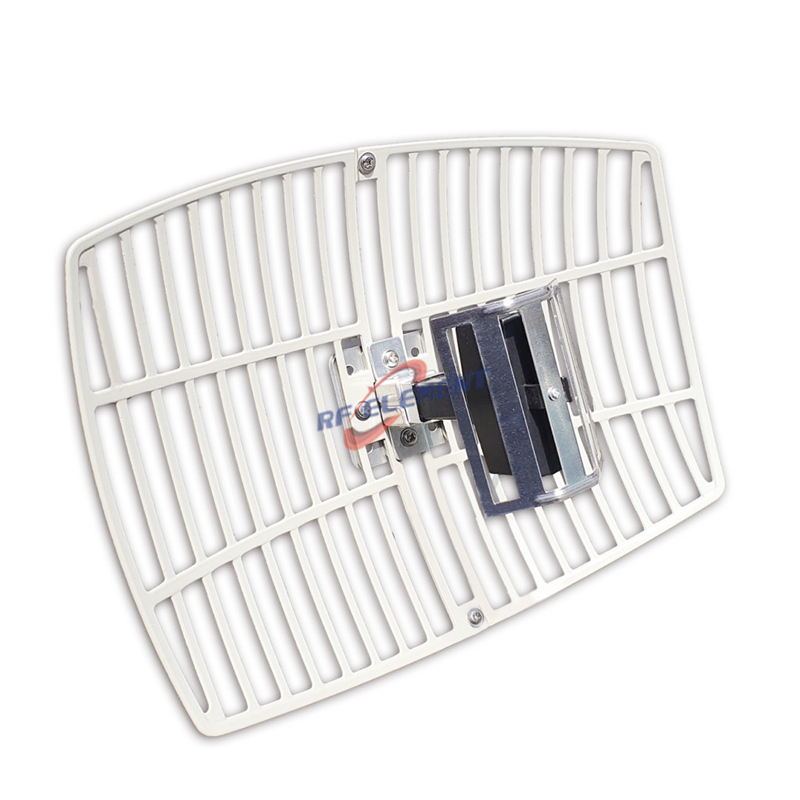
At the same gain, a Yagi is longer and narrower than a flat panel. The 15 dBi panel in this range measures 239 x 190 mm and produces a 35 degree beam; this Yagi measures 505 mm long and produces 33 degrees. The difference is mostly physical: the Yagi puts its radiating elements along a boom, so it can be mounted on a slim pole where a square plate would catch the wind.
The Yagi also has a different side lobe structure. A well-designed Yagi has lower side lobes than a panel of the same gain, which is useful when the antenna is aimed along a street with interference arriving from the sides. The trade is that the Yagi is a narrower band structure: it works across 100 MHz at 2.4 GHz, while a panel covers the same band with more margin.
The radome is doing real work
A bare Yagi has thin elements and a balun exposed to the weather. This version encloses the whole structure in a 75 mm ABS radome, which protects the elements from rain, salt and bird damage and keeps the impedance stable when the antenna is wet. On a coastal site that difference matters more than a fraction of a decibel of gain.
The radome also fixes the element spacing, so the pattern does not shift when the antenna is handled during installation. That is a practical advantage on a site where the same antenna is installed many times by different crews.
| Frequency Range | 2400-2500MHz | |
| Polarization | Vertical | |
| Gain(dBi) | 15 | |
| Horizontal Beamwidth | 33° | |
| Vertical Beamwidth | 30° | |
| Impedance | 50Ω | |
| VSWR | ≤ 1.5 | |
| Maximum Power | 50W | |
| Connector Type | 1Port, N-Type Male | |
| Antenna Dimension(mm) | Φ75*505 | |
| Net Weight | 1.5 kg | |
| Operating Temperature | -55° to +60° C (-67° to +140° F) | |
| Radome Material | ABS | |
| Radome Color | White | |
| Mounting Options | Pole mounting | |
Aiming and front-to-back
At 33 degrees horizontal, the beam covers about 59 m of width at 100 m and 296 m at 500 m. The front-to-back ratio of a Yagi is typically better than a panel, which means less energy is radiated behind the antenna and less interference is received from that direction. On a mast with two links facing opposite directions, that matters.
The rear of the antenna should still be kept at least 300 mm from a metal surface. A Yagi with a reflector close behind it behaves like a different antenna, and the match at the band edges will move.
Mounting and wind
At 1.5 kg and 505 mm long, the antenna mounts on a pole of 30 mm or more with the bracket supplied. The long boom presents a wind moment that a single clamp at the centre will not resist, so clamp near the rear of the boom and check that the antenna cannot rotate about the pole in gusty conditions. A rotating Yagi is a common cause of intermittent links that are hard to diagnose remotely.
Seal the N-Type male connector with self-amalgamating tape and leave a drip loop. On a Yagi the connector sits at the rear of the boom, which is often the lowest point of the assembly and therefore the place where water collects.
Ordering
N-Type male is standard, with radome colour and packing quantity confirmed at order. Samples in 3-5 days, production in 15-25 days.
Where the installation needs a wider beam and a shorter housing, the 14 dBi 2.4 GHz panel antenna is 239 mm square with a 35 degree beam. For multi-sector coverage rather than a single direction, the 90 degree 2.4 GHz MIMO sector antenna covers a wide azimuth with two polarisations.
Send the link direction, the mounting height and whether the site is coastal. The last answer decides whether the radome version is worth specifying over a bare Yagi.
FAQ — 2.4GHz WiFi Yagi Antenna
What is the 2.4GHz WiFi Yagi Antenna used for?
What frequency band does the 2.4GHz WiFi Yagi Antenna cover?
What are the key specifications of the 2.4GHz WiFi Yagi Antenna?
Can RF element customize the 2.4GHz WiFi Yagi Antenna for my application?
What is the MOQ and lead time for the 2.4GHz WiFi Yagi Antenna?
How do I get a quotation for the 2.4GHz WiFi Yagi Antenna?