UHF Yagi Antenna | 450-470MHz | 10dBi
Specifications
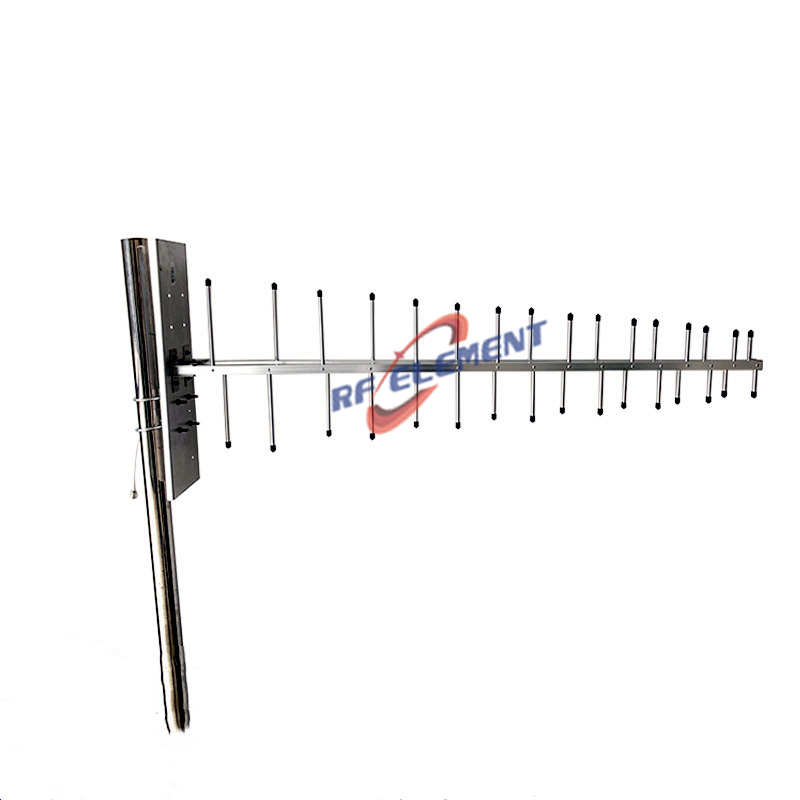
A UHF Yagi for the 450-470 MHz band with 10 dBi of gain, an 815 x 370 x 80 mm aluminium frame and a weight of 0.8 kg. The horizontal beam is 65 degrees and the vertical beam 60 degrees, VSWR is at or below 1.5 across the 20 MHz band, and the single port is an N-Type male connector rated at 50 W. The design is cut for a 20 MHz band, so the match holds across the full range rather than only at the centre.
Twenty megahertz is a narrow design band
The 450-470 MHz band is only 4.4 percent wide, which allows a Yagi to be cut precisely for it and to hold a VSWR of 1.5 or better across the whole range. A wider design, such as the 470-860 MHz log periodic, cannot match that figure because the element lengths have to compromise across 390 MHz.
The consequence is that this antenna should not be used outside its band. On 470-520 MHz the match degrades quickly and the pattern shifts upward in frequency, and on 400-450 MHz the antenna behaves like a shorter, lower gain structure. If the site uses several UHF bands, a log periodic is the correct part and this Yagi is not.
A 65 degree beam at 10 dBi
Ten decibels with a 65 degree horizontal beam is a modest gain for a Yagi, and that is deliberate. At 450 MHz the wavelength is 660 mm, so an 815 mm boom holds only a small number of directors; the gain is limited by the physics of the band rather than by the design. A 10 dBi Yagi at 450 MHz is roughly the same physical size as a 14 dBi Yagi at 900 MHz.
The wide beam suits a base station that serves handheld or mobile radios across a yard, a depot or a section of road. It is not a point-to-point antenna in the narrow sense: at 65 degrees, the beam covers 127 m of width at 100 m, which is a sector rather than a pencil beam.
| Frequency Range | 450-470MHz | |
| Polarization | Vertical | |
| Gain(dBi) | 10 | |
| Horizontal Beamwidth | 65° | |
| Vertical Beamwidth | 60° | |
| Impedance | 50Ω | |
| VSWR | ≤ 1.5 | |
| Maximum Power | 50W | |
| Connector Type | 1 Port, N-Type Male | |
| Antenna Dimension(mm) | 815*370*80mm | |
| Net Weight | 0.8 kg | |
| Operating Temperature | -55° to +60° C (-67° to +140° F) | |
| Material | Aluminum | |
| Radome Color | White | |
| Mounting Options | Pole mounting | |
Business band and public safety use
The 450-470 MHz range covers the UHF business band, GMRS and FRS two-way services and a number of public safety allocations depending on the country. In those applications the antenna is usually mounted on a building or a mast and aimed along the area to be covered, with the radio at the base.
Because the band is used by licensed and unlicensed services together, the front-to-back behaviour of a Yagi is useful: less energy is radiated behind the antenna, which reduces interference into neighbouring premises and improves the isolation from a co-sited transmitter on the same band.
Mounting an 815 mm boom at UHF
At 0.8 kg the antenna is easy to handle, but the 370 mm element span is a wind area that a small bracket will not hold in a gale. Clamp the boom at two points and check that the elements cannot rotate about the boom. At 450 MHz the elements are long and flexible, and a bent director changes the pattern more than the same deformation would at 900 MHz.
Keep the antenna at least 500 mm from any metal surface. At this wavelength, a mast or a metal roof inside the near field will distort the pattern significantly, and the effect is larger than at higher frequencies because the obstacle is a comparable fraction of a wavelength.
Ordering
N-Type male is standard, with packing quantity confirmed at order. Samples in 3-5 days, production in 15-25 days.
Where the site has to cover 470-860 MHz as well as the 450-470 MHz band, the UHF log periodic antenna covers the wider range at the same 10 dBi. For a directional antenna at 900 MHz rather than 450 MHz, the 14 dBi 900 MHz GSM Yagi antenna is the equivalent design one band higher.
Send the exact frequency range, the radio connector and the area to be covered. The band edges are the first thing to confirm, because a Yagi cut for 450-470 MHz will not cover a 480 MHz channel.
FAQ — UHF Yagi Antenna
What is the UHF Yagi Antenna used for?
What frequency band does the UHF Yagi Antenna cover?
What are the key specifications of the UHF Yagi Antenna?
Can RF element customize the UHF Yagi Antenna for my application?
What is the MOQ and lead time for the UHF Yagi Antenna?
How do I get a quotation for the UHF Yagi Antenna?