The 5G Indoor Ceiling Dome Antenna Solution
What the indoor brief looks like now
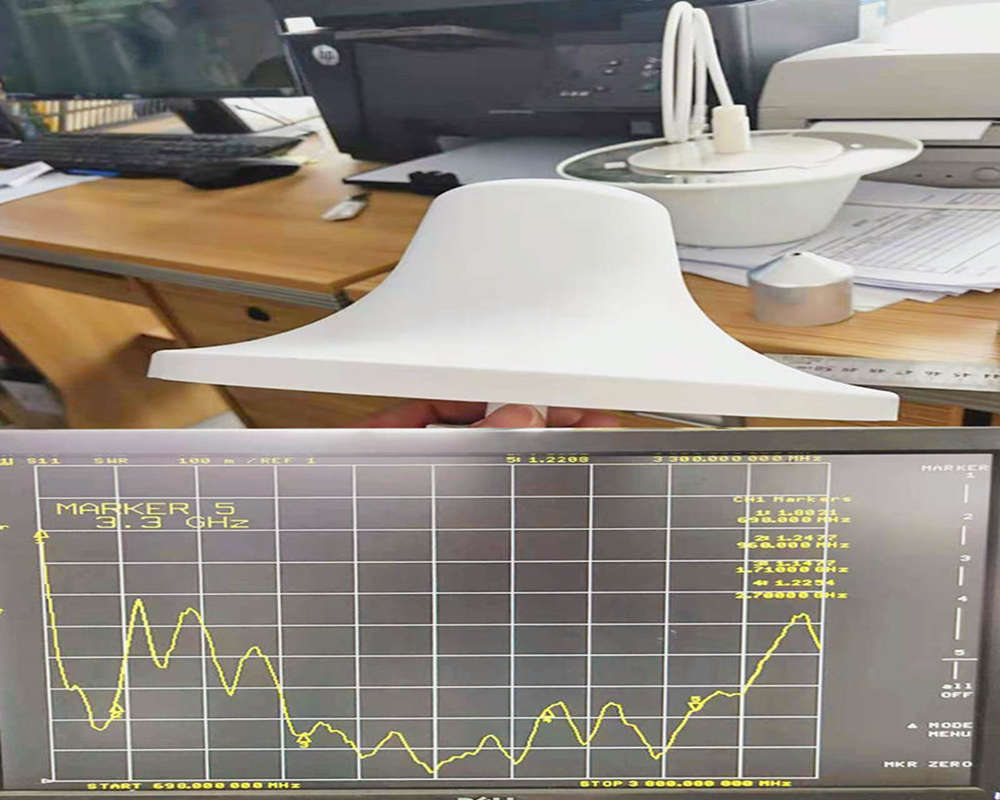
When we designed our first 5G ceiling antenna, the brief was narrow: keep the 4G ceiling bands at 698-960 MHz and 1710-2700 MHz, then add 3300-3800 MHz so the same fixture could carry n78. That is no longer the whole job. Venues now hand the same ceiling unit a longer list: 3800-4000 MHz for private and campus networks, and 5150-6000 MHz where Wi-Fi 6E and licensed indoor spectrum share the ceiling void. A dome that stops at n78 is a fixture the building will outlive in three to five years.
So we rebuilt the platform around six sub-bands instead of three.
What a ceiling dome does that a wall panel cannot
Put a directional panel on a wall and it lights one corridor, in one direction, and only if that corridor runs the right way. A ceiling dome radiates in 360° azimuth, which is why it is the standard answer for rooms with more than one approach: elevator lobbies, open-plan offices, hospital corridors that branch, shopping-centre service passages.
That 360° azimuth has to hold across the whole band, and the vertical pattern has to change as frequency rises. On our full-band dome the vertical beamwidth is 90 ±10° at 698-806 MHz, 85 ±10° at 806-960 MHz, 65 ±10° across 1710-2700 MHz, 40 ±20° at 3800-4000 MHz, and 50 ±10° at 5150-6000 MHz. The wide low-band beam fills a stairwell and reaches behind a door frame; the narrow high-band beam stops 5 GHz energy from spending itself on the ceiling slab instead of reaching the desk.
What the current platform specifies
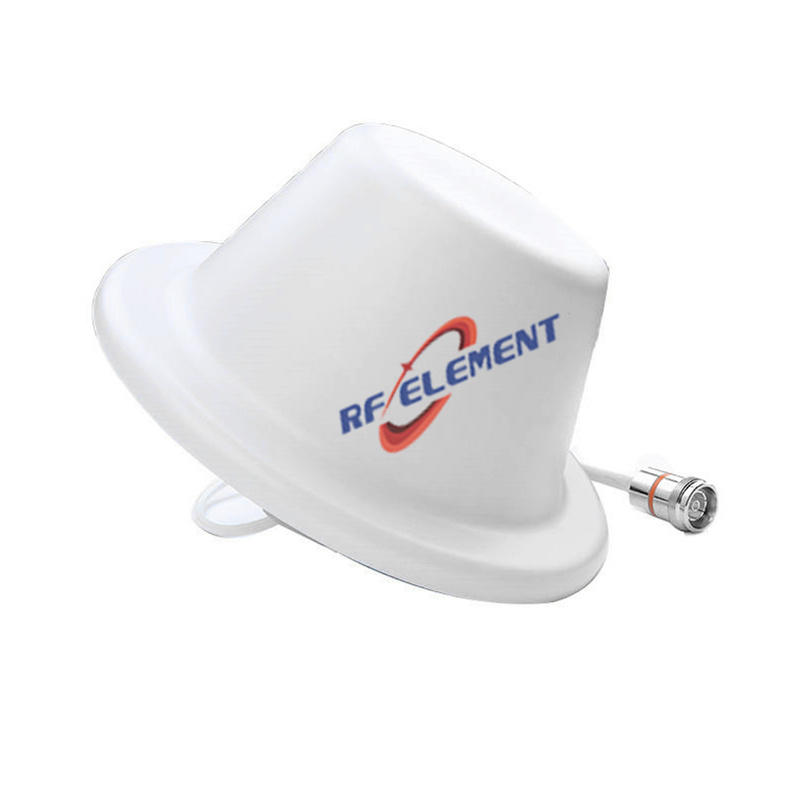
The full-band 5G ceiling antenna covers 698-6000 MHz continuously in six sub-ranges: 698-806, 806-960, 1710-2700, 3300-3800, 3800-4000, and 5150-6000 MHz. Gain rises through the band from 1.5 ±0.5 dBi at 698-806 MHz to 2.2 ±0.5 dBi, 3.5 ±0.5 dBi at 1710-2700 MHz, 4.5 ±0.5 dBi at 3800-4000 MHz and 5.5 ±0.5 dBi at 5150-6000 MHz, carried on a 50 Ω feed with 50 W power handling and a single 4.3-10 Female or N-Type Female port. VSWR is specified at ≤ 1.8 in the 698-806 MHz sub-band, ≤ 1.5 across 806-960 MHz and 1710-2700 MHz, and ≤ 1.6 from 3300 MHz upward. The unit weighs 0.4 kg and is rated from -55° to +60° C.
Three neighbouring parts in the same family cover the cases where that one is not the right choice.
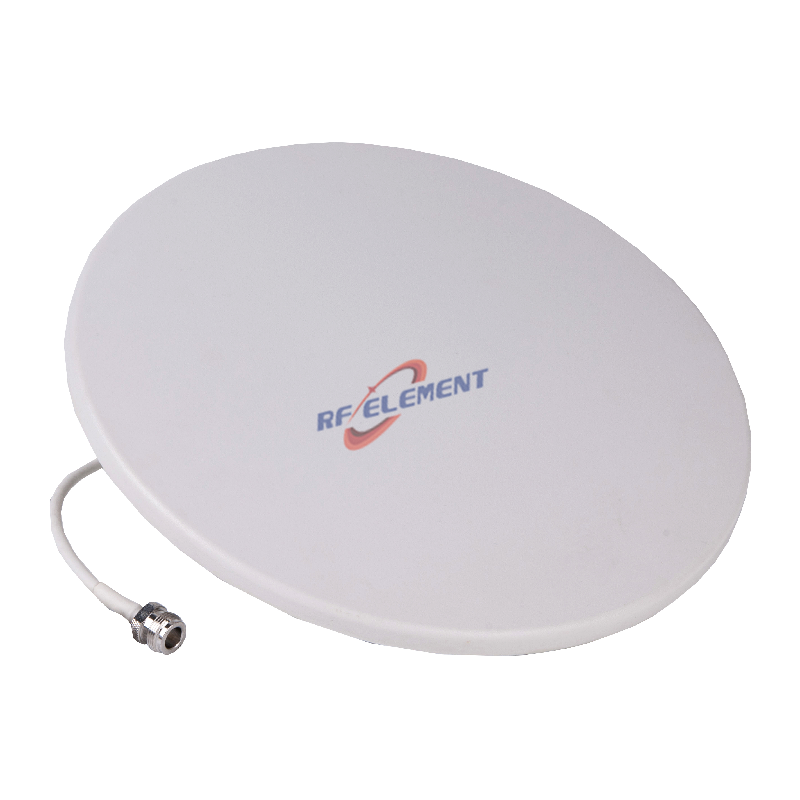
When the ceiling feeds a distributed antenna system shared by several operators, PIM sets the noise floor, so the part to specify is our low-PIM cellular ceiling antenna: 698-3800 MHz in four sub-bands, 1.5 / 2.0 / 5.0 / 4.0 dBi, 360° azimuth with 60 ±10°, 50 ±10°, 30 ±10° and 40 ±20° vertical beams, third-order PIM measured at -150 dBc @ 2×43 dBm, in a φ186 × 85 mm, 0.3 kg housing on a 4.3-10 Female port.
Where the coverage plan needs two polarizations rather than one, our dual polarized 5G MIMO ceiling antenna carries two linear feeds across the same 698-3800 MHz range, 2.5 / 4.5 / 4.0 dBi by sub-band, the same -150 dBc @ 2×43 dBm PIM figure, in a φ215 × 42 mm, 0.5 kg envelope.
Where the ceiling void is shallow or the building is listed, our wide band UHF ceiling antenna turns the same electrical job into an 18 mm profile: 380-3800 MHz across 380-400, 400-698, 698-960, 1350-1550, 1710-2700 and 3300-3800 MHz, 1.5 to 5 ±0.5 dBi of gain, VSWR ≤ 2.0 falling to ≤ 1.5 in the upper sub-bands, 50 W, 280 mm across at 0.5 kg.
And if the building is still a 4G site with no 5G plan in writing, the sensible part is the 4G LTE ceiling antenna at 698-2700 MHz, 3 dBi, VSWR ≤ 1.5, in a φ185 × 90 mm, 0.4 kg housing on an N-Type Female port, with 5G-ready mechanicals available on the same tooling when the upgrade is finally funded.
Reading a ceiling installation before you order
Three numbers decide which of those four parts you want, and all three are usually missing from the first enquiry.
Ceiling height. A dome at 3 m and a dome at 7 m do not behave the same way. The higher the fixture, the more of the vertical beam lands on floor area where nobody is standing. Above roughly 6 m a 360° dome starts wasting energy in the middle of a room, and that is the height at which a directional indoor panel aimed downward beats a dome, even though the dome is easier to mount.
What sits above the ceiling. A metal deck or foil-backed insulation layer reflects the back lobe and skews the pattern. Suspended acoustic tile does not. If the fixture has to sit under a metal deck, plan the coverage radius from the measured pattern of the installed unit rather than from a free-space estimate.
How the users are distributed. A dome serves a floor plate evenly, which is what an open office wants and what a long narrow corridor does not. In a corridor, a dome puts most of its energy into the two walls at right angles to the run.
Where a ceiling dome is the wrong choice
Tunnels, subways and service ducts. A tunnel is a one-dimensional problem, and a 360° radiator sends more than half its power into concrete. Use a directional panel or a sector antenna aligned with the run.
Stadium bowls, airport piers and open platforms. Long, low, user-dense spaces are directional problems. A dome on a 12 m roof cannot shape a beam onto a seating tier.
Street furniture and outdoor cabinets. The indoor dome housing is not weather-rated. Specify an outdoor IP-rated unit; we build the same electrical design in an outdoor mechanical package.
Ceilings that cannot carry a connectorised feed. A 50 W port with a 4.3-10 interface needs a cable path and a bend radius. If nobody has walked the ceiling void, check that before the specification meeting, because it changes the answer more often than the antenna choice does.
What to send us
Five items are enough for us to come back with a part number and a quotation: the frequency plan you are licensed for, ceiling height and what is above it, the coverage radius you need per unit, the connector and cable already on site, and the quantity per building. On our standard platform, samples run 3-5 working days and mass production 15-25 working days.
We build these units in our own plant in ZhaoQing, Guangdong, and support OEM/ODM on the same tooling: connector type, cable length, mounting hardware, radome colour and mechanical dimensions can all be changed, and gain or beamwidth can be retuned for a specific coverage plan. Send the band plan and the ceiling drawing to sales@rfelement.com and our engineering team will tell you which of the four parts fits your building, and which one does not.
TAG:The 5G Indoor Ceiling Dome Antenna Solution https://www.rfelement.com