Unleashing the Potential of IoT with LoRa Antennas
A LoRa link is settled on the mast, not in the gateway. A radio can only reach the sensitivity printed on its own datasheet if the antenna above it presents the impedance its front end was matched to, in the pattern the installation actually occupies, on the band the network actually uses. Most of the range complaints that reach us are mechanical before they are electrical: a whip bought for one sub-band and bolted to a mast serving another, or a 5 dBi part chosen for a site that needed 8 dBi and a narrower vertical lobe.
Two sub-bands, and a third family still in service
LoRa deployment in the field splits between the European and Indian window around 860-870 MHz and the North American one at 902-928 MHz, with a large population of legacy 824-960 MHz sites sitting underneath both. The 5 dBi LoRa omni we build is cut for 860-870 and 902-928 MHz in a single part, keeps VSWR within 1.5 on both, presents 50 ohm, accepts 50 W, stands 600 mm tall on a 22 mm fibreglass body of 1.0 kg, delivered as a two-piece detachable unit so the radiator can travel apart from the base. Its 8 dBi relative covers the same two windows on a longer 1200 mm body of 38 mm across at 3.5 kg. Where the mast also carries cellular traffic, the 824-960 MHz omni spans the whole legacy window at 5 dBi in a 600 mm grey fibreglass housing.
What three decibels actually buy
Gain in an omnidirectional antenna is bought with the vertical pattern, never for free. The 5 dBi part throws its energy across a 35 degree vertical lobe, which is what makes it tolerant of a mast that leans a little and a node that sits below the horizon. The 900-930 MHz 8 dBi omni compresses that lobe to 16 degrees over a 1540 mm body at 1.5 kg, which doubles the reach along the horizon and halves the tolerance for a badly aimed mount. Neither figure is better in the abstract; the site decides. Flat ground with nodes scattered in a ring wants the wider lobe, while a long line of sensors along one road wants the narrower one.
Omnidirectional, panel or yagi
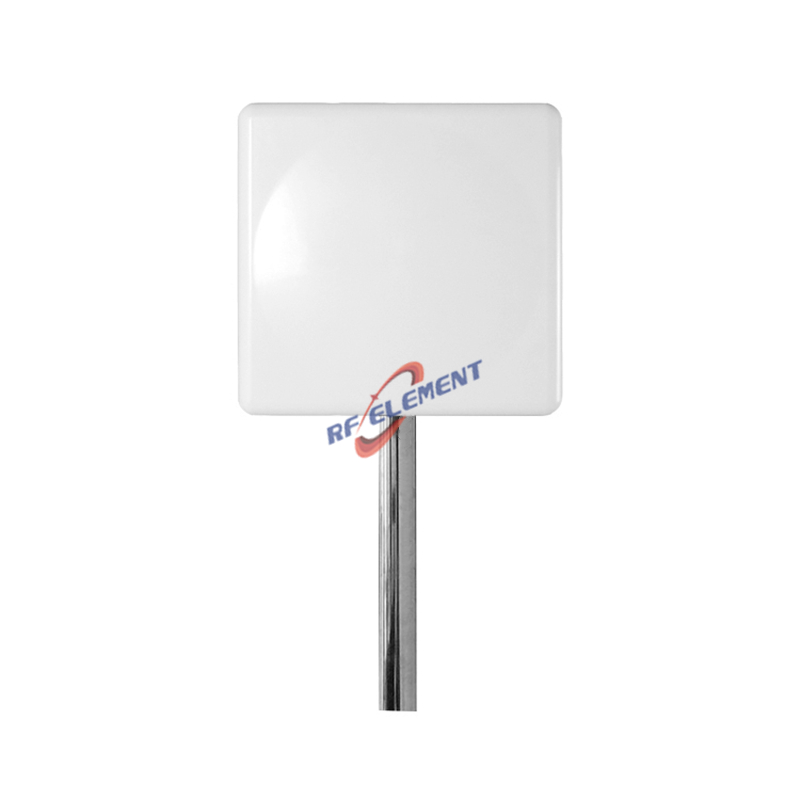
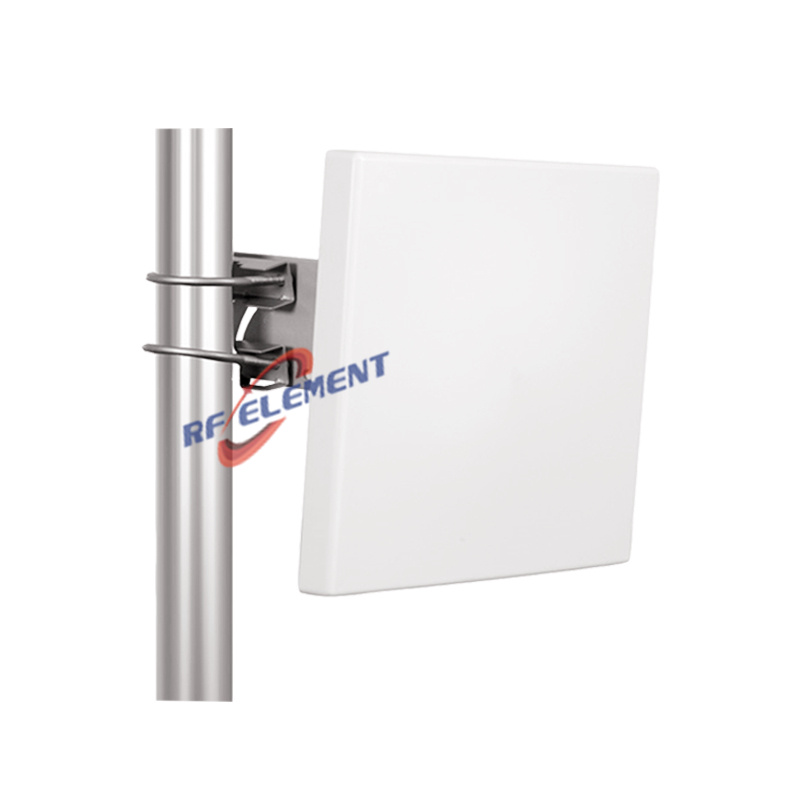
The three families solve three different geometries. An omni radiates a disc and asks for nothing but height. A 900-930 MHz panel trades that disc for a 55 by 50 degree sector at 11 dBi, measuring 370 by 370 by 20 mm at 2.5 kg in a white ABS case terminated in one N-type female connector, and it is the right part for a yard where the traffic all lies to one side. A 900 MHz yagi narrows further to 40 by 35 degrees at 14 dBi along a 1350 by 185 by 65 mm aluminium boom of 1.1 kg, and it exists for the fixed link whose far end never moves. Choosing a yagi for moving nodes is the most common mismatch we see, because the pattern is generous enough on paper and unforgiving in the field.
The band that people forget is a band
LoRa is a modulation, not a frequency. Two networks described with the same word can sit 45 MHz apart, and a part trimmed for one end of a window is not the same part at the other. That gap is small enough to look harmless in a link budget and large enough to cost several decibels at the connector, so we name the sub-band in the part number rather than the protocol. For sites that genuinely sit outside both windows, the 433 MHz omni covers 428-438 MHz at 5 dBi on a 1200 mm body, and its longer wavelength is a feature in cluttered ground and a penalty on the mast, where a taller antenna needs a taller pole and a wider turning radius.
Mechanical details that decide the field life
Everything above is undone by a mount that moves or a joint that takes water. Our LoRa parts share the same 55 °C lower limit and 60 °C upper limit as the rest of our outdoor line, use fibreglass radomes in white or grey, and terminate in N-type or SMA depending on the part. The detachable construction is there for a practical reason: a two-piece design lets the base be fitted, cabled and sealed before the radiator is screwed on, which keeps the connector dry during installation and makes a replacement a one-handed job on a mast. Torque at the connector, a drip loop below it, and stainless hardware at the bracket do more for mean time between failures than any change to the antenna itself.
Why the mast often matters more than the gain figure
An antenna at six metres and the same antenna at twelve metres do not see the same radio horizon, and the taller install costs nothing in bandwidth or pattern. On level ground that horizon grows with the square root of height, so doubling the mast buys roughly 40 percent more reach before the curve of the earth intervenes, without touching the antenna at all. A site that has already bought a 14 dBi yagi and still cannot close a twelve kilometre path should price a taller pole before a second antenna. Where height is fixed, the honest lever is the lobe: a 16 degree pattern aimed along the run will outlast a 35 degree pattern on the same transmitter, because the energy leaving at a steep angle is energy the far node never receives.
What the cable and the gateway contribute
A gateway is usually specified with more care than the cable that feeds it, which is the wrong order. A metre of thin coaxial at 900 MHz can give back a third of what the antenna was chosen to provide, and the loss is paid on both the transmit and the receive path, so it is charged twice in a link budget. Keeping the run short, choosing a cable whose loss is published at the operating frequency rather than at 100 MHz, and terminating it in the connector the antenna was built with recovers more range than stepping up one gain class. The gateway then sees the antenna the installer intended, which is the only condition under which the datasheet means anything.
Where the wrong part is the wrong choice
Four cases are worth naming. A site that buys on the word LoRa without checking the sub-band will find the mismatch at the connector, not in the coverage. A network with nodes that move, or that surrounds the mast, cannot use a panel or a yagi, whatever their gain. A run of 15 km in open country is a question of height and lobe width long before it becomes a question of gain, and a 5 dBi whip on a low pole will not solve it. And an antenna mounted flat against metal, or inside a metal cabinet, radiates the cabinet rather than the horizon, which is a placement fault no specification on the datasheet can overcome.
What we need to quote a LoRa antenna
Give us the sub-band, whether the nodes are fixed or moving, the mast height available, the run length and whether the site carries anything else on the same mast. We reply with the part, its pattern, and any mechanical change the mounting needs. Prototypes leave a few days after the drawing is released, and the production date follows the quantity we agree. Mail the sub-band, the layout and the mast height to sales@rfelement.com; what comes back starts with a sub-band, never a protocol.
TAG:Unleashing the Potential of IoT with LoRa Antennas https://www.rfelement.com