Search "what is 6G network" and you will find glossy slides promising the impossible. We build antennas for a living, so we will give you the version we can stand behind: what standards bodies have actually committed to, what has not been decided, and what a network operator or integrator should do about it in 2026. The short form: 6G is a real standards process with real dates, most of the RF engineering underneath it is not new, and the money you spend this year should still go to hardware whose specs you can measure.
What 6G actually is today
6G is the working name for the next generation of mobile standards, being framed by the ITU-R under the IMT-2030 umbrella with 3GPP carrying the detailed specification work. Two things are genuinely settled at this stage. First, the process exists and has a timeline that points to commercial deployment around 2030. Second, the vision documents describe a network that integrates terrestrial and non-terrestrial segments, so satellites and ground infrastructure appear in the same design rather than as separate industries.
Almost everything else is still moving. Candidate frequency ranges, peak-rate targets, and latency goals circulate in research papers and vendor roadmaps, and the numbers differ between sources. We will not quote a terabit figure at you, because no standard we can design against has frozen one. When a datasheet claims "6G-ready" today, ask what frequency range and what interface that claim maps to; in our experience the honest answers are narrower than the slide deck.
What 6G changes for antenna engineering, and what it does not
The history of every generation from 3G onward says the same thing: new generations are built on top of old spectrum, not instead of it. 4G networks still carry 2G and 3G bands; 5G mid-band deployments ride alongside legacy LTE at the same sites. Whatever bands 6G eventually claims, the existing sub-6 GHz estate will carry traffic through the transition decade, which means the installed base of antennas matters for longer than most forecasts admit.
Three requirements from the 6G vision do shape hardware thinking already:
Satellite integration pushes demand for high-gain, narrow-beam directional antennas on the ground segment, because link budgets to orbit are unforgiving in a way terrestrial links never are.
Densification keeps pushing PIM performance down, since more carriers sharing more infrastructure means every passive junction matters more.
Wideband reuse rewards mechanical platforms that can be retuned across bands, because no operator wants to buy a new antenna for every band decision a standards body has not yet made.
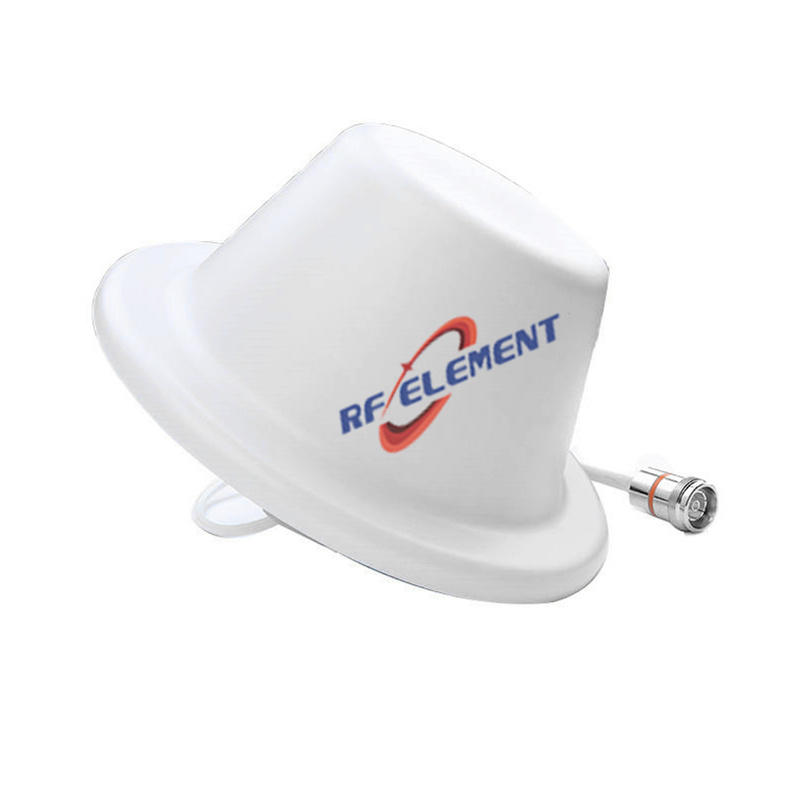
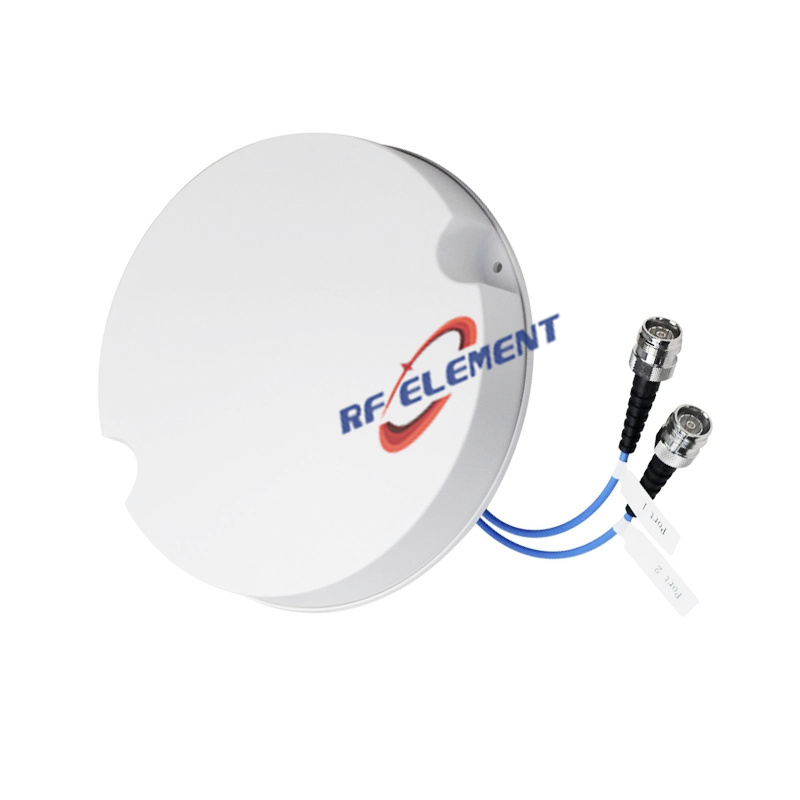
It also helps to picture what a real site looks like during the transition. One tower or campus might carry omnidirectional ceiling units covering 380-3800 MHz at 1.5 to 5 dBi indoors, 698-3800 MHz sector panels outside, and a 12.7-13.4 GHz link for backhaul, all specified to run from -55° to +60° C. Standards bodies will redraw band plans several times before 6G arrives; that mixed hardware estate will be replaced slowly and only where it must be, which is why the specs you buy against today set the ceiling on network quality for the decade.
What we ship today, and why it survives the transition
Our production line currently covers UHF through 13 GHz microwave, and the two ends of that range are exactly the hardware the transition scenario needs.
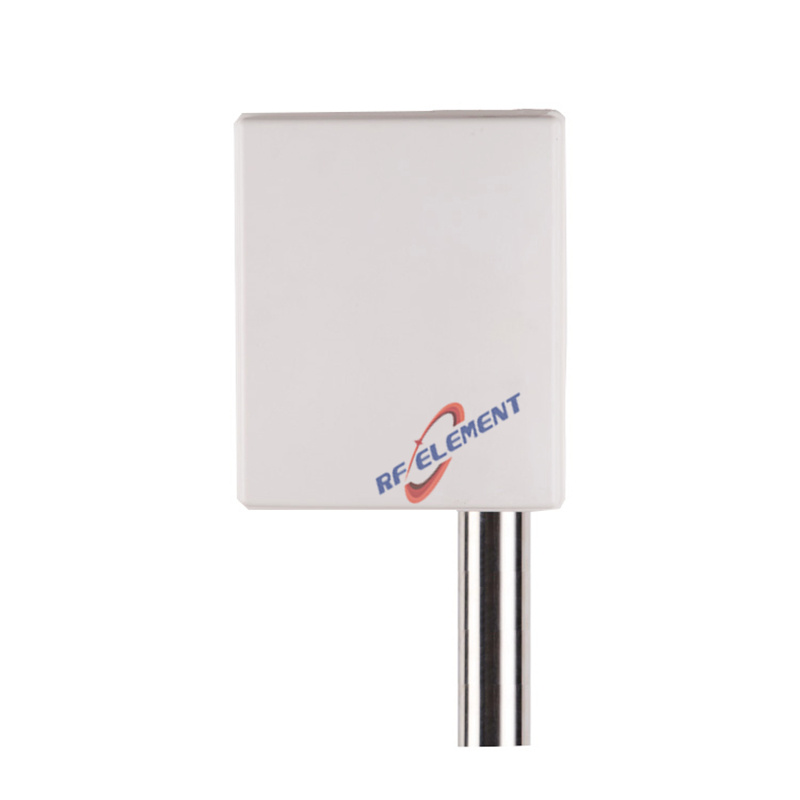
On the coverage side, our 5G MIMO panel antenna spans 698-3800 MHz in one enclosure: dual-polarized ±45° ports on a 50-ohm input that holds VSWR ≤ 1.8 across all three sub-bands, with a horizontal half-power beam of 90 ±15° at 698-960 MHz, 65 ±15° at 1710-2700 MHz, or 60 ±20° at 3300-3800 MHz, and matching vertical beams of 85°, 60°, and 55°. Third-order PIM is measured at -153 dBc @ 2 x 43 dBm, two-carrier, at realistic carrier power rather than a lab-friendly fraction of it. That number is the part we would ask you to check against any competitor's, because it is measured, and it is what keeps a combined multi-carrier DAS quiet when every operator's traffic shares the same panel. Mechanically it stays deployment-friendly at 360 x 155 x 65 mm and 1.1 kg, terminating on 4.3-10 female ports with 50 W power handling per the specification table.
On the link side, our 13 GHz panel carries 28-30 dBi of gain in a 5° by 3.5° pencil between 12.7 and 13.4 GHz, in a 340 x 340 x 30 mm, IP65 enclosure on a WR62 flange. Between them the two products show how differently the problems scale: one panel spans more than 3 GHz of spectrum, while the pencil beam concentrates everything into a 700 MHz window an order of magnitude higher in frequency. As operators stitch terrestrial and non-terrestrial segments together, this class of high-gain directional hardware moves from niche to routine.
Both platforms are built for retuning rather than replacement. When a project lands on a band our catalog does not list, our engineering team re-works gain and pattern on the existing mechanicals. Samples ship in three to five working days, and volume orders run fifteen to twenty-five days on our own line, which matters when a band decision finally lands and the network has to respond within a quarter.
Where 6G is the wrong answer
We would rather lose a line item than sell you the wrong antenna, and by that standard there are three places where "6G" is the wrong shopping category today:
Any antenna sold primarily as "6G-ready." Until target bands are frozen, that phrase maps to nothing measurable. Buy against published specs, band by band, the way you buy today.
Coverage problems you have right now. A dropped-call complaint in a high-rise or a dead zone in a warehouse will not wait until 2030, and no future standard fixes a mounting plan that never got built. Fix today's coverage with today's hardware.
Budget reallocation away from measured performance. The networks that will carry 6G traffic are built on the sub-6 GHz estate, and the single best 6G investment available in 2026 is raising the quality of that estate: lower PIM, better isolation, honest gain figures.
The questions we would ask in your position
When a supplier presents 6G positioning, ask for the frequency range the claim maps to, ask whether the referenced specs are measured or simulated, and ask for the raw pattern data in both principal planes. A manufacturer answers those without hesitation. If you want to see how we answer them, request the measured datasets behind the two platforms above, or email sales@rfelement.com with your band plan and we will tell you plainly which parts of it belong in 2026 and which should wait for the standards to settle.
TAG:What is 6G network https://www.rfelement.com