5G Small Cell Antenna | 4x4 MIMO Panel Antenna 617-4200MHz
Specifications
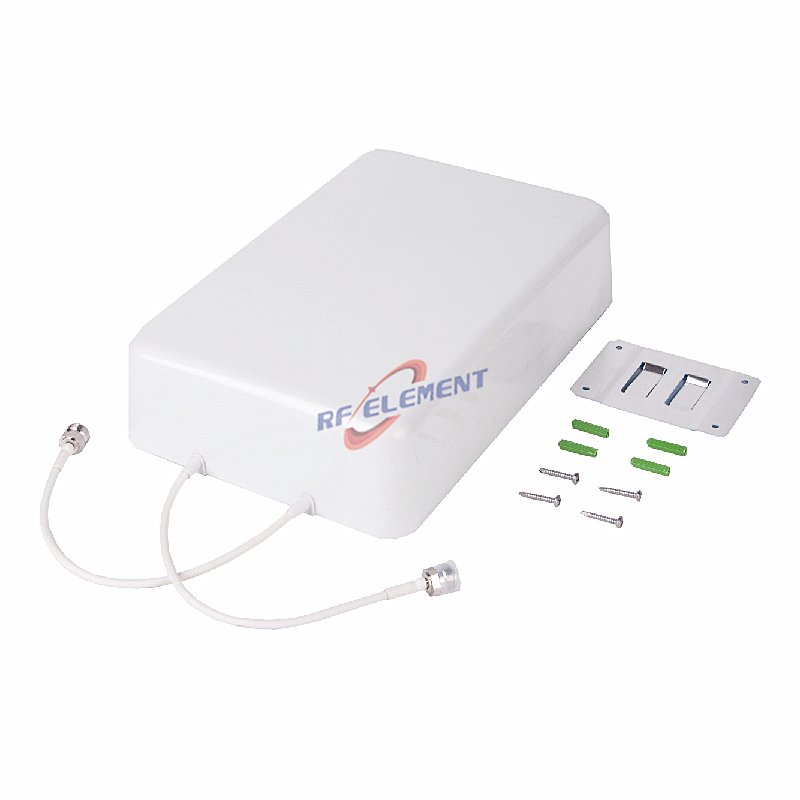
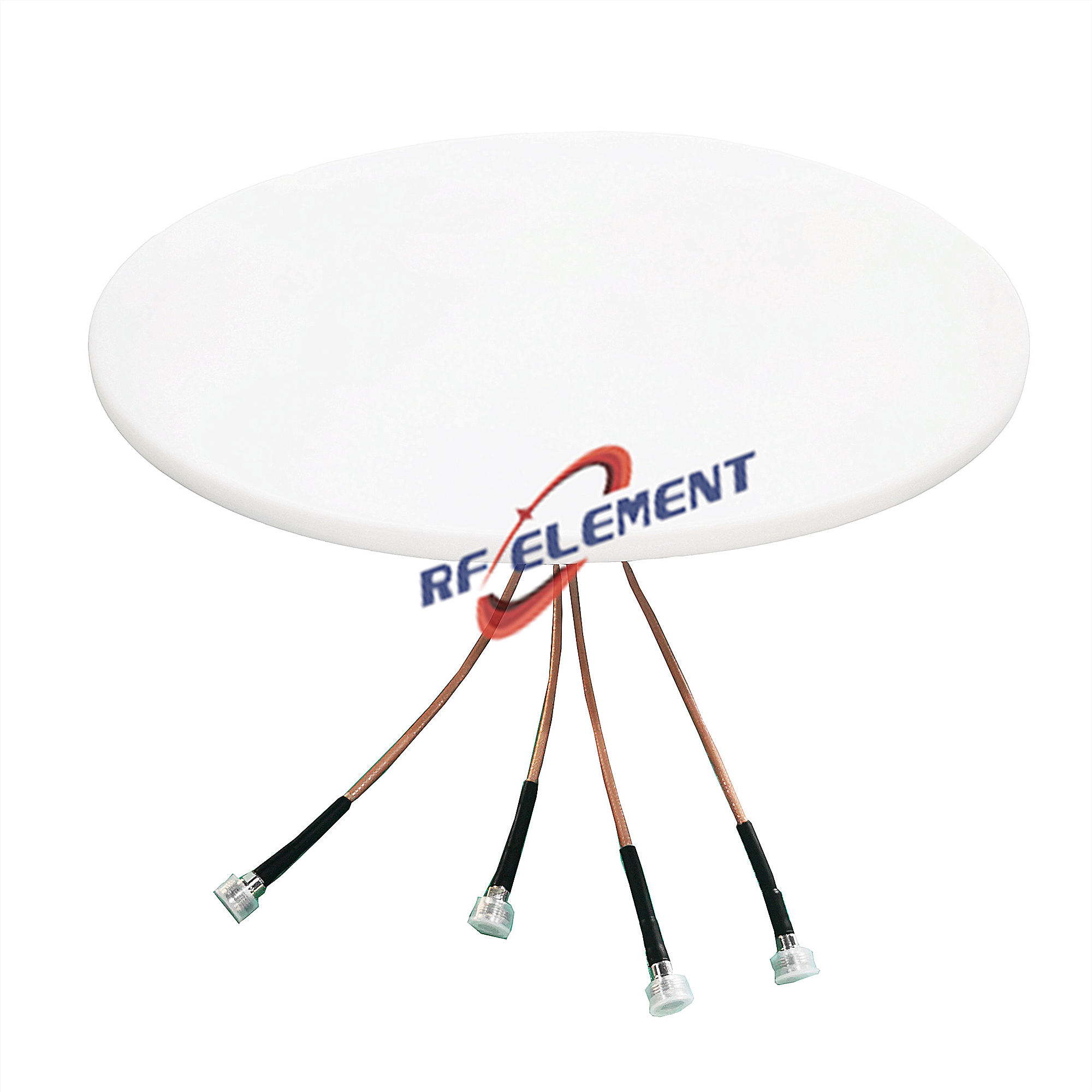
A four-port panel for small cells and in-building systems that need four streams and coverage that starts below 700 MHz. The band runs from 617 MHz to 4200 MHz in five sub-ranges, with 7.5 dBi at the bottom edge rising to 10.5 dBi at 3800-4200 MHz. Four 4.3-10 female or N-Type female ports sit on a 450 x 450 mm plate that is 110 mm deep and weighs 2.5 kg.
Why 617 MHz is not just a lower number
Most wideband panels start at 698 MHz, which covers the 700 MHz public safety and commercial bands but stops short of the 600 MHz band plan used in North America. A 617 MHz lower edge covers n71 and the 600 MHz uplink, so one antenna can serve a small cell that aggregates 600 MHz, 700 MHz, PCS, AWS and C-band without a second low band unit.
The cost of that extension is aperture. Holding a match at 617 MHz requires a larger radiating structure than a 698 MHz design, which is why this panel is 450 mm square rather than 310 mm. If the project does not use anything below 698 MHz, the smaller panel in the range will do the same job at a third of the weight.
The capacity case for four ports
Four ports allow a 4x4 MIMO branch, which in a small cell context means four streams instead of two on the same radio channel. The gain is not simply double throughput: it depends on the scattering environment, and in a corridor with a strong dominant path the fourth stream is rarely usable. In a furnished open plan space with ceilings and partitions, four streams are realistic and the spectral efficiency improvement is worth the larger antenna.
The practical argument for four ports is often cable economics rather than raw capacity. If a ceiling or wall position has to deliver 4x4, doing it with one plate avoids a second mounting position, a second penetration and a second run of coax to the radio.
| Frequency Range | 617-4200MHz | ||||
| Frequency Sub-Range(Mhz) | 617-806 | 806-960 | 1710-2700 | 3300-3800 | 3800-4200 |
| Polarization | ±45° | ||||
| Gain(dBi) | 7.5±0.5 | 8.0±0.5 | 10±0.5 | 10±0.5 | 10.5±0.5 |
| Horizontal Beam width | 80±10° | 80±10° | 65±10° | 60±10° | 60±10° |
| Vertical Beam Width | 45±10° | 45±10° | 40±10° | 35±10° | 35±10° |
| Impedance | 50Ω | ||||
| VSWR | ≤ 1.8 | ≤ 1.5 | ≤ 1.5 | ≤ 1.8 | ≤1.8 |
| 3rd Order for 2×20 W Carriers | -153 dBc | ||||
| Isolation | ≥ 15dB | ≥ 18 dB | ≥ 12 dB | ≥ 15 dB | ≥20 dB |
| Maximum Power | 50 W | ||||
| Connector Type | 4 Port, 4.3-10 Female or N-Type Female | ||||
| Length | 450 mm | ||||
| Width | 450 mm | ||||
| Depth | 110 mm | ||||
| Net Weight | 2.5 kg | ||||
| Operating Temperature | -55° to +60° C (-67° to +140° F) | ||||
| Radome Material | Plastic ABS | ||||
| Radome Color | White | ||||
| Mounting Options | Fasteners and screws included for wall mounting | ||||
Isolation between the four ports
Isolation is listed per sub-range: 15 dB at the bottom, 18 dB at 806-960 MHz, 12 dB at 1710-2700 MHz, 15 dB at 3300-3800 MHz and 20 dB at 3800-4200 MHz. The 12 dB figure in the middle band is the one to design around, because it is the band where most small cell capacity is deployed.
Twelve decibels of isolation means the ports are not independent radio chains. Treat the four ports as a MIMO branch with correlated coupling rather than as four isolated channels, and confirm that the radio unit can tolerate the coupling at the modulation order you intend to run. Where the four ports are used for different operators rather than for MIMO, 12 dB is not enough separation and a diplexed combining scheme is required.
Mechanical reality of a 450 mm plate
At 2.5 kg and 110 mm deep, this is not a ceiling tile antenna. The mounting surface has to carry the weight plus the cable load, and the fasteners supplied are intended for solid wall or structural mounting rather than plasterboard. On a ceiling grid, a drop wire to a structural anchor is required, and the grid itself should not carry the load.
The vertical beamwidth is 45 degrees in the low band narrowing to 35 degrees at the top, so the panel is designed to be mounted on a wall or a column facing the coverage area rather than flat on a ceiling. Aim it at the far end of the space and keep the first 2 m in front of the radome clear of partitions.
Ordering
Connector type and radome colour are fixed at order, and packing quantity is confirmed per project. Samples in 3-5 days, production in 15-25 days.
If the band plan starts at 698 MHz and only two streams are needed, the two-port 698-3800 MHz panel weighs 1.1 kg and covers the same upper bands. For a narrow single-band sector at 3.5 GHz, the n78 panel antenna delivers 12 dBi in a much smaller housing.
Send the band plan, the radio port count and the mounting surface. Those three answers decide whether the 617 MHz extension is worth the weight and whether four ports will actually be used.
FAQ — 5G Small Cell Antenna
What is the 5G Small Cell Antenna used for?
What frequency band does the 5G Small Cell Antenna cover?
What are the key specifications of the 5G Small Cell Antenna?
Can RF element customize the 5G Small Cell Antenna for my application?
What is the MOQ and lead time for the 5G Small Cell Antenna?
How do I get a quotation for the 5G Small Cell Antenna?