n78 Antenna Forms: Panel, Omni or Feedhorn at 3.5 GHz
n78 Antenna Forms: Panel, Omni or Feedhorn at 3.5 GHz
Ask three integrators for an n78 antenna and you may get three completely different parts. One is a 240 mm flat panel. One is a fibreglass rod six hundred millimetres tall. One is a small horn that bolts onto a dish. All three are correct answers inside the 3.5 GHz band, and all three carry a 50 ohm port with VSWR under 1.5 — yet they cover anything from a 360° circle down to an 8° beam, and the gain between them spans 11 to 23 dBi. Choosing between them is a more consequential decision than choosing a gain figure within one family, and it is usually made last.
This page sets out the three forms we manufacture for n78, with the published numbers for each, and the order in which we suggest making the choice.
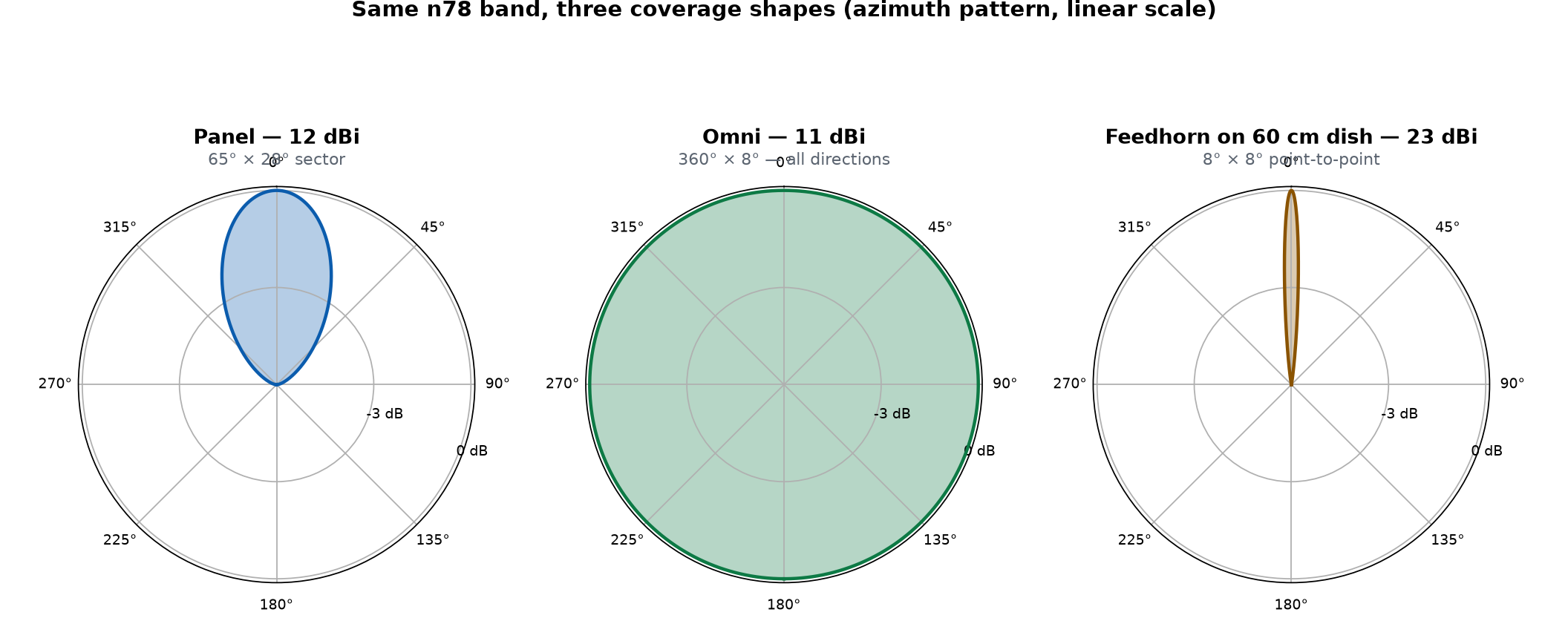
One band, three shapes, one table
Every part below is specified for the 3.5 GHz band at 50 ohm, dual-polarised for MIMO except the omni. The panel and the feedhorn are rated across 3300–3800 MHz; the omni covers 3400–3800 MHz, which is its published band.
| Form | Gain | H × V beamwidth | Size / weight | Covers |
|---|---|---|---|---|
| Panel | 12 dBi | 65° × 28° | 239 × 190 × 35 mm · 1.0 kg | One sector, wall or ceiling |
| Omni | 11 dBi | 360° × 8° | Φ42 × 630 mm · 1.0 kg | All directions from one mast |
| Feedhorn on 60 cm dish | 23 dBi | 8° × 8° | Feedhorn 0.8 kg | One distant point |
The panel and the omni are within 1 dB of each other. That single decibel hides the fact that one covers a 65° sector and the other covers the entire horizon — a difference of roughly a hundredfold in solid angle. Gain, on its own, tells you almost nothing about which part belongs on your site.
Why the form matters more at 3.5 GHz than at 700 MHz
n78 sits at 3300–3800 MHz, which is a half wavelength of 43 mm. At that scale a modest aperture produces real directivity, and this is why the same factory that needs a panel the size of a road sign to reach 9–11 dBi at 700 MHz can deliver 12 dBi in a 239 × 190 mm footprint at 3.5 GHz. The comparison is covered in more detail in our note on choosing between the low band and n78; what matters here is the consequence.
Because the radiating structure is small, the housing, the radome and the mounting bracket are no longer negligible parts of the design. At 700 MHz they sit electrically far from the elements. At 3.5 GHz they are within a small multiple of a wavelength of the radiating surfaces, and anything metallic near the aperture — a pole, a wall, a bracket — changes both the pattern and the impedance. Two practical results follow: the published pattern is only achievable with the part mounted as specified, and a form that installs in the right relationship to its surroundings is worth more than one that is 1 dB stronger on paper.
Panel — the 65° sector workhorse
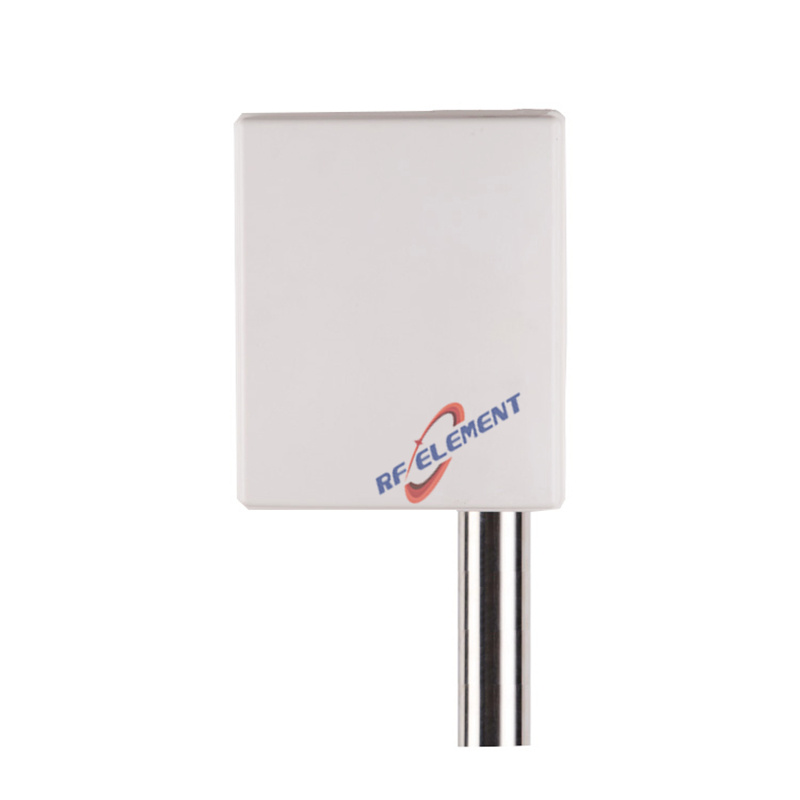
A printed or die-cast array behind a flat radome. Our n78 MIMO panel is 239 × 190 × 35 mm, weighs 1.0 kg, and holds 12 dBi across a 65° horizontal sector with a 28° vertical pattern.
Where it wins: any installation with a defined coverage sector — a corridor, a hall, one side of a building, or one face of a small cell. The flat face is stable and obvious to aim, which matters more at 3.5 GHz than installers expect.
The compromise: 65° × 28° means coverage stops at the sector edges. Four panels are needed for a full circle, and the seams between them have to be planned rather than discovered.
Our range: 12 dBi dual-polarised. For the background on how a compact body holds a 65° beam at this frequency, see the custom n78 panel design notes.
Omni — one mast, every direction
A vertical element in a fibreglass radome. Our n78 omni is 630 mm tall on a 42 mm body, covers 3400–3800 MHz, delivers 11 dBi on a 360° horizontal pattern, and holds it in an 8° vertical beam.
Where it wins: a gateway serving endpoints spread around it, a relay that must hear in every direction, or a site where the subscriber positions are simply not known in advance. One mast, no aiming.
The compromise: the 8° vertical beam is the number to watch. It is narrow enough that a small difference in mounting height changes the ground coverage noticeably, and it is the reason an omni at this gain is not the "safe" choice it is at 900 MHz. If the endpoints are not roughly at the same elevation, a panel aimed at them is usually the better answer.
Our range: 11 dBi, single-polarised, pole mounted. Our coverage notes for 5G indoor antennas set out where a circular pattern earns its place.
Feedhorn on a dish — point-to-point only
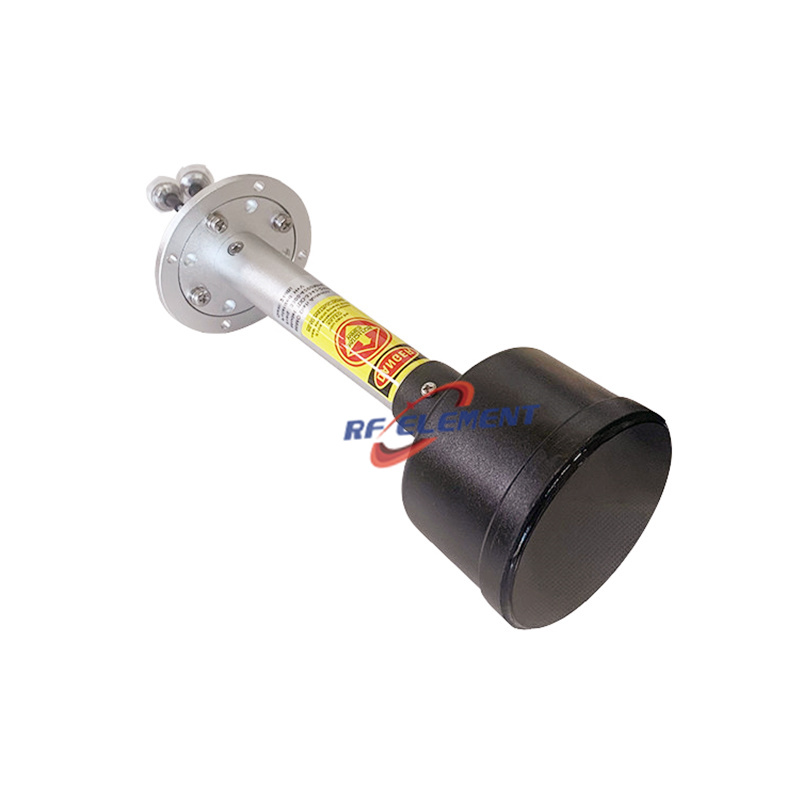
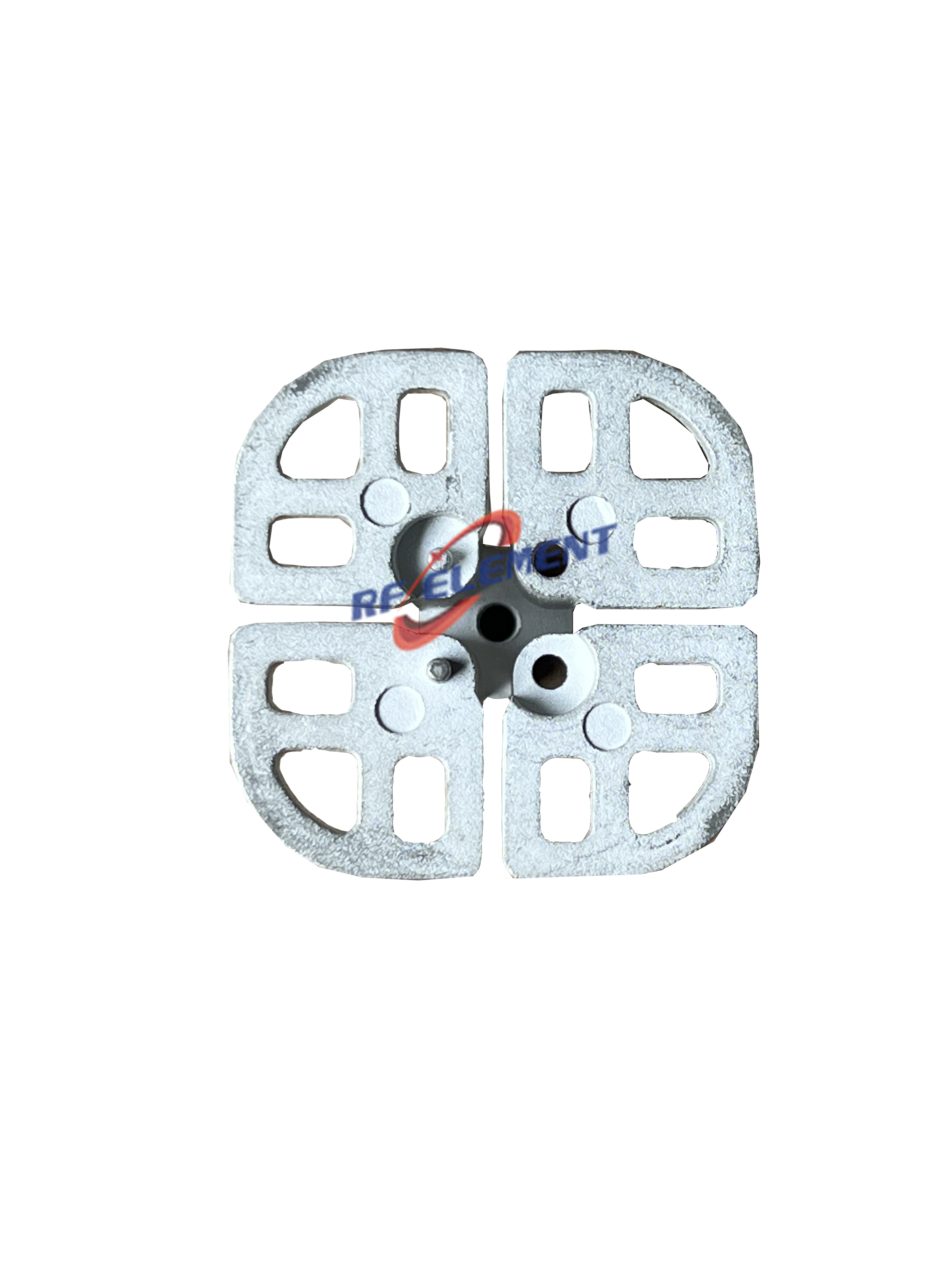
A horn at the focus of a reflector. Our n78 feedhorn weighs 0.8 kg and reaches 23 dBi on a 60 cm dish, with an 8° × 8° beam; the same horn will work on a 60 × 90 cm grid where more gain is needed.
Where it wins: a single link between two fixed points — backhaul, a bridge between buildings, a run to a distant mast. Nothing else in our n78 range comes close on gain.
The compromise: an 8° beam leaves almost no aiming tolerance. A mast that twists a couple of degrees in wind moves the link off peak, and the reflector itself is a wind load the mounting has to carry. This is a link-planning decision, not a box on an order form.
Our range: the n78 horn above, plus a wider 1700–4200 MHz feedhorn that covers n78 alongside the low bands from the same reflector. If the reflector is shared with a 5 GHz link, our 60 cm 5 GHz dish uses the same mounting family.
The decision path we suggest
Work through these in order. The first two usually settle the form before gain is discussed.
1. Are the endpoints in known directions? If yes, the form can be directional. If no — or if they move between sites — the answer is an omni.
2. Is it one far point, or a crowded area? One far point with a clear path points to a feedhorn on a reflector. A populated area inside a building points to panels.
3. How many sectors does the area need? A 65° panel covers roughly one sixth of a circle. Four to six of them make a 360° installation, and each seam needs overlap. If the site cannot carry four mounts, the omni is the honest answer.
4. What can the mounting carry? A dish is a wind load and a rigid-mount requirement. A 1.0 kg panel or omni is neither.
5. Gain last. Once the form is fixed, the gain is mostly determined by the family. Choosing 12 dBi instead of 11 dBi is not the decision; choosing a panel instead of an omni is.
One specification worth asking about early. At 3.5 GHz the passive intermodulation performance of the antenna and its connectors is a first-order concern rather than a footnote, because the band is deployed in time division duplex and the transmit and receive paths share the same frequency. Our note on how we designed our 3200–3800 MHz antenna covers what we hold and why it is specified separately from VSWR.
Three mistakes we are asked to fix
An omni specified for a point-to-point link. 11 dBi spread over 360° puts very little energy in any one direction. Where the far end is a single known point, a feedhorn delivers better than 12 dB more on that path than an omni of similar size — and the site pays for the difference in aiming effort, not hardware.
A panel specified to cover a circle. Two panels at 65° leave more than half the horizon uncovered. Where a full circle is needed and only two mounts are available, one omni is the accurate answer and two panels are not.
A 3.5 GHz antenna mounted on a pole that was fine at 900 MHz. At this frequency the mast is inside the antenna's electrical near field. A part that measures perfectly on the bench can be several dB down once it is clamped to a metal pole at the wrong spacing. This is the single most common cause of an n78 installation that underperforms its specification.
Frequently asked questions
Should I use a panel or an omni for n78 coverage?
It depends on whether the endpoint directions are known. A panel concentrates 12 dBi into a 65° sector and is the better choice where coverage is a defined area. An omni spreads 11 dBi across the full circle and is the better choice where endpoints are spread around the site or their positions are not yet fixed. The gains are within 1 dB, so the pattern, not the gain, is the decision.
How much gain do I get from an n78 feedhorn on a dish?
Our n78 feedhorn is specified at 23 dBi on a 60 cm parabolic dish. The same horn can be used on a 60 × 90 cm grid where higher gain is required. The horn itself weighs 0.8 kg; the reflector and its mounting are separate decisions, and the wind load they carry is part of the site plan.
Does a wider band antenna mean I can use one part for several bands?
Our wideband feedhorn covers 1700–4200 MHz, which spans the low bands and n78 from a single reflector. For panel and omni forms, each part is specified for its own band — the 3300–3800 MHz panel is a 14% relative bandwidth design, and extending it across the low bands would cost pattern performance.
Why does my n78 antenna measure worse than specified?
The usual cause is the mounting environment. At 3.5 GHz a half wavelength is 43 mm, so a pole, a wall or a bracket sits electrically close to the radiating aperture. Moving the antenna, changing the bracket, or increasing the standoff distance normally recovers the pattern and the match without any change to the antenna.
Choose the form, and the gain follows
At 3.5 GHz the antenna decision is not really about decibels. It is about whether the site needs a circle, a sector or a line — and each of those has a form that fits it, with a gain that comes along as a consequence. We build all three for n78 and will tell you which one suits a given site, including when the answer is the 12 dBi panel rather than the 23 dBi horn. The wider range is set out under our 5G antennas, with the radiating elements behind them under antenna elements.
TAG:n78 Antenna Forms: Panel, Omni or Feedhorn at 3.5 GHz https://www.rfelement.com