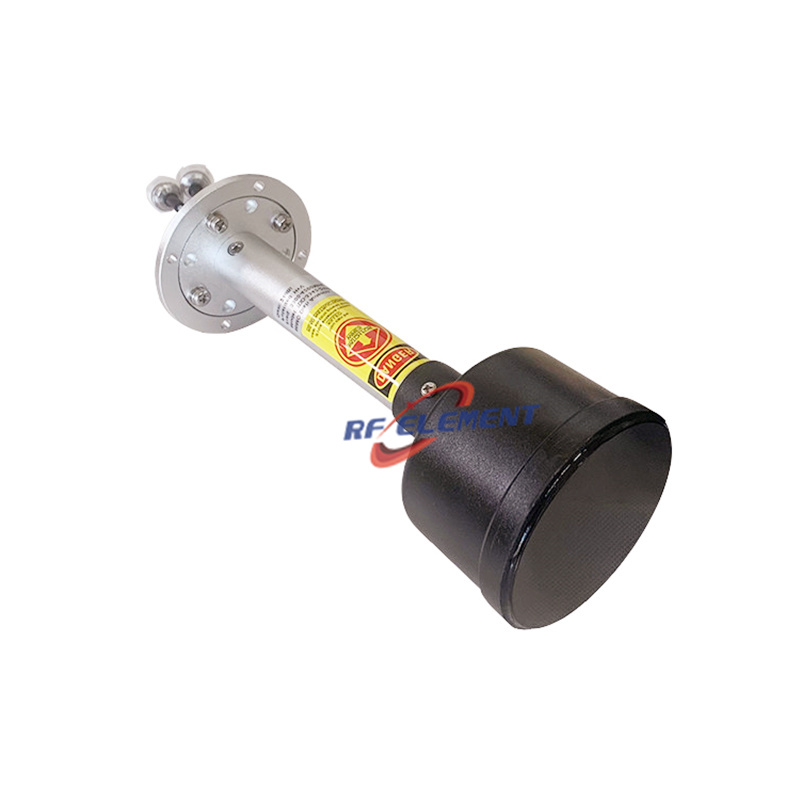
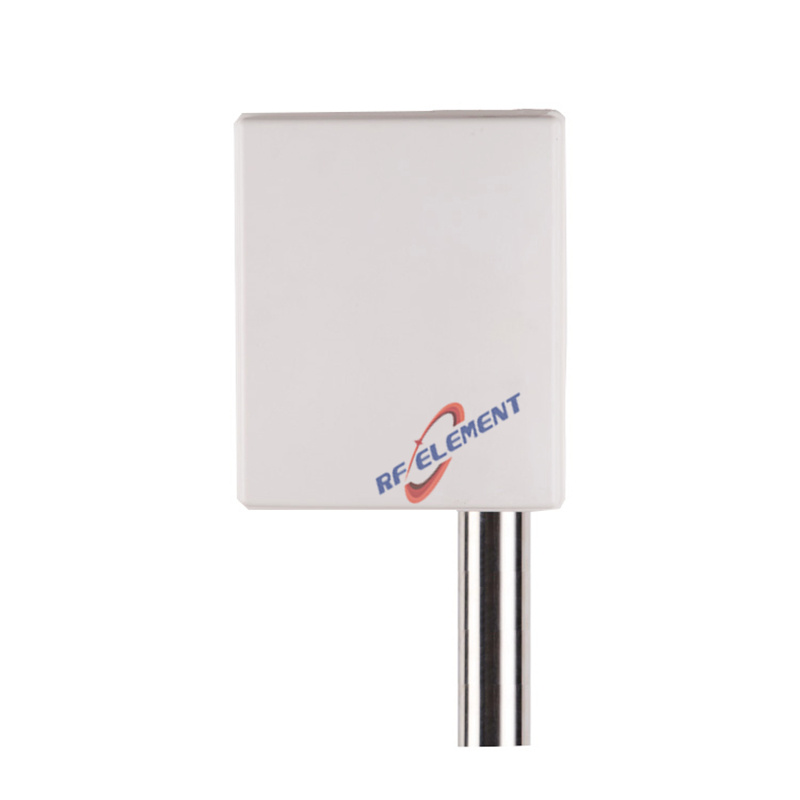
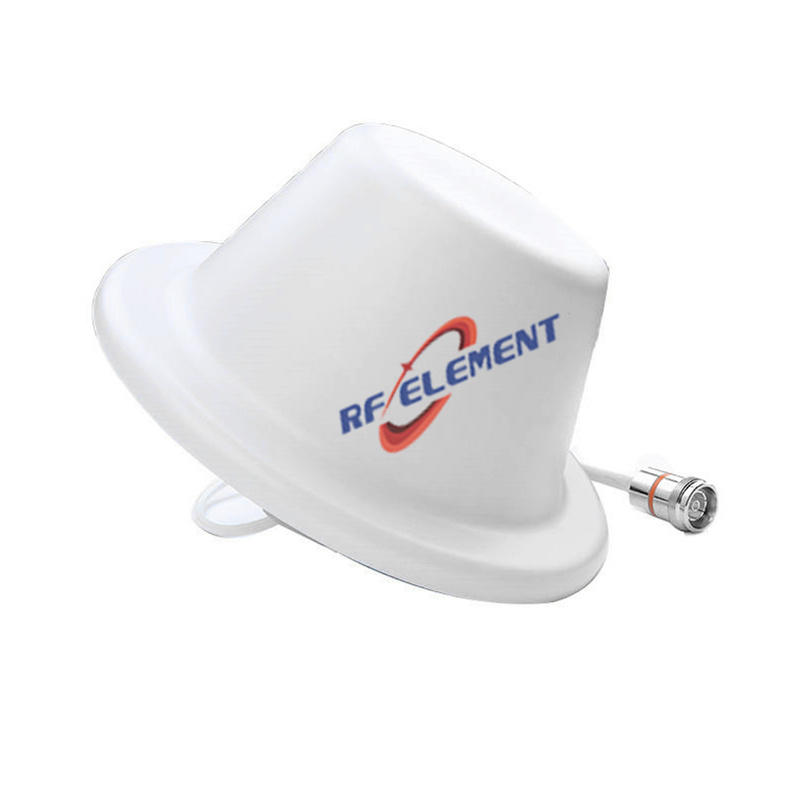
"5G antenna" is a category label, not a purchase decision. When an integrator emails us a floor plan or a tower layout, the first thing we do is sort the requirement into one of four antenna families — ceiling, panel, omni, or feedhorn — because each family trades gain, beamwidth, and mounting style differently. This page walks through all four with real numbers from our own catalog, so you can shortlist a type before you ever open a datasheet.
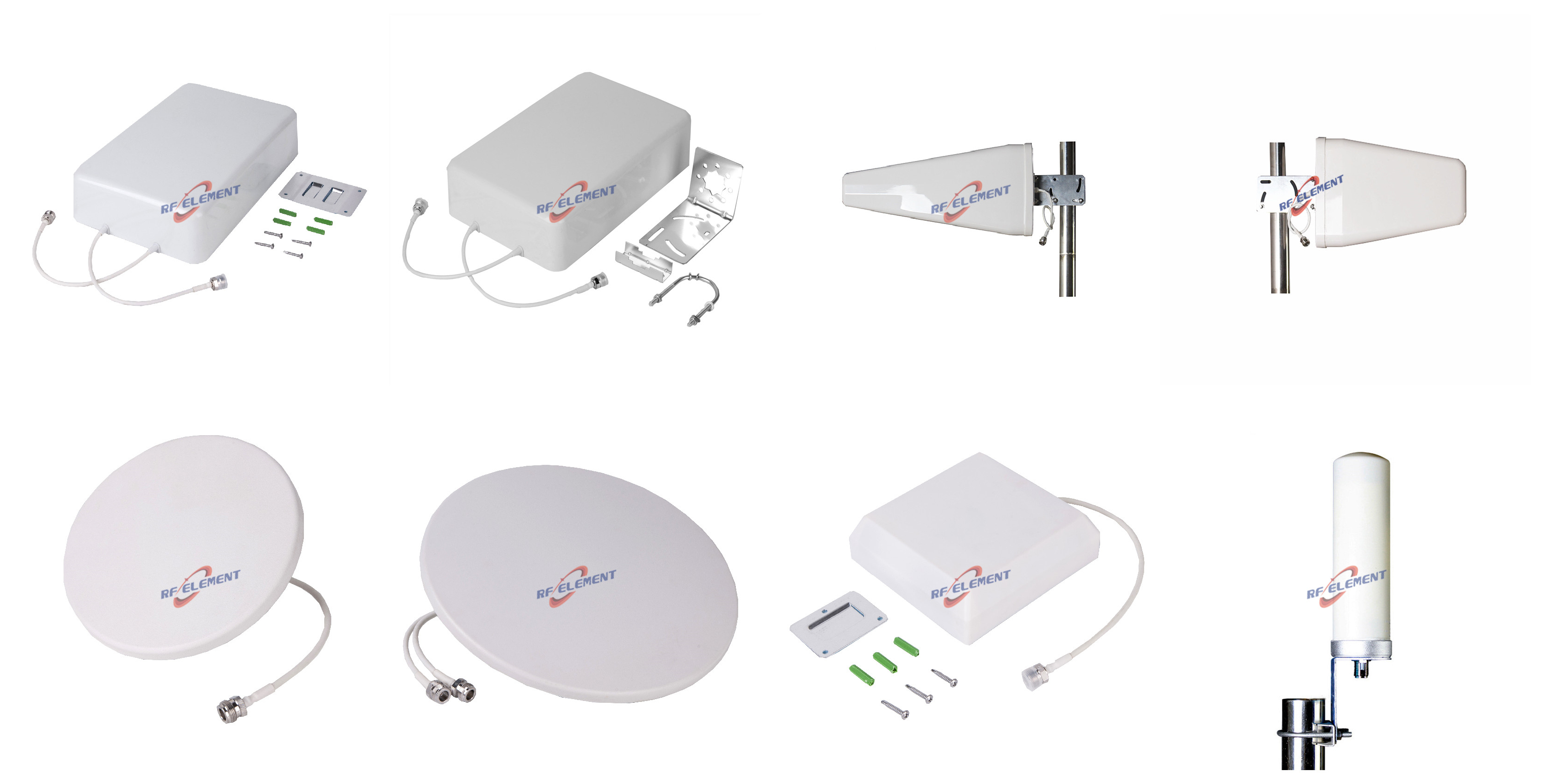
Ceiling antennas: the indoor workhorse
Ceiling models are omnidirectional or wide-beam units that mount flush to a tile or a T-bar, which makes them the default choice for in-building wireless (DAS) deployments. The trade is mechanical: gains stay in the 1.5-5.5 dBi range because the radome is thin and the radiators sit close to the ceiling plane.
Our compact 5G ceiling antenna covers 698-4200MHz in six sub-bands — 1.5 dBi at 698-806 MHz rising to 5.5 dBi at 3800-4200 MHz — inside a 180 mm × 12 mm radome that weighs 0.3 kg and holds −153 dBc PIM at 2×20 W carriers. Step up to the wideband MIMO version and the diameter grows to 280 mm at 15 mm thick, adding two ports with 22 dB isolation at 3300-3800 MHz. When the site plan calls for 4×4 MIMO, the slim model spreads four radiators across a 385 mm × 13 mm face, keeping the same sub-band gain ladder and −153 dBc rating at 1.3 kg.
Two selection notes that matter in practice. First, check the PIM figure against your carrier's acceptance test — ours are rated at −150 dBc or better with 2×20 W or 2×43 dBm carriers depending on the model. Second, connector choice (4.3-10 Female vs N-Type Female) is decided at ordering time, not on site; the low PIM cellular ceiling variant fixes the connector at 4.3-10 precisely because of that acceptance-test discipline.
Panel antennas: directional gain where you need it
Panels put the same sub-6GHz spectrum behind a directional beam. The high-performance 5G outdoor panel covers 698-4200 MHz with ±45° cross polarization, delivering 5 dBi in the low band and 8 dBi at 3300-3800 MHz from a 310 × 230 × 73 mm, 1.0 kg enclosure. Port-to-port isolation runs 10 dB at the low end up to 25 dB in the C-band.
For pure n78 deployments, the dedicated 3.5 GHz n78 panel narrows to 65° × 28° and lifts gain to 12 dBi across 3300-3800 MHz with a VSWR cap of 1.5 — the right shape for sector coverage on a new standalone network.
Omni antennas: 360° coverage on a fiberglass whip
Where a sector plan is overkill — a small campus, a private network, a rural fixed-wireless cell — the n78 fiberglass omni covers 3400-3800 MHz with 11 dBi gain, an 8° vertical beamwidth, and a 360° horizontal pattern in a Φ42 × 630 mm, 1.0 kg radome. One N-type port, 50 W power handling, and pole mounting make it a single-visit installation.
Feedhorn antennas: gain borrowed from the dish
A feedhorn carries no reflector of its own; it borrows gain from the parabolic dish or grid it illuminates. Our wideband horn covers 1700-4200 MHz in three sub-bands and delivers 23-28 dBi depending on the reflector — 23 dBi once paired with a 60 cm dish at 3300-3800 MHz, 28 dBi behind a 60 × 90 cm grid — with beamwidths between 6° and 10°. The n78 feedhorn simplifies this to a single band: 23 dBi at 3300-3800 MHz, 8° beamwidth, 2 N-type ports, tuned for a 60 cm dish at 0.8 kg.
Where each type is the wrong choice
Ceiling is wrong outdoors or on any wall that faces weather — the radome is indoor-rated, and the 360° pattern wastes energy where a sector would aim it.
Panel is wrong for uniform in-building coverage; mount it on a wall and every room behind it becomes a dead zone.
Omni is wrong when interference, not distance, is the problem — 11 dBi of gain in all directions amplifies the neighbors' signals too.
Feedhorn is wrong without a dish; the horn alone is a component, not an antenna, and the gain numbers assume the reflector is there.
Matching type to deployment
| Requirement | Type to shortlist | Example from our line |
|---|---|---|
| Discreet in-building DAS | Compact ceiling | 180 × 12 mm, −153 dBc |
| 4×4 MIMO indoor capacity | Slim 4-port ceiling | 385 × 13 mm, 22 dB isolation |
| Outdoor sector coverage | Cross-pol panel | 8 dBi @ 3.3-3.8 GHz |
| n78 standalone sector | 3.5 GHz panel | 12 dBi, 65° × 28° |
| Rural 360° cell | Fiberglass omni | 11 dBi, Φ42 × 630 mm |
| Long point-to-point link | Feedhorn + dish/grid | 23-28 dBi, 6-10° beam |
Ordering, samples, and what we send you
All four families come off our own line in ZhaoQing, so connector type, cable length, bracket, and radome colour are OEM/ODM changes rather than custom projects — gain and beamwidth retunes on the same mechanical platform are routine. Sample units ship from our own production floor in 3-5 working days; volume orders follow a 15-25 working day schedule, and MOQ is set so a first-site pilot does not need a container. Send sales@rfelement.com your band plan, mounting environment, and port count, and the reply comes back with the model match, the full specification table, and mechanical drawings. If you send the coverage sketch, we will also flag which type we would not use, and why.
TAG:RF element, The 5G Antenna Types https://www.rfelement.com