5G Antenna Manufacturer: RF element Low-PIM Solutions for Next-Generation Networks
Passive intermodulation is the kind of problem that never appears on the bench and always appears on the site. Two strong carriers share a junction that has corroded by a fraction of a millimetre, the mixing product that comes out lands inside your own uplink, and every test that passed at the factory is suddenly irrelevant. The radio blames the network, the network blames the hardware, and the fix costs a tower climb. Our answer as a manufacturer is to rate the antennas against that failure mode from the start: the low PIM rating across our 5G ceiling and small cell line is specified at -150 dBc with 2×43 dBm test tones, which is the condition a shared tower actually imposes rather than a best-case pair of gentle carriers.
Reading the rating the way a site reads it
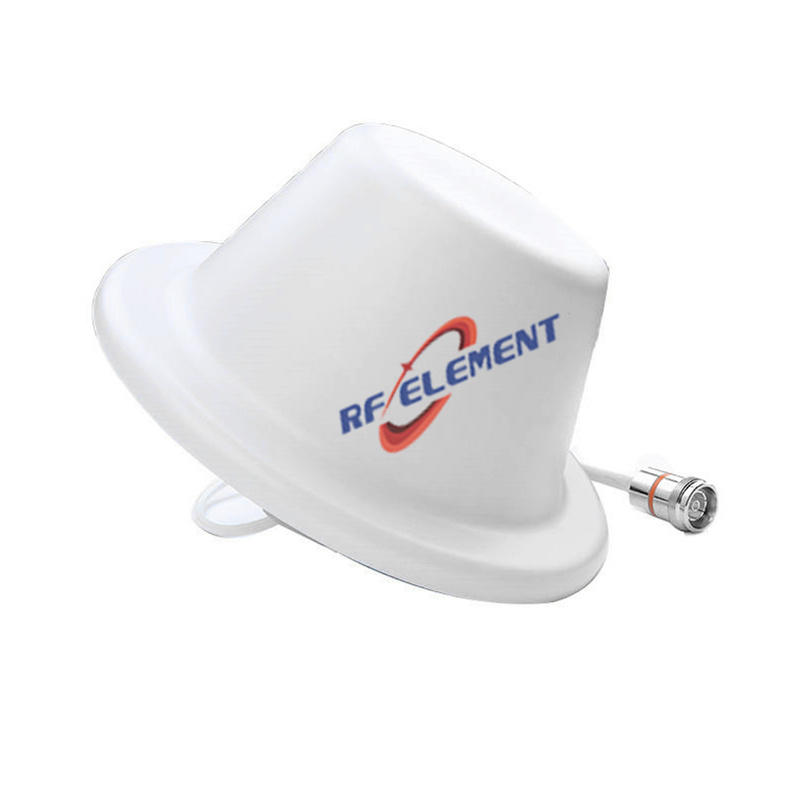
Two numbers make that rating meaningful. The first is the test condition: 2×43 dBm is roughly 20 watts per carrier at the antenna port, which is where multi-carrier towers actually operate, so the figure describes behaviour under load instead of in a quiet lab. The second is what the antenna contributes to the condition: a junction count you can count on one hand. The two discs in our ceiling line — the 5G cellular low PIM ceiling antenna and the low profile low PIM ceiling antenna — span 698-3800 MHz on a lone 4.3-10 female port, hold VSWR to 1.8 at worst, and weigh 0.3 kg each. One cable, one connector, one factory-sealed joint: every interface removed from the transmit path is a mixing product that can no longer be born. The discs differ in profile rather than principle — the cellular version is a φ186 × 85 mm body with 1.5 dBi gain and a 60±10° vertical beam, while the low profile version flattens to φ186 × 15 mm with 2.5 dBi and a 90±10° vertical beam for interiors where the ceiling cannot afford depth.
Where the discipline extends to the street
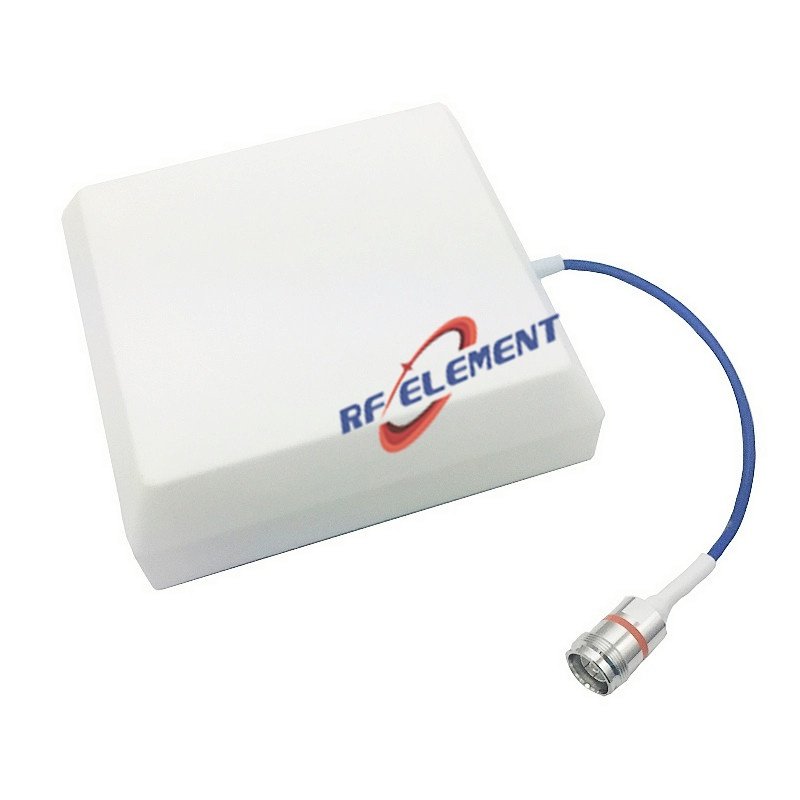
Outdoors the carrier count climbs and the PIM budget tightens. Our 4×4 MIMO small cell panel carries the same discipline into a 617-4200 MHz span: third-order intermodulation measured at -153 dBc for 2×20 W carriers, four connectors in 4.3-10 or N-type female finish, ±45° cross polarization, 7.5±0.5 dBi gain, an 80±10° by 45±10° beam, and a 450 × 450 × 110 mm, 2.5 kg radome. Isolation belongs in the same sentence as intermodulation: two transmit paths that leak into each other manufacture their own products regardless of how clean each port is, and that is why the isolation figure — at or above 15 dB here — ships beside the PIM figure instead of hiding in a footnote.
The capacity layer at 3.5 GHz
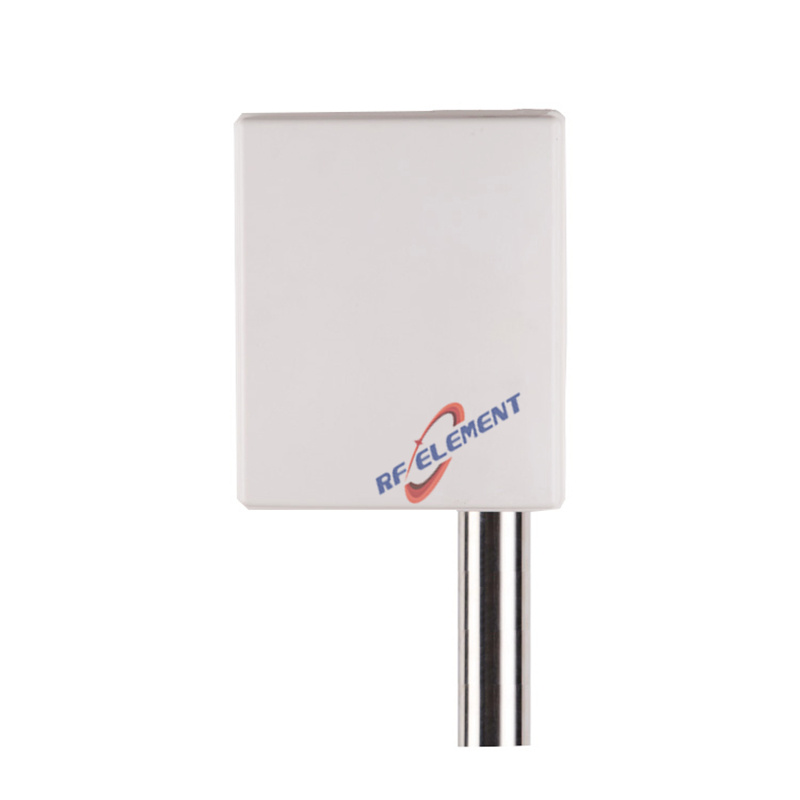
Where the network runs a dedicated mid-band layer, our n78 MIMO panel for 3300-3800 MHz puts 12 dBi behind a 65° horizontal by 28° vertical beam, carries horizontal and vertical polarization across two N-type ports; the shell weighs 1.0 kg and runs 35 mm thin, spanning 239 mm by 190 mm on the wall, with VSWR staying inside 1.5. It is the panel we quote for capacity infill — a courtyard, a campus spine, an industrial yard — where the operator's own discipline downstream deserves an antenna that does not become the weak link in an otherwise careful chain.
Hybrid sites, one reflector
Most sites in this transition still carry LTE and 5G side by side, and the sector conversation has its own arithmetic. Our ±45° cross-polarized LTE sector keeps that era honest: 698-2700 MHz, 7 dBi, a 65±5° beam, a front-to-back ratio held above 20 dB, a 100 W rating on a pair of N-type ports, its 450 × 280 × 180 mm, 2.5 kg PVC radome finished in grey for pole mounting. Both polarizations live on one reflector, which halves the frontal area a two-panel legacy arrangement would hang on the steel — the same reason crews consolidating mounts as carrier counts grow keep landing on it.
Where low PIM is money wasted
A PIM rating costs engineering effort, and some rooms give that effort nothing back. A single-carrier booster covering one band at modest power has no strong two-tone condition to violate; our 4G LTE indoor ceiling antenna — rated 3 dBi over 698-2700 MHz, 50 W, a Φ185 × 90 mm white ABS body at 0.4 kg — exists for exactly that job, at a price that reflects what it must survive. Specifying a -150 dBc disc there is not incorrect; it is unpaid for. And when a distributed antenna system needs a wideband endpoint with two receive paths at one ceiling point, our MIMO ceiling antenna for DAS takes 698-3800 MHz onto two N-type ports separated by at least 15 dB of isolation, with third-order intermodulation capped at -97 dBm under 2×2 W tones; the housing measures 215 × 215 × 41 mm at 0.8 kg — the part for a shared headend that puts two signals on one tile.
The rest of the path deserves the same care
A rated antenna can be undone by the hardware behind it, so the low PIM conversation we have with customers usually ends on the jumper rather than the disc. Factory-sealed joints are only as good as the treatment they receive on the tower: connectors torqued to specification rather than wrist-tight, plating inspected before the mating, adapters kept off the high-power run wherever the design allows, and every outdoor joint sealed so that a season of rain cannot begin the corrosion cycle that turns a clean interface into a mixer. None of that is exotic, and none of it is optional on a site where the PIM budget was part of the design. We ship mounting and weatherproofing guidance with the antenna precisely so the rated figure survives the installation.
One family, the whole sub-6 spread
Set the line side by side and the band logic is easy to see: 698-3800 MHz on the ceiling discs and the DAS endpoint covers legacy LTE through mid-band 5G in one part; 617-4200 MHz on the small cell panel adds the low digital-dividend bands below 700 MHz that rural planning keeps requesting; 3300-3800 MHz on the n78 panel isolates the capacity layer where it needs aiming rather than flooding; and 698-2700 MHz on the cross-polarized sector serves the hybrid sites still carrying the LTE era on their back. A project can therefore standardize on one manufacturer, one connector discipline, and one PIM rating across a rollout that spans indoor discs, street panels, and rooftop sectors — which, in practice, is how the specification table gets shorter instead of longer.
Choosing by the tower, not the table
Send us the band list, the carriers per sector, the mounting structure, and the quantity, and the reply names the part whose rating matches the site's worst day rather than its average one. Samples for evaluation ship within a working week of the confirmed drawing; volume runs are scheduled against the production calendar once quantities are fixed. Send the request over to sales@rfelement.com ; the specification table you receive is the one the production test bench signs off against — the rating you quote is the rating the site actually measures.
TAG:5G Antenna Manufacturer: RF element Low-PIM Solutions for Next-Generation Networks https://www.rfelement.com