

5G Antenna Manufacturer– PCB Technology at Scale
For any 5G antenna manufacturer, the single most critical component is the radiator—the metallic element that actually transmits and receives electromagnetic waves. Often called the “antenna element” in RF engineering, the radiator’s design determines gain, bandwidth, efficiency, and ultimately the viability of mass production.
At RF element, we have spent over a decade mastering both major radiator families: traditional metal die‑cast radiators and PCB‑based radiators. While metal radiators retain their place in high‑power, narrow‑band applications, the industry’s overwhelming shift toward PCB radiator technology is driven by one undeniable force: scalable, high‑precision, low‑cost mass production.
This article explains why, from the perspective of an experienced 5G antenna manufacturer, PCB radiators have become the dominant choice for modern 5G networks—especially in massive MIMO, small cell, and millimeter‑wave deployments.
Why PCB Radiators Dominate at Scale
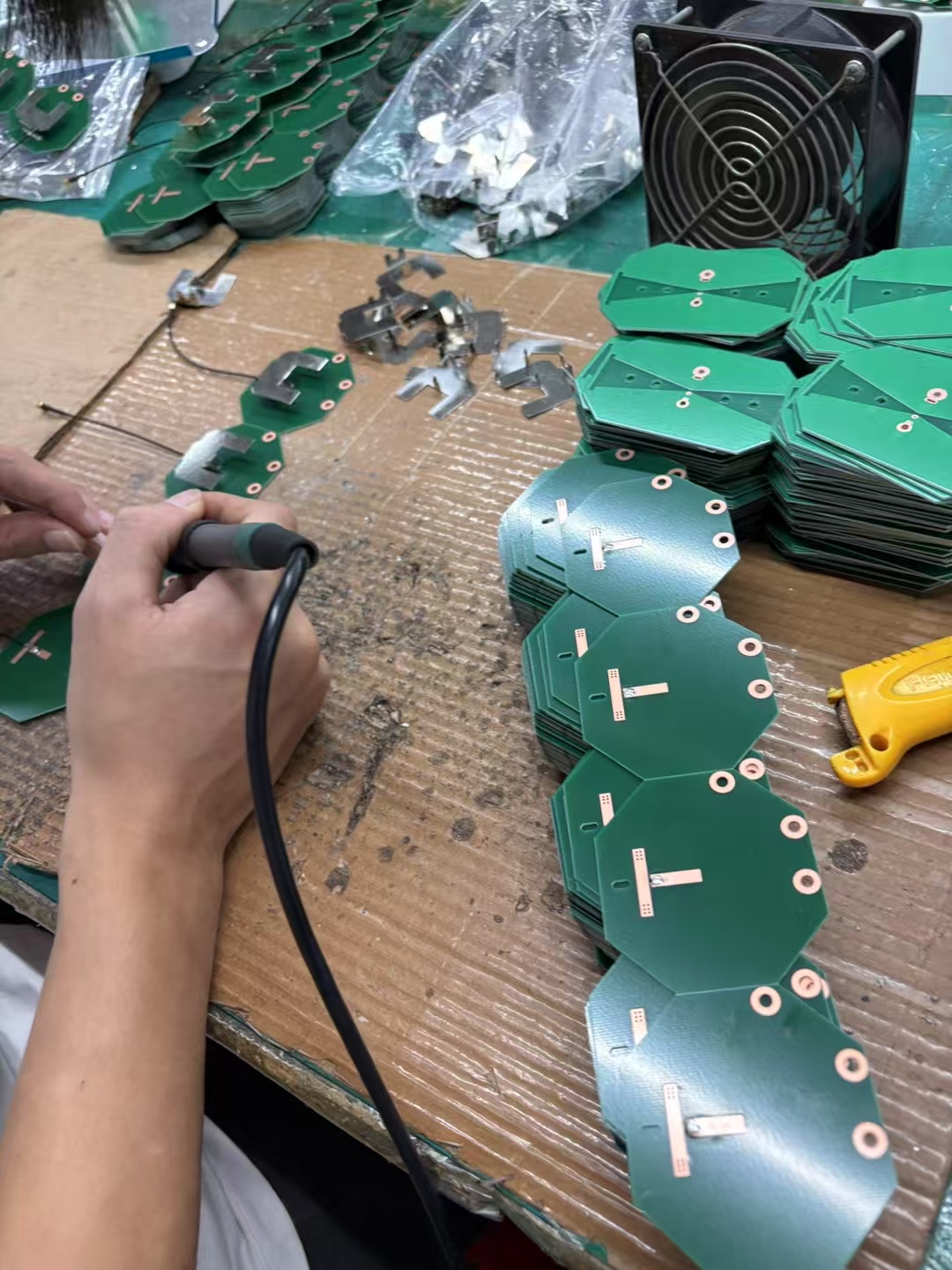
✅ 1. Unmatched Consistency
Massive MIMO requires 64–256 radiators in perfect phase coherence. Metal parts suffer from mold wear, porosity, and manual soldering variations.
PCB radiators are photolithographically defined. Trace width and spacing controlled within ±5% across entire panels. For beamforming arrays, this consistency is non-negotiable.
✅ 2. Integration Density
A 64T64R antenna needs:
128 dual-polarized feeds
Feed network + phase shifters
Control circuits + RFIC connections
With metal radiators: separate components, dozens of cables, manual assembly—a reliability and cost bottleneck.
With PCB: entire antenna system fabricated in one multi-layer laminate. Assembly labor reduced by 80%, thousands of failure points eliminated.
✅ 3. Agile Iteration
Metal: 4–8 weeks + $5k–$15k per mold. Design flaw? Scrap and recut.
PCB: revise in hours, fabricate in 24–48 hours. Ten design cycles in the time of one metal cycle. In the fast-paced 5G market, this agility is decisive.
✅ 4. Total Cost at Scale
| Cost Factor | Metal Die-Cast | PCB Radiator |
|---|---|---|
| Tooling/NRE | High | Low (<$500) |
| Assembly Labor | High (manual) | Near-zero (SMT) |
| Cost @ 10k units | High | Low |
| Cost @ 1M units | Prohibitive | Minimal |
Breaking the Performance Myths
"FR‑4 is too lossy for 5G."
A 2024 IEEE study demonstrated a metasurface-enhanced patch array on standard FR‑4 achieving:
32.3% bandwidth (24.1–33.4 GHz)
19.7 dBi gain – +8dB vs. conventional design
"PCB antennas can't handle power."
Modern PCB arrays with thermal vias handle 5–10W per element, 50W+ per array—sufficient for >95% of 5G applications.
"PCB antennas as SMD components?"
A 2023 IEEE TCAS-II paper showed a FR‑4 patch antenna in BGA package:
5.2 × 3.2 × 1.4 mm
56.1% bandwidth (20–35.6 GHz)
Covers n257, n258, n261
Pick-and-place compatible
This is the ultimate scalability breakthrough. No cables. No manual soldering. No dedicated assembly stations.
RF element PCB Radiator Capabilities
As a specialized 5G antenna manufacturer, RF element delivers:
Multi-Layer Stackup Optimization
From 2-layer FR‑4 for FWA CPE to 12-layer mixed-dielectric for 39 GHz active arrays.
Advanced Feeding Techniques
Aperture-coupled, proximity-coupled, SIW – achieving bandwidths >25% with pattern purity.
3D EM Simulation
CST/HFSS full-wave simulation correlated with anechoic chamber measurements. First-pass success rate >80%.
Mass Production Partnership
ISO 9001/ITAR-registered fabricators capable of:
Impedance tolerance: ±5%
Min trace/space: 50/50 μm
Panel size: 610 × 500 mm
Layer count: up to 24
The 5G revolution is a manufacturing revolution. To deliver massive antenna arrays at operator-affordable price points, the industry has moved decisively away from manually assembled metal radiators toward PCB-based antenna systems.
RF element stands at the forefront.
Whether you need:
Ultra-low-cost FR‑4 arrays for FWA CPE
High-efficiency FPCB mmWave arrays for 5G small cells
Custom multi-band radiators for private networks
As an experienced 5G antenna manufacturer, we combine deep RF expertise with production-ready PCB antenna solutions tailored to your frequency, gain, and form-factor requirements.
Contact our engineering team today for your next 5G antenna project.
TAG:5G Antenna Manufacturer– PCB Technology at Scale https://www.rfelement.com
