Custom Antenna Design Service: What to Send and What Comes Back
A custom antenna project rarely starts with a design. It starts with a specification, and the same three or four fields are usually missing from it. We have been building antennas in Zhaoqing since 2017, covering everything from UHF up to the 13 GHz microwave band; the projects that run smoothly are almost always the ones where the customer spent an hour on those fields before anyone drew anything. This is the list we would hand you if you asked what to prepare, and an honest account of the parts of a custom antenna that cannot be specified away.
What a design needs from you before it starts
Band and bandwidth come first, because most of the rest follows from them. A narrow band is cheap to serve. Our 5G n78 omni antenna holds 11 dBi inside a tube 42 mm across and 630 mm long, with a vertical beam only eight degrees thick and VSWR at or under 1.8 across 3400-3800 MHz. Ask the same tube family to cover 698-2700 MHz instead and the budget changes: the outdoor 4G LTE omni in our range needs 4 dBi to reach across roughly four octaves, and its shell grows to 52 mm by 1200 mm. Neither number is a defect. They are the same trade written twice.
Gain and pattern shape come next, and they are not the same request. A figure in dBi tells you how hard the antenna pushes in one direction; the beamwidth tells you how wide that direction is. A LoRa omni in our catalogue delivers 5 dBi through a vertical beam 35 degrees tall, which suits a mast that has to hear nodes scattered below it. A 630 mm 5G omni with an eight degree beam is the opposite shape of answer, aimed at a corridor rather than a field. Tell us which shape you need, not only the number.
Polarisation and port count decide the radio interface. A single vertical port, a dual-polarised pair, or a MIMO set of four are three different mechanical jobs, and the coax routing inside the shell changes with them.
The mechanical envelope is the constraint that kills more projects than any electrical requirement. We need the maximum diameter, maximum length, and the mounting arrangement, because these set how much radiator fits inside the shell and therefore how much gain is available at your frequency. A 22 mm by 600 mm shell and a 52 mm by 1200 mm shell are not interchangeable housings; they are different design budgets.
Environment is the last input, and it is the one that is most often left blank. Operating temperature across -55 to +60 degrees Celsius, wind and ice load, salt exposure, UV, and whether the joint has to hold IP-rated sealing for a decade all push material and process choices. Where the shell has to survive that outdoors, a fiberglass radome is usually the answer, and its wall thickness becomes an electrical parameter rather than a cosmetic one.
Interface and power complete the picture: connector type such as N-Type female or male, the power the antenna must handle, and any lightning or surge requirement. After that come volume, schedule, and the market the product is certified for, because these decide which tooling is worth building.
The four decisions that shape almost everything
Frequency and bandwidth, gain and beamwidth, mechanical envelope, operating environment. Four answers, and the rest of a custom antenna design is largely a consequence of them: shell material and wall thickness, radiator topology, element count, connector placement, mounting hardware, and the finish. When a project stalls, it is nearly always because two of these four were left to the supplier to guess, and the guess turned out to be the opposite of what the buyer had in mind. We would rather ask three uncomfortable questions at the start than send a quotation built on an assumption.
What can be changed, and what physics will not change
The list of things we can adjust is longer than most buyers expect: gain, frequency, antenna dimensions, and OEM packaging, along with connector type, mounting, colour and finish. The line that cannot be crossed is the one drawn by three numbers pulling against each other. Size, gain and bandwidth cannot all be improved at once. A radiator that has to be small will not deliver high gain, and one that has to work across many octaves will not deliver a narrow beam. The LoRa omni antenna and the n78 omni make the point from opposite ends: a LoRa omni antenna 22 mm across and 600 mm long gives 5 dBi in a 35 degree beam, while the electrically larger 5G omni gives 11 dBi in eight degrees. Same family of materials, same factory, different budget being spent.
This matters commercially because it is where custom specifications most often drift away from what the deployment actually needs. A buyer who asks for maximum gain and maximum bandwidth in the smallest possible shell is asking for three things that trade against each other, and the honest answer is a conversation about which two matter.
Where a standard antenna beats a custom one
Custom is not automatically better, and we say so before taking an order. Three situations point the other way. The first is when the requirement already sits inside a catalogue. We hold antennas from 144 MHz to 13 GHz, and a large share of incoming custom enquiries are met by an existing product once the real constraints are on the table, which removes tooling cost and weeks from the schedule. The second is low volume. Tooling, mould and first-article work are amortised over the units you order, so a custom shell at fifty pieces carries a cost per unit that a standard product never will. The third is an unvalidated system. If the link budget, the mounting position or the interference environment is still moving, build the first version on a standard antenna, measure it, and customise once the unknowns are gone. A custom design is best spent solving a problem that is already understood.
There is a fourth case worth naming: when the "custom" requirement is really a labelling or packaging requirement. OEM packaging and branding do not need a new radiator, and treating them as a design project only adds cost and delay.
From prototype to production, without leaving the building
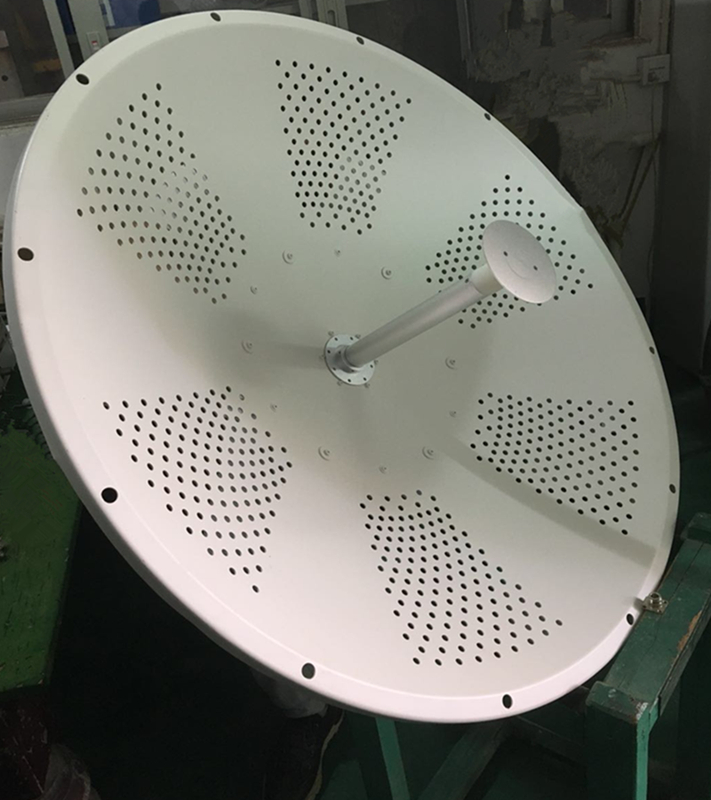
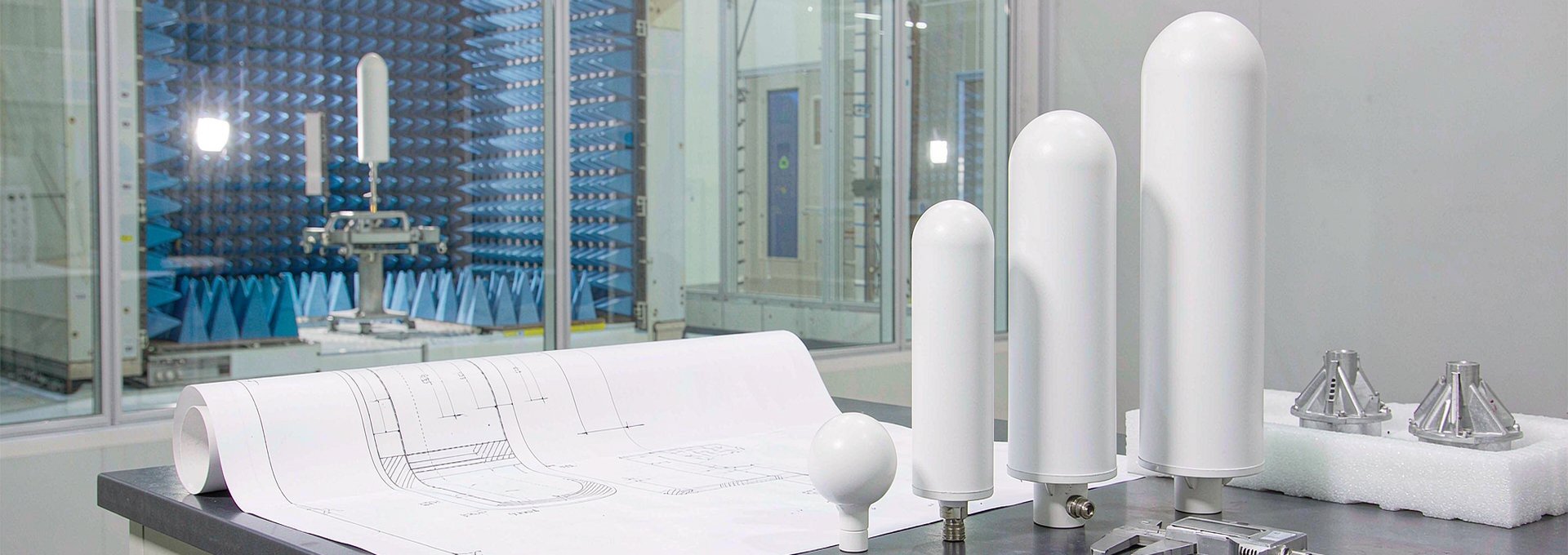
What changes the schedule on a custom antenna is how much of the chain sits under one roof. Machining, aluminium die-casting, injection moulding and laser work all run in the same plant as the design office, so a drawing becomes a sample without a subcontractor in the middle, and the tooling that made the sample is the tooling that serves volume. Low-PIM units are measured on our own chamber at -150 dBc at 2x20W, and the measurement record is packed with the goods rather than filed internally where nobody sees it. Recent work of this kind includes a dual-band sector antenna built for a mining communication site, a full-band anti-drone omni covering 433, 915, 1575, 2445 and 5850 MHz, and a dual-polarised parabolic dish for 6400-7200 MHz; a few more are written up in our case studies.
What comes back at each stage
A feasibility answer first, before any tooling money is committed, including the parts of the request that cannot be met as stated. Then the design itself, with the simulation work behind it, followed by a physical sample and its measured VSWR and gain rather than a promise. Once the sample is signed off, the same in-house chain carries it into production, and the test record travels with each shipment. If your product needs certification for a particular market, that requirement belongs in the first conversation, not after the design is frozen, because it affects materials and markings.
Starting a project
Send the band and the bandwidth you actually need, the gain and beam shape, the mechanical envelope, the environment, the connector and power, the annual volume, and the markets the product will be sold in. Missing items can be worked out together; the wrong assumption about frequency or envelope cannot be fixed later. You can reach the engineering team through contact us, and a first response normally comes back within 24 hours. The full range, including the standard parts that may already fit without any tooling at all, sits on the product overview page.
TAG:Custom Antenna Design Service: What to Send and What Comes Back https://www.rfelement.com