5G Horn Antenna | MIMO Feedhorn for Parabolic Dishes 1700-4200MHz
Achieve ultra-long-range 5G connectivity with RF element's professional 5G horn antenna. This MIMO feedhorn is engineered for parabolic dishes and grids, delivering up to 28dBi gain across 1700-4200MHz. Ideal for point-to-point backhaul, rural broadband, and wireless ISP applications. Its dual-polarized design ensures robust signal quality over distances. Request a quote for your long-range 5G link today!
Specifications
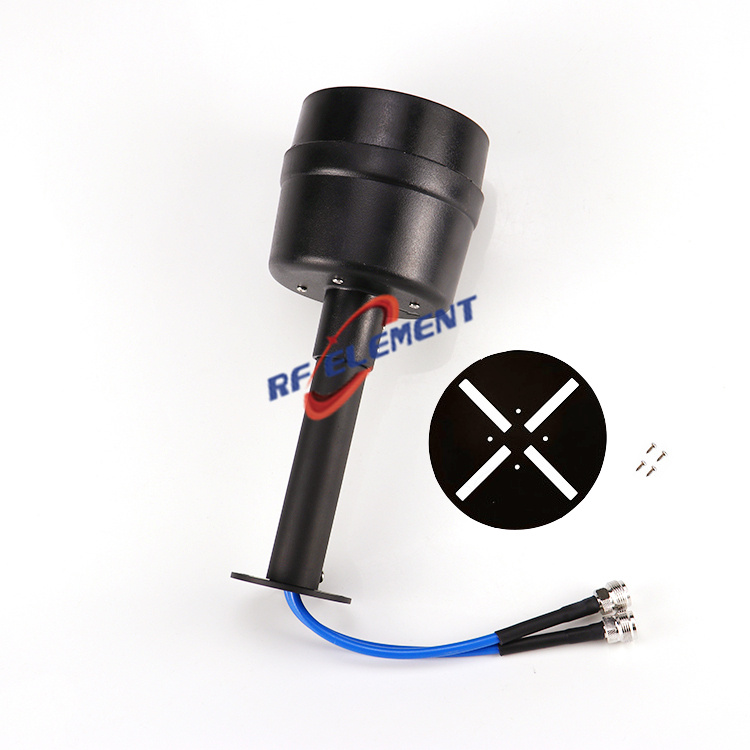
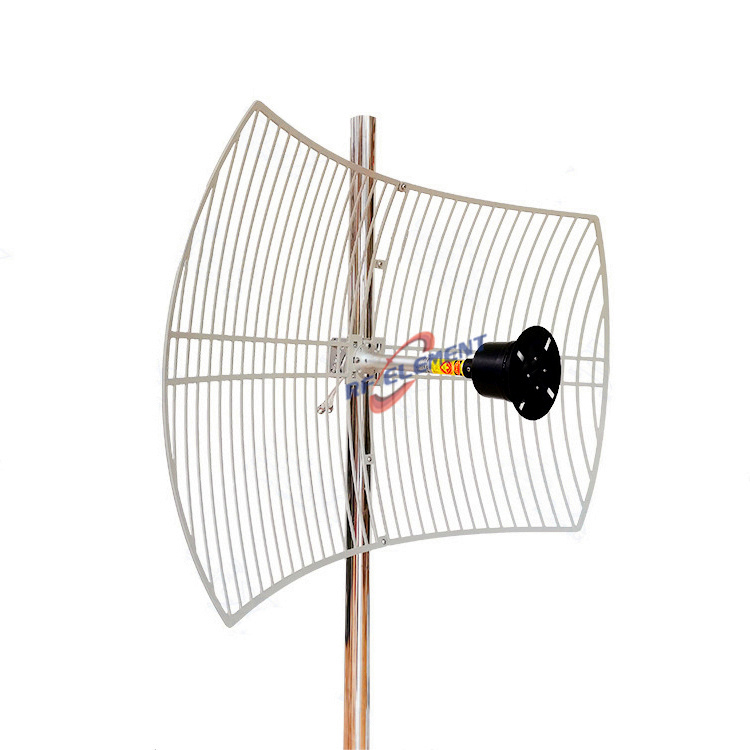
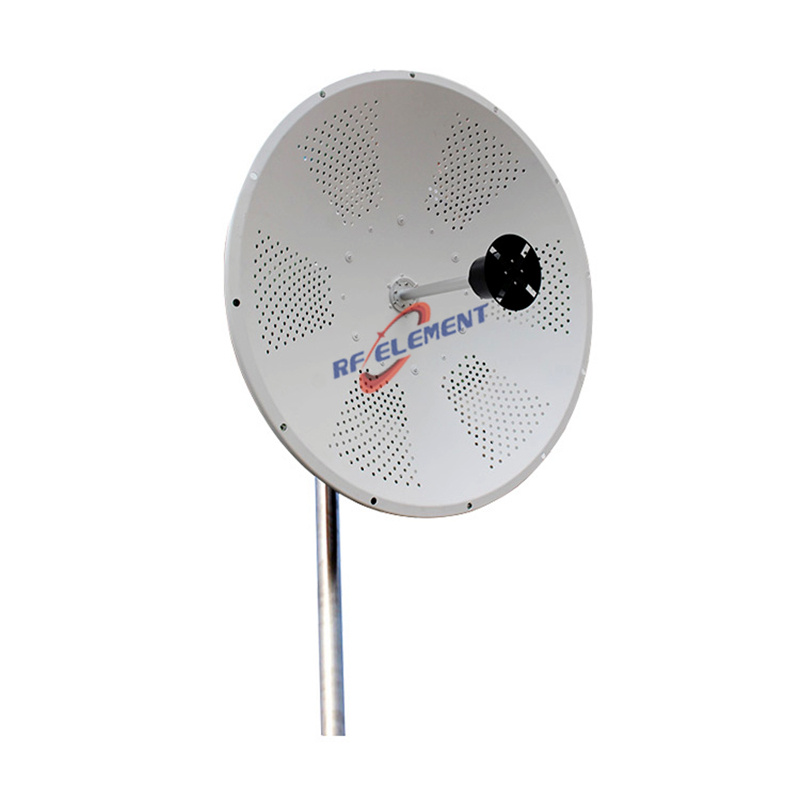
A dual polarized feedhorn that converts an existing parabolic reflector into a 1700 to 4200 MHz link, with two N-Type female ports and a 0.6 kg aluminium and ABS body. The gain depends on the reflector rather than on the horn alone: 25 or 23 dBi on 1710 to 2700 MHz, 27 or 25 dBi on 3300 to 3800 MHz and 28 or 26 dBi on 3800 to 4200 MHz, where the higher figure applies to a 60 by 90 cm grid and the lower to a 60 cm dish. VSWR rises from 1.5 to 1.8 across the three bands, the beam is 8 by 10 degrees at the bottom and 6 by 8 degrees at the top, and the port rating is 50 W.
The gain is a matrix, not a number
Six figures appear on the datasheet for one product because the antenna is only complete once a reflector is fitted. The 60 by 90 cm grid has 0.54 square metres of aperture and the 60 cm dish has 0.283 square metres, a ratio of 1.9, which is 2.8 dB of theoretical difference.
The table shows 2.0 dB at all three sub bands, so the open grid gives back about 0.8 dB to leakage through the mesh and to the slightly wider beam it produces. That 0.8 dB is a constant, not a frequency effect, and it is the price of carrying a grid rather than a solid dish. Quoting a feedhorn gain without naming the reflector is meaningless, and any supplier who does it should be asked which aperture the figure assumes.
Beamwidth tells you which reflector you have
On the 60 by 90 cm grid the beam is 8 degrees horizontal by 10 degrees vertical at 1710 to 2700 MHz, narrowing to 6 by 8 degrees at 3800 to 4200 MHz. The 60 cm dish gives 6 by 9 degrees at the bottom and 6 by 8 degrees at the top, because its narrower aperture in the horizontal plane sets a wider horizontal beam than the grid does.
For a 20 km link the 6 degree horizontal beam covers 2.1 km, so both reflectors have enough footprint to absorb a pointing error of half a degree, which moves the beam centre by 175 m. At that distance the vertical axis is the tighter of the two and the one that needs a level rather than a bearing.
One horn, three bands, one feeder
Covering 1710 to 2700, 3300 to 3800 and 3800 to 4200 MHz from one port pair is what makes this part useful in a retrofit. The site keeps its existing 60 cm dish or 60 by 90 cm grid, its existing pole and its existing feeder, and only the horn and the radio change.
VSWR shows where the horn was tuned. It is 1.5 at 1710 to 2700 MHz, 1.6 at 3300 to 3800 MHz and 1.8 at 3800 to 4200 MHz. The top band is still usable at 1.8, which is a return loss of 10.9 dB, but a site that runs only at 3.8 to 4.2 GHz should sweep the installed match rather than assume the datasheet figure.
| Frequency Range | 1700-4200MHz | ||
| Frequency Sub-Range(Mhz) | 1710-2700 | 3300-3800 | 3800-4200 |
| Polarization | Horizontal+Vertical | ||
| Gain(dBi) | 25(60*90cm grid) / 23(60cm dish) | 27(60*90cm grid) / 25(60cm dish) | 28(60*90cm grid) / 26(60cm dish) |
| Horizontal Beam width | 8° | 6° | 6° |
| Vertical Beam width | 10° | 9° | 8° |
| Impedance | 50Ω | ||
| VSWR | ≤1.5 | ≤ 1.6 | ≤ 1.8 |
| Maximum Power | 50 W | ||
| Connector Type | 2 Port, N-Type Female | ||
| Feeder Horn Weight | 0.6 kg | ||
| Operating Temperature | -55° to +60° C (-67° to +140° F) | ||
| Radome Material | Aluminum, ABS | ||
| Radome Color | Black | ||
| Mounting Options | Pole Mounting | ||
0.6 kg replaces a whole antenna
The horn weighs 0.6 kg and fits on the feed support of a standard dish. Comparing that with a new integrated parabolic antenna, the saving is not only the cost of the reflector: the existing mount, the existing tower loading calculation and the existing feeder entry all stay in place. On a rooftop where a new 60 cm dish would need a structural check, swapping the horn avoids that step entirely.
The body is aluminium with an ABS radome in black. Black is the usual choice for a feed that sits at the focus, because the focus sees the highest concentrated solar load of any point on the assembly. Keep the drain path clear when the dish is mounted on a horizontal boom.
Ordering
Two N-Type female ports are standard, the polarization is horizontal plus vertical, and the horn is supplied with the feed clamp for a 60 cm dish or a 60 by 90 cm grid. Samples in 3-5 days, production in 15-25 days.
For a network that only needs 3300 to 3800 MHz, the n78 MIMO feedhorn is the narrow band alternative with a 1.5 match and 23 dBi on a 60 cm dish. For the wider 5G range that includes the 700 MHz coverage bands, see 5G antenna.
Send the reflector you already have, its diameter and the bands in use. The diameter sets the gain from the matrix above, and the bands decide whether one horn covers them or a narrow band part does the job with a tighter match. For a comparison of reflector sizes against the gain each one produces, the antenna selector lists dishes and grids with their matching feedhorns.
FAQ — 5G Horn Antenna
What is the 5G Horn Antenna used for?
What frequency band does the 5G Horn Antenna cover?
What are the key specifications of the 5G Horn Antenna?
Can RF element customize the 5G Horn Antenna for my application?
What is the MOQ and lead time for the 5G Horn Antenna?
How do I get a quotation for the 5G Horn Antenna?