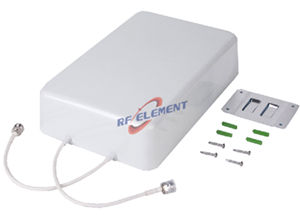
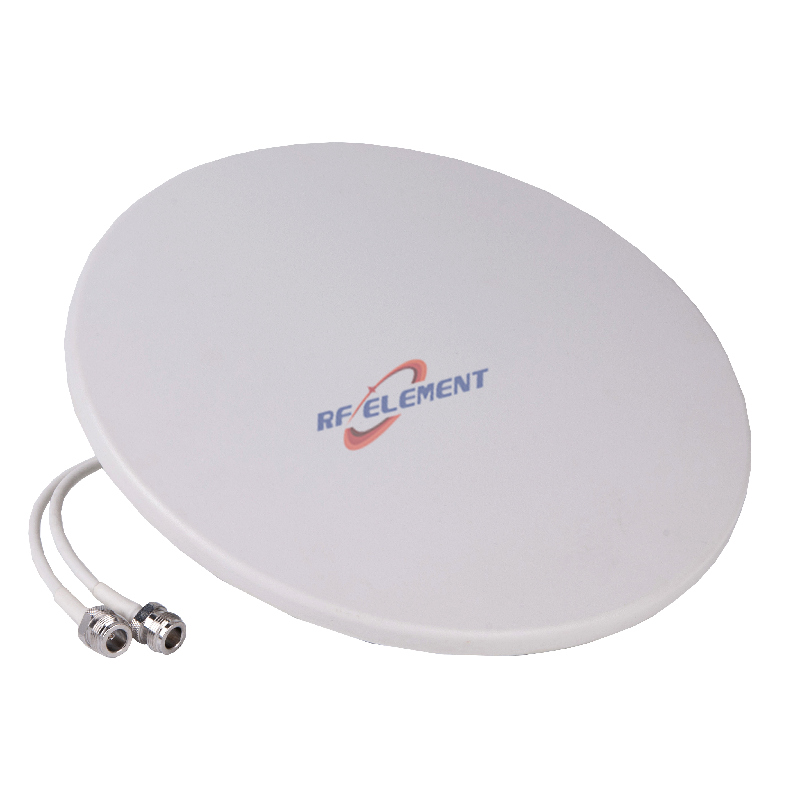
Wideband 5G MIMO Ceiling Antenna | 698-4200MHz Indoor Antenna
Specifications
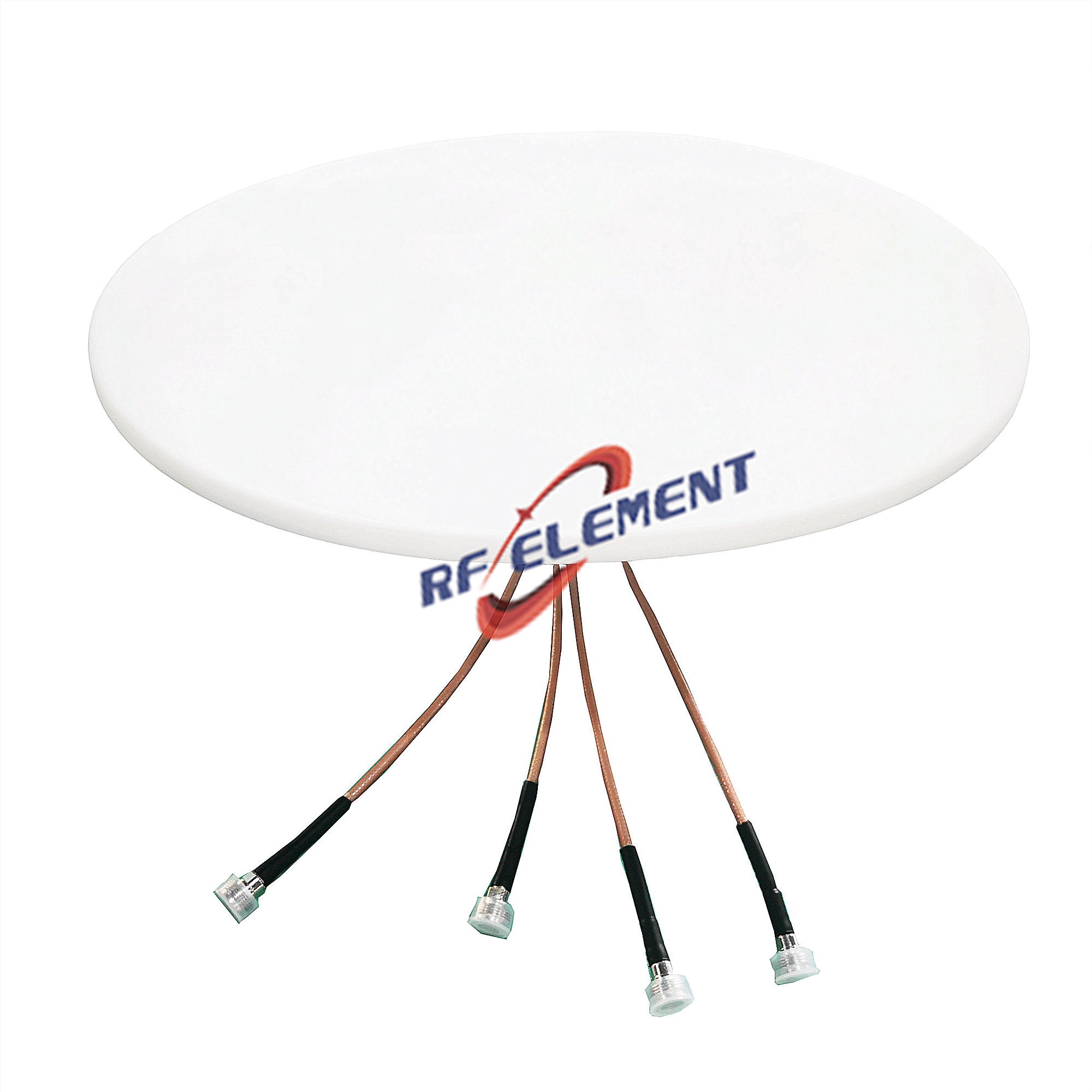
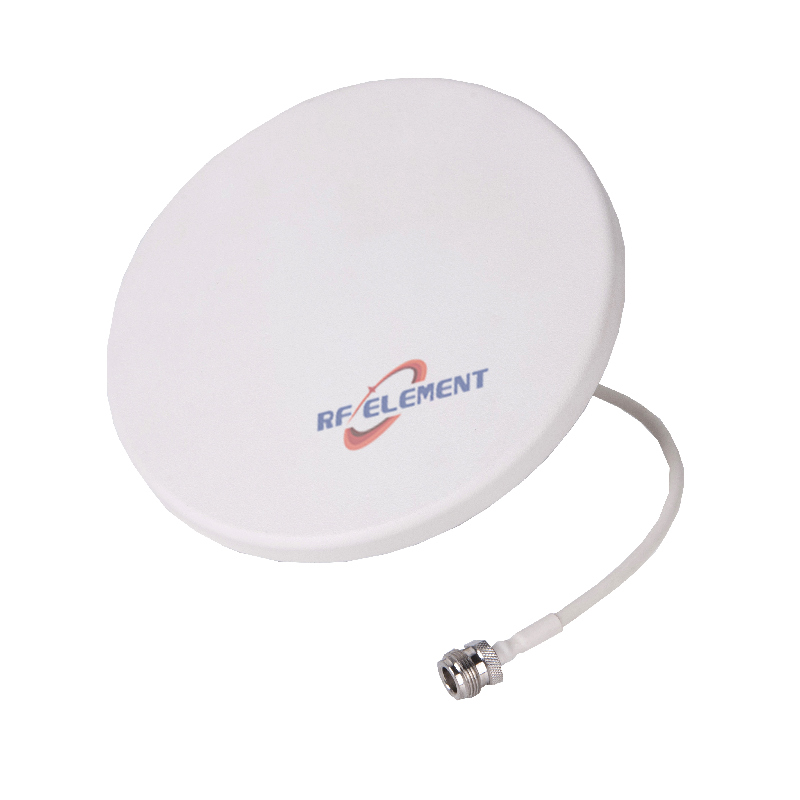
Two ports, 280 mm square, 15 mm deep, and a return loss figure that stays at or below 1.5 across the whole 698-4200 MHz range rather than relaxing at the edges. That last detail is the reason to choose this unit over a cheaper wideband plate: on a neutral host DAS where several operators share the same passive layer, a mismatched edge band shows up as a coverage hole at the cell boundary that no amount of remote unit power will fix.
Why flat VSWR matters more than peak gain
Gain figures are quoted per sub-range and are easy to compare. Return loss is usually quoted as a single worst-case number, which hides where the worst case sits. Here the worst case is 1.5 everywhere, including 3800-4200 MHz, where many plates drift to 1.8 or higher. The practical consequence is that the antenna presents the same load to the remote unit in every band, so a commissioning sweep does not throw up one band that needs a different cable length or a different power setting.
| Frequency Range | 698-4200MHz | ||||
| Frequency Sub-Range(Mhz) | 698-806 | 806-960 | 1710-2700 | 3300-3800 | 3800-4200 |
| Polarization | Vertical | ||||
| Gain(dBi) | 1.5±0.5 | 2.2±0.5 | 3.5±0.5 | 4.5±0.5 | 5.5±0.5 |
| Horizontal Beam width | 360° | ||||
| Vertical Beam width | 90±10° | 85±10° | 65±10° | 40±20° | 40±20° |
| Impedance | 50Ω | ||||
| VSWR | ≤ 1.5 | ≤ 1.5 | ≤ 1.5 | ≤ 1.5 | ≤1.5 |
| 3rd Order for 2×20 W Carriers | -153 dBc | ||||
| Isolation | ≥ 15dB | ≥ 18 dB | ≥ 12 dB | ≥ 15 dB | ≥22 dB |
| Maximum Power | 50 W | ||||
| Connector Type | 2 Port, 4.3-10 Female or N-Type Female | ||||
| Length | 280 mm | ||||
| Width | 280 mm | ||||
| Depth | 15 mm | ||||
| Net Weight | 0.4 kg | ||||
| Operating Temperature | -55° to +60° C (-67° to +140° F) | ||||
| Radome Material | Plastic ABS | ||||
| Radome Color | White | ||||
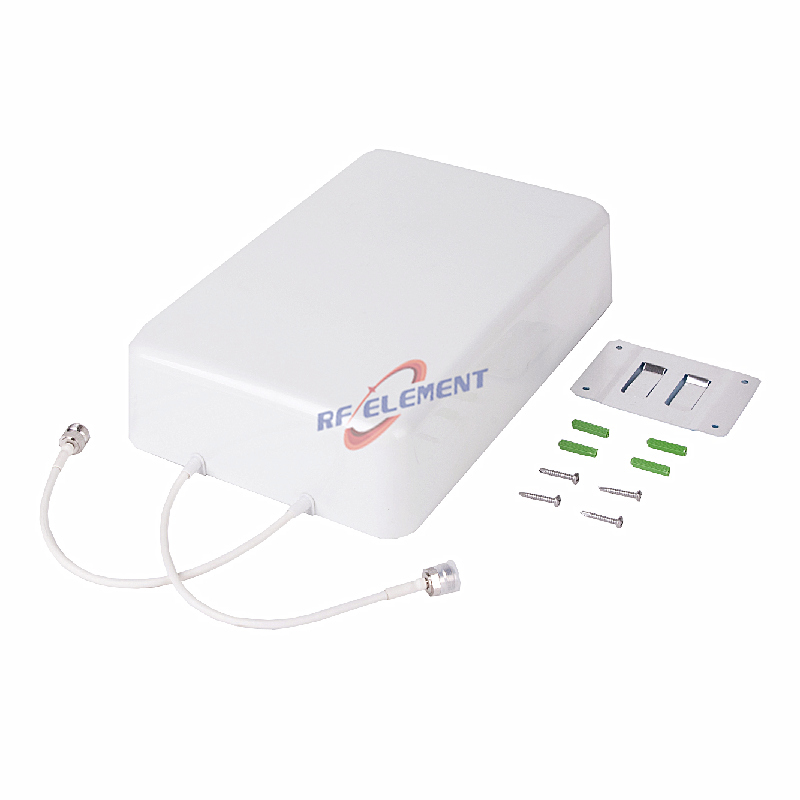
| Mounting Options | Fasteners and screws included for wall mounting | ||||
Isolation between the two ports is 12 dB at 1710-2700 MHz, the lowest value in the table, and 22 dB at 3300-3800 MHz. The low figure in the mid band is a property of the shared radiating structure at that wavelength, not a defect; it constrains how independently the two streams can be driven, which is worth checking against the remote unit's MIMO configuration rather than against the antenna data sheet alone.
2x2 in a 280 mm plate
A 280 mm aperture is the largest that still fits a standard 600 mm grid without overhanging a tile joint, and the 15 mm depth clears most suspended ceiling voids. Weight is 0.4 kg, so a single drop wire and a standard grid clip carry it without a secondary support. The two ports are 4.3-10 Female or N-Type Female at order.
For a floor that needs four streams, this unit can be paired: two plates at right angles give four ports and better spatial separation than one 385 mm four-port plate, at the cost of a second ceiling penetration. Whether that trade is worth it depends on how much separation the remote unit expects between streams.
Layout and cabling
Space ceiling positions at roughly 1.5 times the mounting height for a 40-65 degree vertical beamwidth; at 3 m that is about 4.5 m centres, which matches a typical grid module. Keep the plate at least 300 mm from metal pipework and do not mount it inside a closed metal enclosure, which would turn an omnidirectional pattern into a resonator.
The 2x2 configuration doubles the cable count per position. Where the cable tray is already full, the alternative is the 4x4 slim ceiling plate, which puts four ports on one 13 mm plate and removes the second penetration entirely.
Where it belongs
Office floors, conference centres, airport lounges and hospital wings where the band plan runs from 700 MHz to 4.2 GHz and the design has to stay valid when a new operator joins. It is also the sensible default for an in-building DAS that has not yet fixed its operator mix, because the flat return loss leaves headroom for a band that is not in use today.
Customisation and ordering
Connector type, radome colour and packing quantity are selectable. The 698-4200 MHz span and the flat VSWR are properties of the current structure; narrowing the band would not improve them further, and widening it would cost return loss at the top end. Samples in 3-5 days, production in 15-25 days.
Send the full band plan and the remote unit model. If the remote unit is 4x4, we will quote the four-port plate instead; if the band plan stops at 3.8 GHz, the 698-3800 MHz version is cheaper for the same performance in the bands you actually use.
FAQ — Wideband 5G MIMO Ceiling Antenna
What is the Wideband 5G MIMO Ceiling Antenna used for?
What frequency band does the Wideband 5G MIMO Ceiling Antenna cover?
What are the key specifications of the Wideband 5G MIMO Ceiling Antenna?
Can RF element customize the Wideband 5G MIMO Ceiling Antenna for my application?
What is the MOQ and lead time for the Wideband 5G MIMO Ceiling Antenna?
How do I get a quotation for the Wideband 5G MIMO Ceiling Antenna?