
900MHz MIMO Yagi Antenna | Dual Polarity 11dBi Gain
Specifications
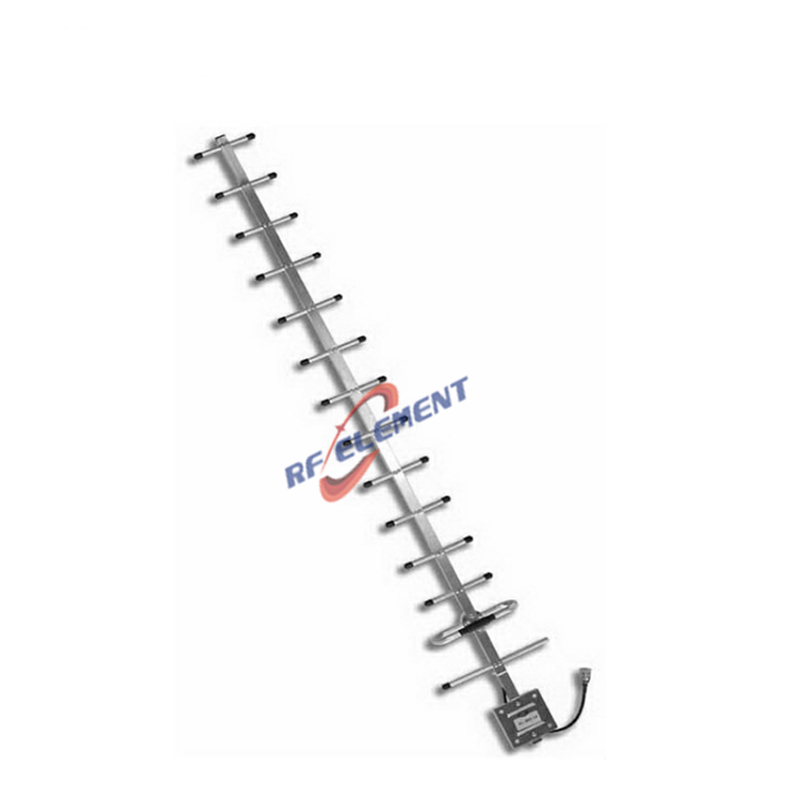
A 900 MHz Yagi with two ports on a plus or minus 45 degree polarisation lattice, 11 dBi of gain and a stainless steel frame, 1020 mm long and 1.8 kg in weight. The horizontal beam is 45 degrees and the vertical beam 40 degrees, VSWR is at or below 1.8 across 900-930 MHz, and both outputs are N-Type female.
Dual polarisation on a Yagi is unusual
Most Yagi antennas are single polarised because the element geometry makes it difficult to interleave two orthogonal arrays without disturbing the pattern. This one interleaves them along the same boom, which allows a 2x2 MIMO radio at 900 MHz to use one antenna instead of two separate Yagis on a cross-arm.
The benefit is not only mechanical. Two separate Yagis on a short cross-arm couple into each other and their patterns distort; a single interleaved structure keeps both polarisations on the same boresight, so the two MIMO branches see the same coverage area. That matters for a 900 MHz access point serving LoRa, RFID or GSM clients in one direction.
Choosing the polarisation angle
The plus or minus 45 degree lattice is the standard for cellular and public safety radios, and it is also what most 900 MHz MIMO access points expect. If the far end uses a vertically polarised antenna, the cross-polar discrimination between the two ends will be poor and the link will lose most of the benefit of the second branch.
For a LoRa gateway or an RFID reader with a single vertical antenna, this Yagi can be used with one port connected and the other terminated, but the gain figure then applies to the single port only and the second port reflects rather than radiates. Terminate the unused port with a 50 ohm load rather than leaving it open.
| Frequency Range | 900-930MHz | |
| Polarization | ±45° | |
| Gain(dBi) | 11 | |
| Horizontal Beamwidth | 45° | |
| Vertical Beamwidth | 40° | |
| Impedance | 50Ω | |
| VSWR | ≤ 1.8 | |
| Maximum Power | 50W | |
| Connector Type | 2 Port, N-Type Female | |
| Antenna Dimension(mm) | 1020*140 | |
| Net Weight | 1.8 kg | |
| Operating Temperature | -55° to +60° C (-67° to +140° F) | |
| Material | Stainless Steel | |
| Radome Color | White or Black | |
| Mounting Options | Pole Mounting | |
Stainless steel in a coastal environment
The frame is stainless steel rather than aluminium, which is the specification that matters on a coastal or industrial site. Aluminium Yagis corrode at the element-to-boom joints, and the corrosion changes the contact resistance and therefore the pattern and the match. A stainless frame costs more and weighs more, but it holds its electrical performance over a longer service life.
At 1.8 kg and just over a metre long, the antenna still needs a pole of 40 mm or more and two clamps along the boom. Check the fixings for galvanic corrosion where stainless steel meets a galvanised pole, and isolate with a nylon washer if the site is wet or coastal.
Coverage for LoRa, RFID and GSM
The 45 degree horizontal beam at 11 dBi covers about 83 m of width at 100 m and 414 m at 500 m. For a LoRa gateway on a rooftop serving sensors in one direction, that is a good match: the narrow beam gives range without illuminating the whole neighbourhood. For an RFID portal that has to cover a 90 degree dock opening, the beam is too narrow and a panel is the better tool.
The 900-930 MHz band is narrower than the GSM 900 band, so this antenna will not cover the 824-960 MHz range. If the site uses both the 850 MHz cellular band and the 900 MHz ISM band, a wider band Yagi is required and this one should not be specified.
Ordering
Two N-Type female ports are standard, with radome colour and packing quantity confirmed at order. Samples in 3-5 days, production in 15-25 days.
Where the site needs the full 824-960 MHz range on a single port, the 14 dBi 900 MHz GSM Yagi antenna covers the wider band with a 40 degree beam. For a shorter, lighter Yagi on the same band, the 12 dBi GSM Yagi antenna is 800 mm long at 0.6 kg.
Send the radio port count, the polarisation of the far end and the band plan. The polarisation match between the two ends is the detail that decides whether the second branch is worth connecting.
FAQ — 900MHz MIMO Yagi Antenna
What is the 900MHz MIMO Yagi Antenna used for?
What frequency band does the 900MHz MIMO Yagi Antenna cover?
What are the key specifications of the 900MHz MIMO Yagi Antenna?
Can RF element customize the 900MHz MIMO Yagi Antenna for my application?
What is the MOQ and lead time for the 900MHz MIMO Yagi Antenna?
How do I get a quotation for the 900MHz MIMO Yagi Antenna?