

2.4GHz WiFi Omni Antenna | WiFi Booster Omni Antenna | 8dBi
Specifications
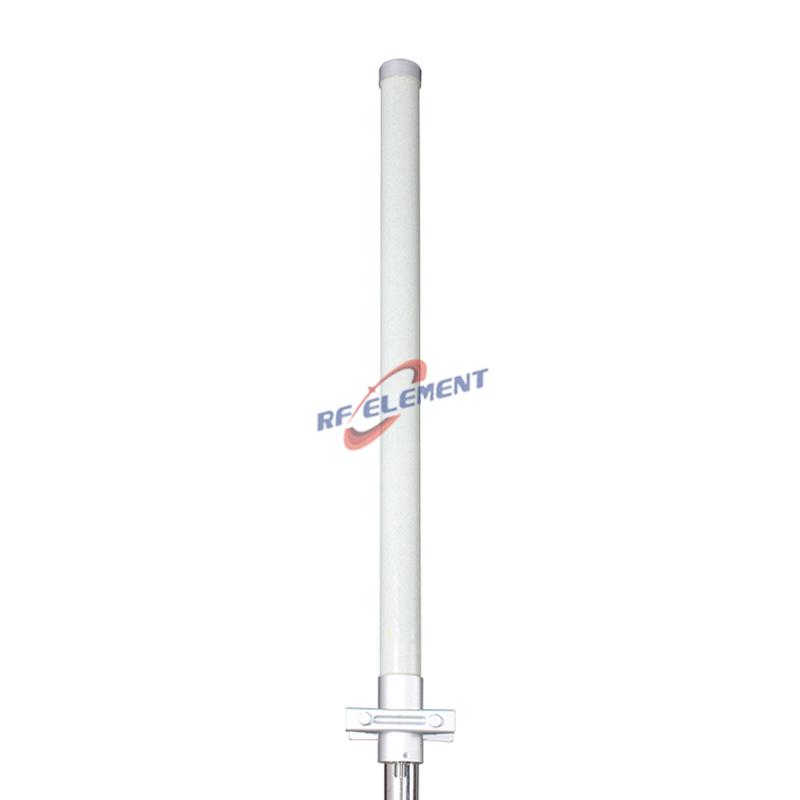
A slim fibreglass omni for 2.4 GHz hotspot and booster installations, 22 mm in diameter and 560 mm long, weighing 0.5 kg. Gain is 8 dBi with a 360 degree horizontal pattern and a 15 degree vertical beam, VSWR is at or below 1.5 across 2400-2500 MHz, and the single port is available as N-Type female or N-Type male. The radome is white or grey.
Why 8 dBi is the working figure at low height
At 8 dBi the vertical beam is 15 degrees wide, which is a useful compromise for an antenna mounted between 3 and 8 m: the beam reaches the ground close enough to the pole to cover the immediate area and still carries a usable signal to the far edge of an outdoor hotspot. Going up to 13 dBi narrows the beam to 8 degrees and pushes the inner edge of coverage further out, which is the wrong trade when the users are near the mast.
At 5 m mounting height, a 15 degree beam intersects the ground at about 19 m from the base and stays above the noise floor out to roughly 150 m with a typical 20 dBm access point and a 10 dBi subscriber unit. Those numbers shift with cable loss and local clutter, but the geometry is the part that matters when choosing between 5, 8 and 13 dBi.
Fibreglass instead of ABS
The 22 mm radome is filament wound fibreglass, which is the reason the antenna can be this slim at 560 mm long. Fibreglass has lower loss than a thick ABS wall at 2.4 GHz and does not deform in direct sun, so the pattern stays stable across the operating temperature range of -55 to +60 C. The trade is weight distribution: the radome is stiff but the internal element stack is light, so the antenna should be clamped at the base rather than gripped in the middle.
Where the installation is indoors or under a canopy, the ABS units in the range are cheaper and perform identically. The fibreglass advantage is in ultraviolet exposure and in the slimmer profile that reduces wind load on a lightweight pole.
Choosing the connector
The N-Type male version screws directly onto a bulkhead or a short pigtail and removes one interface from the weather path, which is why it is the usual choice on a mast. The N-Type female version is used where the feeder terminates in a male connector or where the antenna may be swapped without replacing the cable.
Every additional connector in an outdoor 2.4 GHz run costs roughly 0.1 dB and adds a water ingress point. On a 560 mm antenna with 8 dBi, that loss is small, but the reliability benefit of fewer joints is not. Seal whichever interface you use with self-amalgamating tape, not PVC tape.
| Frequency Range | 2400-2500MHz | |
| Polarization | Vertical | |
| Gain(dBi) | 8 | |
| Horizontal Beamwidth | 360° | |
| Vertical Beamwidth | 15° | |
| Impedance | 50Ω | |
| VSWR | ≤ 1.5 | |
| Maximum Power | 50W | |
| Connector Type | 1 Port, N-Type Female/ N-Type Male | |
| Antenna Dimension(mm) | Φ 22*560/Φ 20*560 | |
| Net Weight | 0.5 kg | |
| Operating Temperature | -55° to +60° C (-67° to +140° F) | |
| Radome Material | Fiberglass | |
| Radome Color | White or Grey | |
| Mounting Options | Pole mounting | |
Coverage shape in practice
An omni pattern is only circular in free space. Mounted on a wall, the 360 degree figure becomes a cardioid with a null behind the mounting surface, and mounted close to a metal pole the pattern splits into two lobes. Keep at least 200 mm between the radome and any metal surface at 2.4 GHz, and prefer a fibreglass or timber mounting arm over a steel one where the choice exists.
Two of these antennas on the same mast should be separated vertically by at least 1.5 m. At closer spacing the vertical beams overlap and the two radios interfere with each other more than they serve the same area.
Ordering
Connector gender, radome colour and packing quantity are confirmed at order. Samples in 3-5 days, production in 15-25 days.
If the access point is 2x2 MIMO, the dual-polarised 13 dBi omni carries both branches in one radome at 3.2 kg. For a shorter unit with a wider vertical beam, the 5 dBi 2.4 GHz omni antenna is 300 mm long and weighs 0.2 kg.
Tell us the mounting height, the required radius and the radio connector. Those three details fix the gain class and the interface, and they are the only things that usually need to change between sites.
FAQ — 2.4GHz WiFi Omni Antenna
What is the 2.4GHz WiFi Omni Antenna used for?
What frequency band does the 2.4GHz WiFi Omni Antenna cover?
What are the key specifications of the 2.4GHz WiFi Omni Antenna?
Can RF element customize the 2.4GHz WiFi Omni Antenna for my application?
What is the MOQ and lead time for the 2.4GHz WiFi Omni Antenna?
How do I get a quotation for the 2.4GHz WiFi Omni Antenna?