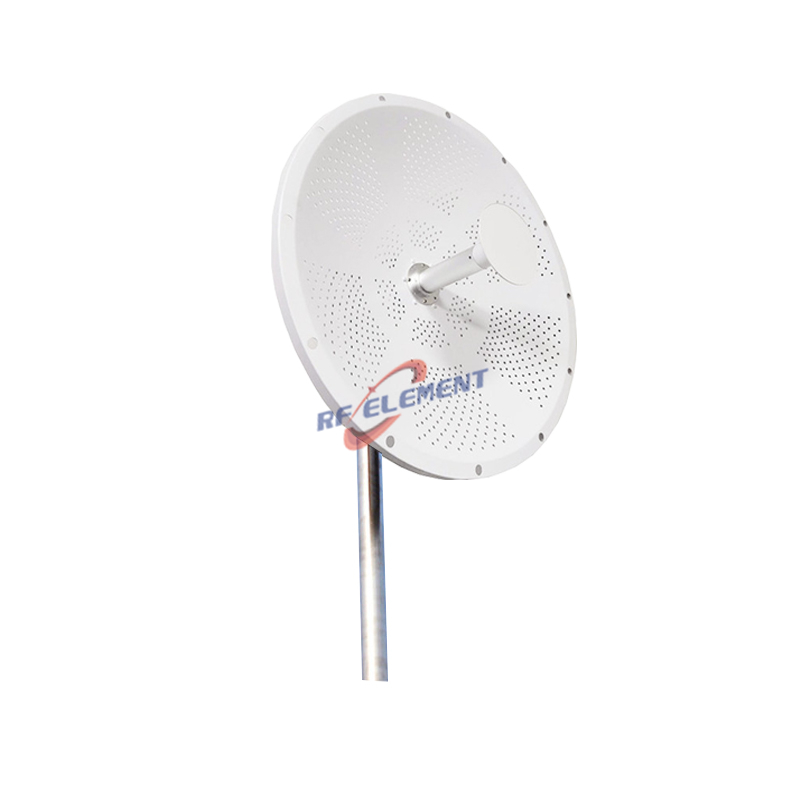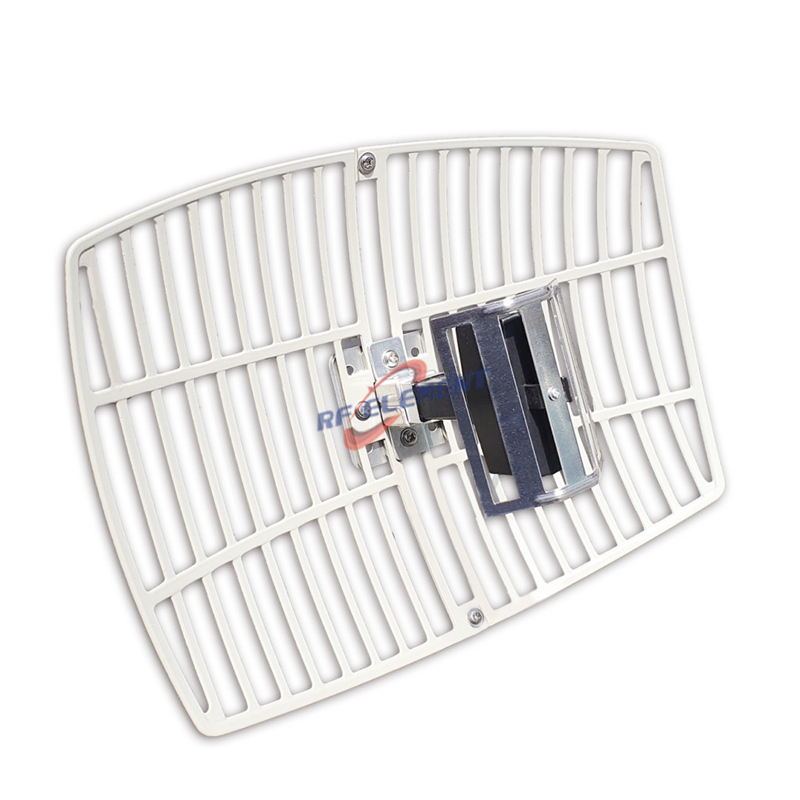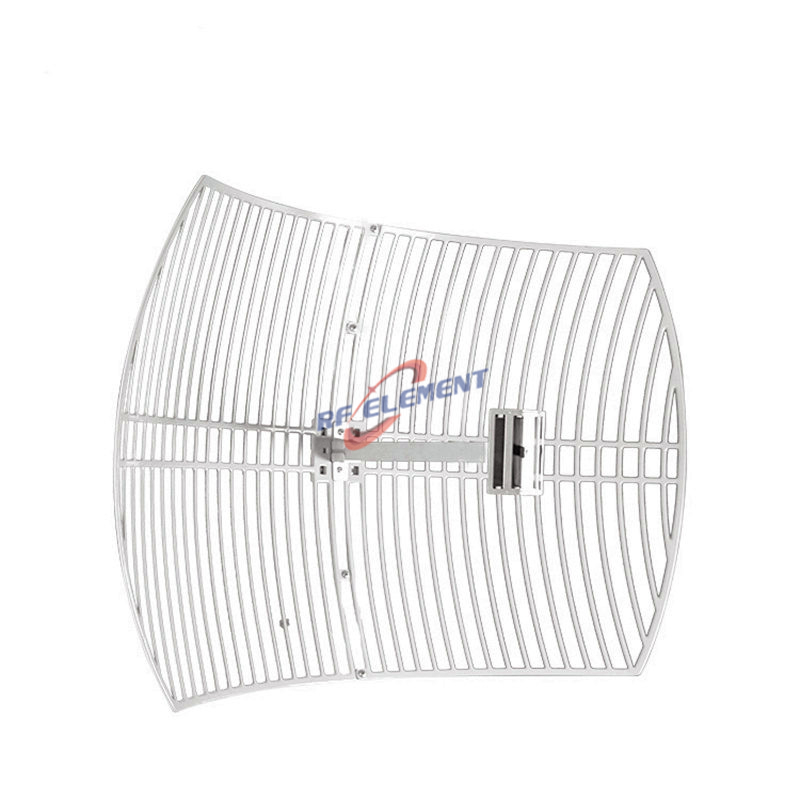


5GHz MIMO Parabolic Dish Antenna | 34dBi Dual Polarized 90cm Parabolic Dish Antenna
Specifications
A 900 mm parabolic dish for 4900 to 6000 MHz with two N-Type female ports on orthogonal polarizations and 31 to 34 dBi of gain across the three sub bands. The horizontal beamwidth is 4 degrees, the vertical beamwidth is 3 degrees, front to back ratio is at least 35 dB, cross polarization isolation is at least 30 dB, and each port handles 100 W. The reflector is aluminium with a grey or white finish, the assembly weighs 12 kg, and it ships in a 100 by 23 by 100 cm case.
Four decibels is 1.58 times the distance
Against the 600 mm dish, this reflector adds 4 dB at the top of the band. Range grows with the square root of the gain ratio, so 4 dB is a factor of 1.58 on the same path with the same radios. A 20 km link becomes a 31 km link, and that is the entire commercial case for the larger dish.
There is a second way to use the gain figure. A 34 dBi antenna has an effective area of about 0.53 square metres at 5800 MHz, against 0.64 square metres of physical dish. When a path calculation tool asks for effective aperture rather than dBi, that is the number to enter, and it is also the fastest way to check a competitor sheet: a 34 dBi claim on a 900 mm dish is physically consistent, while the same claim on a 600 mm dish is not.
A 3 degree beam over 30 km
At 30 km the 3 degree vertical beam covers 1.57 km and the 4 degree horizontal beam covers 2.1 km. That sounds generous until the pointing budget is worked through. Half a degree of elevation error moves the beam centre by 262 m at that distance, which is one sixth of the beam width, so the aim has to be set with a level and a received signal reading rather than with a compass bearing.
The vertical beam is the tighter of the two and it is also the axis that ground curvature works against. Over 30 km the earth bulges 17.7 m above the straight chord at the mid point, so the far antenna appears about 0.034 degrees lower than a flat earth calculation would predict. That is small, but it is the same order as a mast settling by a few centimetres, which is why long links are re peaked after the first month rather than only at commissioning.
The Fresnel zone sets the mast height
At 30 km on 5800 MHz the first Fresnel radius at the mid point is about 19.7 m. For a clear line of sight with 60 percent clearance, the path needs roughly 12 m of clear space above the obstruction at the mid point, and the mast height follows from the terrain profile rather than from the antenna gain.
This is the figure that decides whether a 34 dBi dish is worth buying. If the profile only allows a mast that gives 40 percent clearance, the extra 4 dB is spent on diffraction loss before it reaches the receiver, and the smaller dish on a taller mast will outperform the larger dish on a short one.
| Frequency Range | 4900-6000MHz | |||||
| Frequency Sub-Range(Mhz) | 4900-5150 | 5150-5850 | 5850-6000 | |||
| Polarization | Horizontal+Vertical | |||||
| Gain(dBi) | 31±0.5 | 33±0.5 | 34±0.5 | |||
| Horizontal Beam width | 4±0.5° | |||||
| Vertical Beam width | 3±0.5° | |||||
| Impedance | 50Ω | |||||
| VSWR | ≤ 1.8 | ≤ 1.5 | ≤2.0 | |||
| Front-to-Back Ratio | ≥35dB | |||||
| Cross-Pol Isolation | ≥30dB | |||||
| Maximum Power | 100W | |||||
| Connector Type | 2 Port, N-Type Female | |||||
| Antenna Size | Φ900mm | |||||
| Weight | 12kg | |||||
| Packing Size | 100*23*100cm | |||||
| Operating Temperature | -55° to +60° C (-67° to +140° F) | |||||
| Material | Aluminum | |||||
| Color | Gray or White | |||||
| Mounting Options | Hange on pole | |||||
12 kg and a 100 cm packing case
The dish breaks down into a reflector, a feed support and a mount, and the packed case is 100 by 23 by 100 cm. That is a one person carry on flat ground and a two person lift onto a mast, which is the practical difference from the 7 kg unit.
The wind area is 0.64 square metres, giving about 420 N of drag at 30 m per second with a coefficient of 1.2. Use a 76 mm pole or larger for an exposed site and check the clamp bolts after the first storm. The 35 dB front to back ratio also means the mast itself sits in a deep null, so a rear mounted dish does not illuminate its own structure as strongly as a lower ratio design would.
Ordering
Two N-Type female ports are standard, the finish is grey or white, and the mount suits a 60 to 90 mm pole. Samples in 3-5 days, production in 15-25 days.
For paths under 20 km, the 60 cm reflector carries 4 dB less gain with two thirds of the wind load. For the selection logic between the two, see the 5 GHz MIMO dish antenna guide. Where the requirement is coverage rather than a single hop, the 360 degree sector antenna covers a site from one mast, and for a higher band the 7 GHz microwave dish uses the same mounting practice.
Send the path profile, the required availability and the tower space available. The profile sets the Fresnel clearance, the availability sets the fade margin, and the tower space decides whether a 900 mm reflector can be aimed without fouling the structure.
FAQ — 5GHz MIMO Parabolic Dish Antenna
What is the 5GHz MIMO Parabolic Dish Antenna used for?
What frequency band does the 5GHz MIMO Parabolic Dish Antenna cover?
What are the key specifications of the 5GHz MIMO Parabolic Dish Antenna?
Can RF element customize the 5GHz MIMO Parabolic Dish Antenna for my application?
What is the MOQ and lead time for the 5GHz MIMO Parabolic Dish Antenna?
How do I get a quotation for the 5GHz MIMO Parabolic Dish Antenna?