

Dual Band WiFi Omni Antenna | 2.4GHz/5GHz 9dBi
Specifications
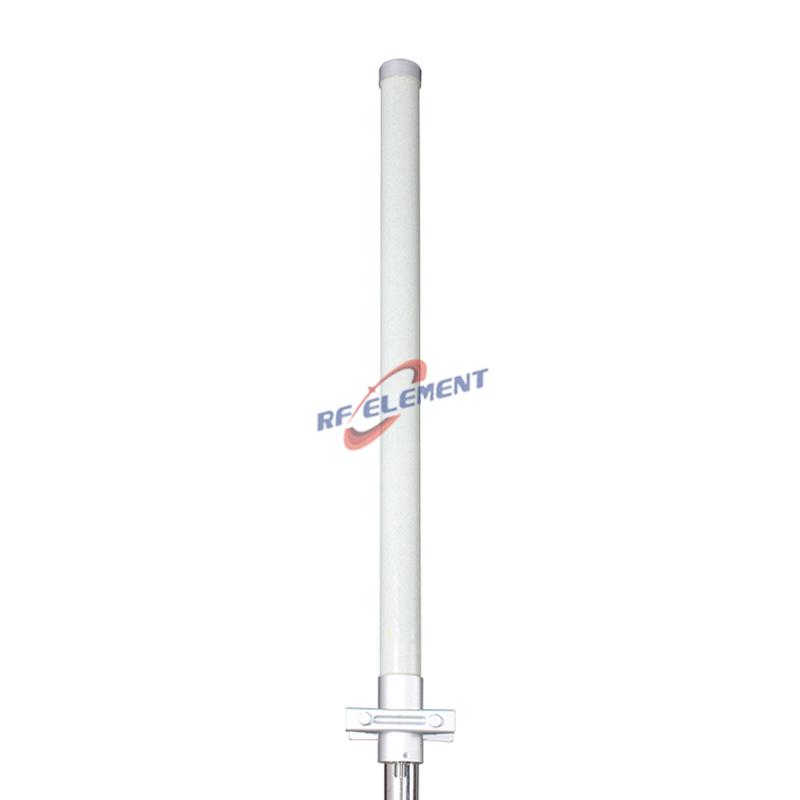
A dual-band omni that combines both polarisations into one 1250 mm radome, with four N-Type female ports on a 75 mm diameter white ABS body weighing 3.2 kg. Gain is 8 dBi at 2400-2500 MHz and 9 dBi at 5150-5850 MHz, with vertical beamwidths of 10 and 9 degrees and a full 360 degree horizontal pattern. VSWR is at or below 2.0 and maximum power is 50 W.
Four ports across two bands: read the mapping
Four ports and two bands means two branches per band, one vertical and one horizontal. That is a 2x2 MIMO arrangement on each band, not a 4x4 on each band. A radio that needs four chains at 5 GHz would need eight ports in total, which is not what this housing provides.
This is the single most common misunderstanding in dual-band omni selection, and it is worth settling before a purchase order rather than after delivery. If the access point is 2x2 per band, this antenna is a good match and the four feeders are manageable. If it is 4x4 per band, the installation needs two antennas or a different product.
Why the beam is wider than the single-band unit
At 1250 mm the radome is the same length as the SISO dual-band unit, but the gain is lower: 8 dBi against 9 dBi at 2.4 GHz and 9 dBi against 12 dBi at 5 GHz. The difference comes from splitting the aperture between two polarisations rather than using all of it for one. The result is a wider vertical beam, 10 degrees at 2.4 GHz and 9 degrees at 5 GHz.
For coverage design that is not a disadvantage. The wider beam puts the inner edge of coverage closer to the mast and makes the antenna less sensitive to mounting height errors, which is useful when the same design is repeated across many sites with different pole heights.
| Frequency Range | 2400 – 2500 MHz | 5150 – 5850 MHz |
| Polarization | Horizontal+Vertical | |
| Gain(dBi) | 8dBi | 9dBi |
| Horizontal Beamwidth | 360° | |
| Vertical Beamwidth | 10° 9° | |
| Impedance | 50Ω | |
| VSWR | ≤ 2.0 | |
| Maximum Power | 50W | |
| Connector Type | 4 Ports, N-Type Female | |
| Antenna Dimension(mm) | Φ75*1250 | |
| Net Weight | 3.2kg | |
| Operating Temperature | -55° to +60° C (-67° to +140° F) | |
| Radome Material | ABS | |
| Mounting Options | Hanged on pole | |
Two polarisations in one radome
The horizontal and vertical elements share the same 75 mm enclosure, so the cross-polar discrimination is lower than in a panel where the elements can be spaced properly. At 2.4 GHz the two branches are partially correlated at the horizon, and the MIMO benefit is realised mainly where the environment provides scattering. At 5 GHz the spacing is a larger fraction of a wavelength and the branches decorrelate more effectively.
Where the link is a clean point-to-point path with no scattering, expect the second branch to contribute little regardless of the antenna, and size the link budget on a single stream.
3.2 kg on a 1.25 m pole
This is the heaviest antenna in the dual-band omni family, and the load is a combination of weight and wind area. Clamp at the base fitting and at a second point no more than 800 mm up the radome. On a rooftop mast, check the design wind speed against the projected area rather than against the weight alone: at 40 m/s this antenna presents roughly 12 kg of equivalent load at the clamp.
Keep the radome 200 mm clear of the pole at 2.4 GHz and 125 mm at 5 GHz. A 75 mm radome close to a metal mast produces a null that is deep enough to look like a failed radio during commissioning.
Ordering
Four N-Type female ports, radome colour and packing quantity are confirmed at order. Samples in 3-5 days, production in 15-25 days.
If the radio needs three chains per band, the dual band 3x3 MIMO omni antenna uses six SMA pigtails in a shorter 280 mm housing. If one feed per band is sufficient, the dual band 12 dBi omni antenna delivers more gain at 5 GHz with a single port.
Send the access point port map, the mounting height and the band that carries most of the traffic. The port map settles whether four ports are enough before any other specification is discussed.
FAQ — Dual Band WiFi Omni Antenna
What is the Dual Band WiFi Omni Antenna used for?
What frequency band does the Dual Band WiFi Omni Antenna cover?
What are the key specifications of the Dual Band WiFi Omni Antenna?
Can RF element customize the Dual Band WiFi Omni Antenna for my application?
What is the MOQ and lead time for the Dual Band WiFi Omni Antenna?
How do I get a quotation for the Dual Band WiFi Omni Antenna?