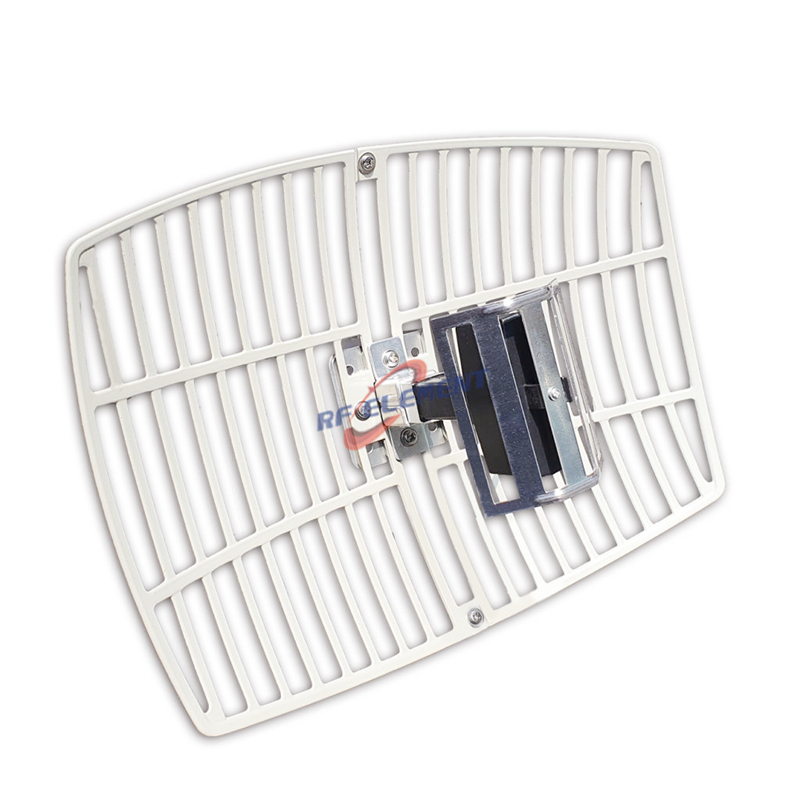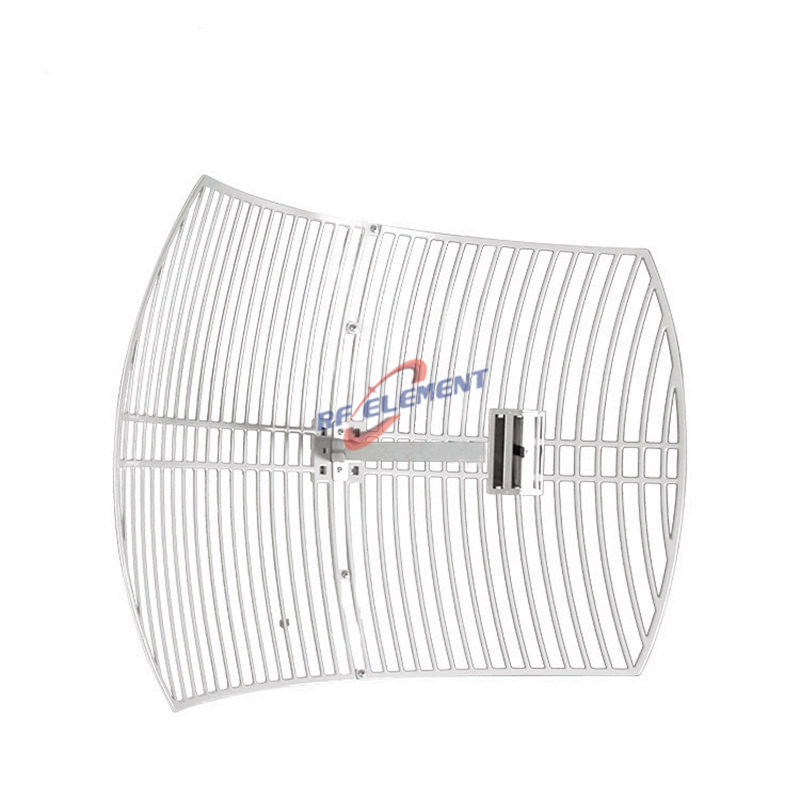

The Advantages of Dual Band WIFI Parabolic Grid Antenna
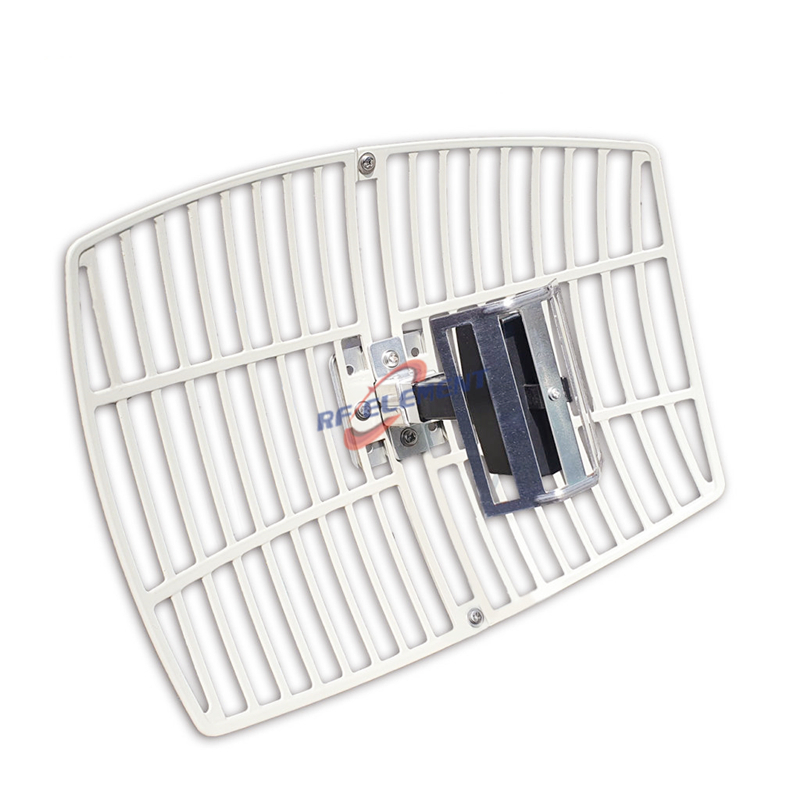
A parabolic grid antenna buys distance. That is the entire argument for using one: where an ordinary Wi-Fi antenna covers a room or a floor, a grid antenna holds a usable link over kilometres — provided both ends can see each other. A dual-band version adds one more thing. It lets a link run on 2.4 GHz or 5.8 GHz through the same reflector, so the path can fall back to the lower band when rain or foliage starts to eat into the 5.8 GHz signal.
Why a Grid Instead of a Solid Dish
The reason is wind. A solid parabolic dish of any useful diameter presents a large flat surface to the airflow and needs a mast built to survive the load. A mesh reflector lets most of the air through. The gaps are small compared with the wavelength at both operating bands, so the surface still behaves as a reflector, and it is the aperture — not the material — that sets the gain. Three consequences follow.
Lower wind load means a lighter mast, simpler guy arrangements and less fatigue on the mounting hardware over years of service.
Lower weight makes a two-person installation practical and reduces the load on an existing pole.
Comparable electrical performance to a solid reflector of the same diameter, because the mesh pitch is a small fraction of a wavelength at 2.4 GHz.
What Dual Band Means in Practice
The reflector is shared; the feed is not. A dual-band grid antenna carries a feed that works at both 2.4–2.5 GHz and 5.15–5.85 GHz, which is why the specification deserves a careful read: a product can carry the dual-band label while performing well in only one of the two bands.
The two bands trade against each other in ways that matter when a link plan is being drawn up.
2.4 GHz has lower free-space loss at a given distance and pushes through foliage more effectively. It also meets more interference from consumer equipment, and its wider Fresnel zone demands more clearance over the path.
5.8 GHz offers more clean spectrum and a smaller Fresnel zone, so it clears an obstructed path more easily and supports higher throughput. It suffers more from rain and from dense foliage.
A practical arrangement is to let 5.8 GHz carry the traffic and keep 2.4 GHz available for the days when conditions degrade, rather than treating the two bands as interchangeable.
Specifications
| Frequency range | 2.4–2.5 GHz and 5.15–5.85 GHz |
|---|---|
| Gain | 15–16 dBi |
| Horizontal beamwidth | 16° |
| Vertical beamwidth | 21° |
| Reflector core | Die-cast aluminium |
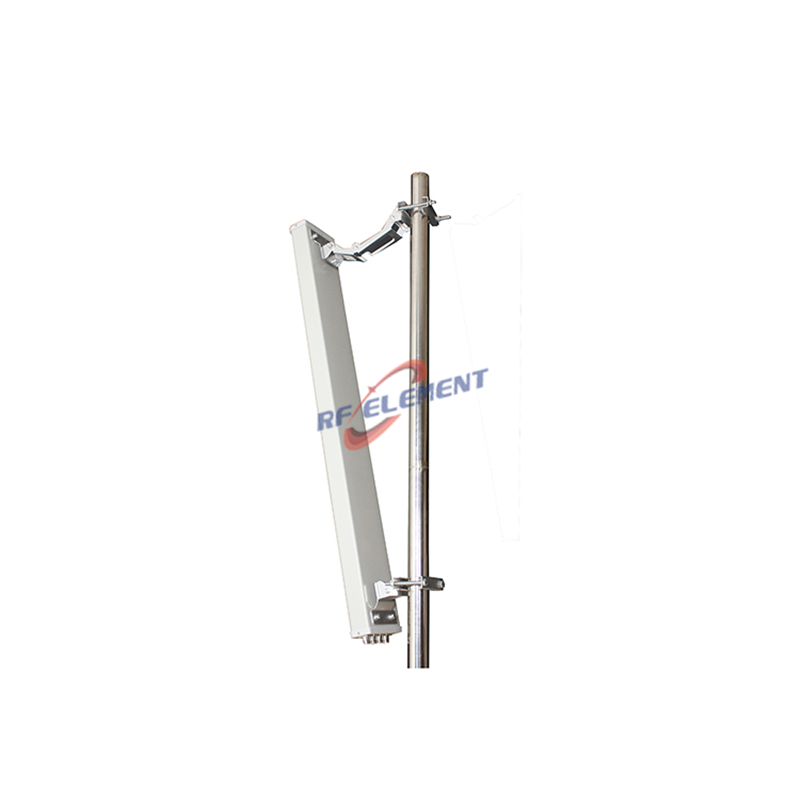
| Mounting | Pole mount |
Aiming a 16-Degree Beam
A 16° horizontal beamwidth is narrow enough that alignment stops being a formality. Point the antenna roughly, watch the received signal level, then move in small increments and log the reading at every step. A grid antenna can sit several degrees off aim and still look plausible on a signal meter while delivering only a fraction of its rated link budget. The 21° vertical beamwidth deserves the same attention to elevation, particularly on a long path where the far end sits below the skyline of the near mast.
Polarisation matters as much as direction. Both ends must use the same polarisation; a mismatch between horizontal at one end and vertical at the other costs a large part of the link margin, and it is a common cause of a link that works but runs slow.
Line of Sight, and the Fresnel Zone
A grid antenna needs line of sight, but line of sight alone is not enough — the path also needs clearance for the first Fresnel zone. Its radius at the midpoint of a link is approximately:
F1 (metres) ≈ 17.32 × √(d₁ × d₂ / (f × D))
where d₁ and d₂ are the distances from each end to that point in kilometres, D is the total path length in kilometres, and f is the frequency in GHz. On a 5 km path measured at the midpoint, the first Fresnel zone is about 12.5 m at 2.4 GHz and about 8.0 m at 5.8 GHz. That difference is one reason a 5.8 GHz link sometimes succeeds where 2.4 GHz does not: the higher frequency needs less clearance over the same terrain.
As a working rule, keep at least 60% of the first Fresnel zone clear of ground, roofs and tree canopy — and add margin for the fact that trees grow.
Where a Grid Antenna Is the Wrong Choice
Covering an area. A grid antenna concentrates energy into a narrow cone. If the job is to serve many clients spread around a site, an omni or sector antenna is the correct tool.
Short links. Over a few tens of metres, a directional grid antenna gains nothing and its narrow beam makes alignment harder than it needs to be.
No clear path. Without line of sight and Fresnel clearance, more antenna gain will not solve the problem. Move the mast or choose a lower frequency.
Mobile endpoints. A 16° beam has to be aimed. If one end moves, a grid antenna is the wrong format.
Before You Order
Two things are worth measuring before a link is specified: the path profile — what actually stands between the two points, including trees and any construction that is planned — and the local interference environment in the 2.4 GHz band, which in dense residential areas can be the limiting factor long before distance is.
Our dual band parabolic grid antenna covers 2.4–2.5 GHz and 5.15–5.85 GHz at 15–16 dBi in a fibreglass and die-cast aluminium housing, pole mounted, with a choice of connector. It sits alongside the rest of our dual band WiFi antenna range, which includes the 5 GHz WiFi wireless bridge antenna solution we build for shorter, higher-throughput backhaul paths.
If you are planning a link, send us the distance, the coordinates of both ends and the throughput you need. Give us the path and we will tell you what the antenna has to do, including custom connector and cable options if the standard configuration does not suit your mast.
TAG:The Advantages of Dual Band WIFI Parabolic Grid Antenna https://www.rfelement.com