
The Versatility of Dual Band WiFi Antennas
One antenna, two bands, zero compromises on the mount: that is the working appeal of dual band WiFi hardware. The 2.4 GHz band carries further through walls but offers narrower channels; 5150-5850 MHz delivers the throughput but fades faster. A dual band antenna receives and transmits on both from the same radome, so one install serves legacy devices and new radios at once. Our catalogue runs the full ladder from 2 dBi router whips to a 22 dBi parabolic grid, all specified for 2400-2500 MHz and 5150-5850 MHz. Here is the line, with the numbers attached.
The product ladder, bottom to top
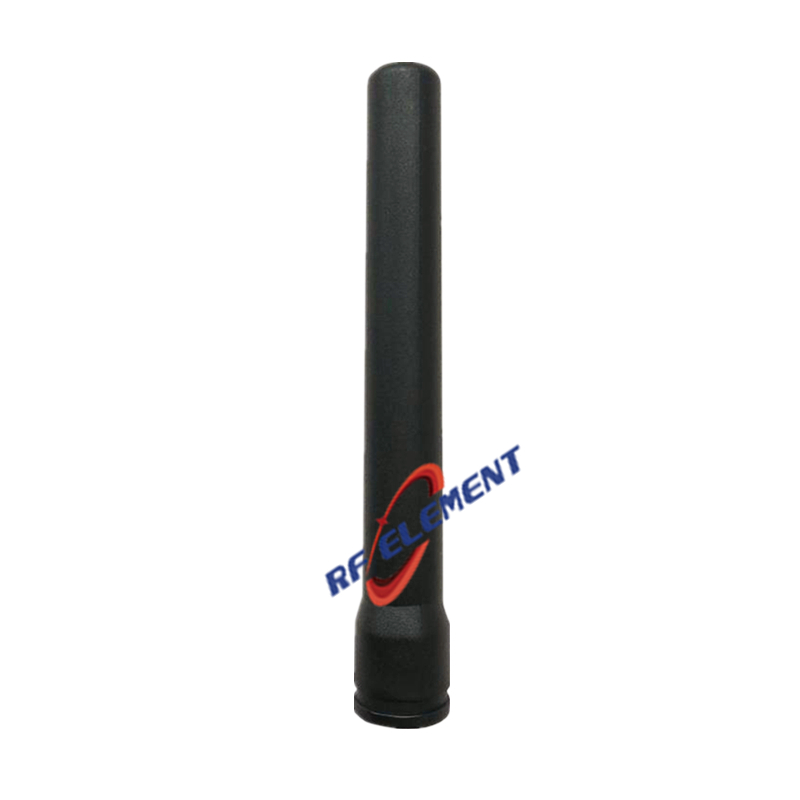
Router whips (2-2.5 dBi). The dual band router antenna is the stock replacement for access points: 2 dBi at 2400-2500 MHz, 2.5 dBi at 5150-5850 MHz, RP-SMA male, 55 g, IEEE 802.11a/b/g/n/ac ready. It restores the factory pattern after a cable extension; it does not extend range beyond the original design.
Omnidirectional (8-12 dBi). Three heights cover the mast-top use case:
8 dBi (2.4/5.8 GHz): 7.5 dBi and 8 dBi across the two bands, six SMA-female ports for 3×3 MIMO on both bands, 132 mm × 280 mm, 1.0 kg.
9 dBi (2.4/5 GHz): 8 dBi and 9 dBi, four N-type ports and a VSWR cap of 2.0, in a 75 mm × 1250 mm radome at 3.2 kg.
12 dBi (2.4/5 GHz): 9 dBi at 2.4 GHz, 12 dBi at 5150-5850 MHz, one N-type port with VSWR 1.8 or less, a 52 mm × 1250 mm radome at 2.0 kg.
Note the trade written into those figures: as gain climbs, the vertical beam flattens (28° down to 7°), and a flatter doughnut covers ground planes better than hillsides.
Sector (16 dBi). The dual band sector antenna focuses 14 dBi at 2400-2500 MHz and 16 dBi at 5720-5850 MHz into 90°/65° horizontal sectors with four N-type ports, 100 W handling, and a 980 × 128 × 58 mm frame at 3.5 kg. Hotspot fences, camp perimeters, and WISP distribution along one corridor are the fit.
Panels (14-19 dBi). The 14 dBi panel is a point-to-multipoint unit: 12 dBi and 14 dBi across the two bands, beamwidths between 40° and 60°, four N-type ports, 239 × 190 × 35 mm at 1.2 kg. Step up to the 19 dBi panel for 16±1 and 18±1 dBi with beamwidths down to 16° — the bridge between a building and a distant access point that is too close for a grid and too far for a panel of 14 dBi.
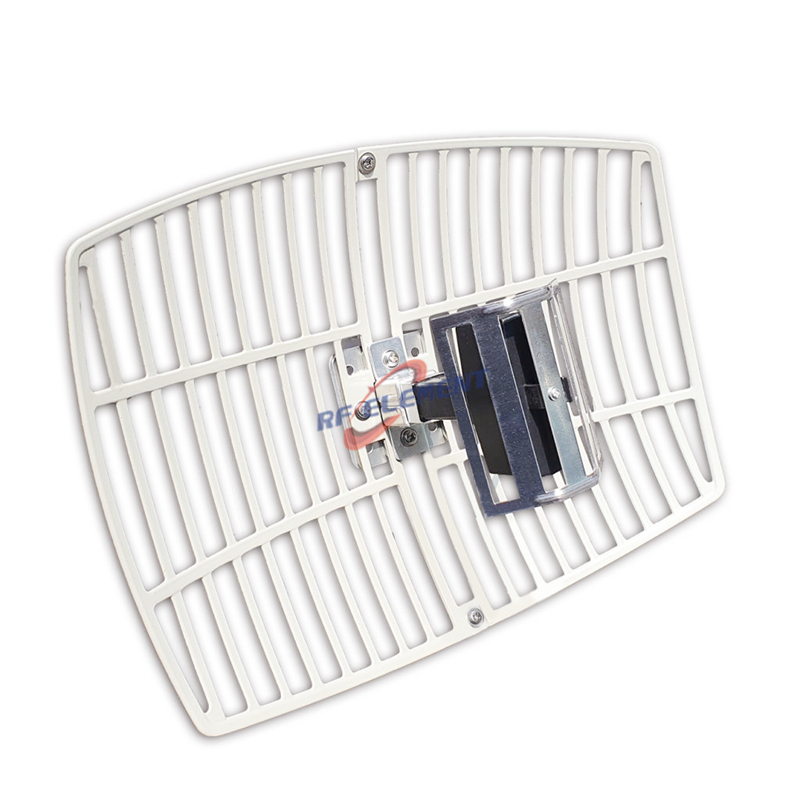
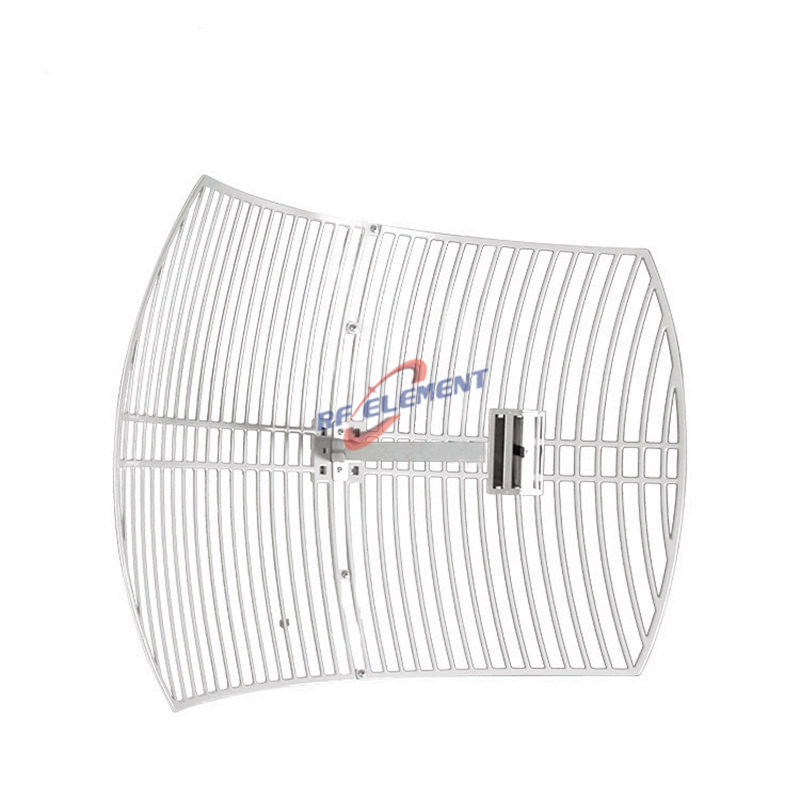
Parabolic grids (15-22 dBi). Two open-frame reflectors close the ladder:
15 dBi: 15 dBi and 16 dBi, a 300 × 400 mm grid at 1.2 kg, VSWR at or below 1.5.
22 dBi: 21 dBi at 2.4 GHz, 22 dBi at 5 GHz, beamwidths of 12° and 15°, a 600 × 900 mm open grid at 3.2 kg. The open frame is deliberate: wind load stays near half of a solid dish of the same gain.
Where each family is the wrong choice
A 12 dBi omni on a rooftop serving one distant farm: 355 of those 360° point nowhere useful. A grid puts the same watts into the one direction that matters.
A 22 dBi grid above a hotel lobby: the 12° beam covers two tables. Indoors, gain is the wrong lever — take the omni and more access points.
Router whips on outdoor masts: they are engineered for desktops and enclosures, not weather and cable runs.
The 3×3 MIMO omni on a 2×2 radio: two of the six ports sit sealed, and the 1.0 kg radome carries isolation the radio cannot use.
Reading the gain columns correctly
Every datasheet in the family lists two gain figures, one per band, and the 2.4 GHz number is always lower by 0.5-4 dBi. That is not a spec inconsistency — aperture gain scales with frequency, so the same reflector or collinear stack does more at 5 GHz. Plan the link budget on the lower figure and treat the 5 GHz performance as the bonus that carries your throughput.
Mounting notes worth checking before you order
Mast diameter, cable length, and the radome's wind profile belong in the order email, not in afterthoughts. The omnis at 1.0-3.2 kg sit on standard pole clamps; the 22 dBi grid spreads its 600 × 900 mm frame into the wind, so schedule a mount torque check after the first storm season. The two panels ship at 1.2 and 2.0 kg in flat enclosures that fit building walls where a cylinder will not. For a leased rooftop, forward the mechanical drawing to the landlord's engineer before the purchase order, not after — the drawing goes out with every quotation pack we prepare.
Ordering, samples, and what we send you
Every family in the list comes off our own production line in ZhaoQing. If the standard version needs a different connector, a longer cable, another bracket or radome colour — or a re-tuned gain profile per band — that is OEM/ODM work our engineers handle weekly. For trials we ship sample units within 3 to 5 working days; volume production is scheduled at 15-25 working days, and MOQ is sized for a first-site pilot rather than a container. Send your coverage map and link budget to sales@rfelement.com — band, distance, mount type, and port count — and we will come back with the model choice, its datasheet, a drawing, and a trial unit. If the map shows more than one corridor of traffic, ask about mixing one omni with sector cells instead of forcing a single high-gain unit to cover all of it.
TAG:The Versatility of Dual Band WiFi Antennas https://www.rfelement.com